Debt, Deficit, Default and Bugatti Veyrons

The other day @WH1SKS tried to bully me into writing a blog post. Normally I don’t give
in to cyber-terrorism but he has big muscles and he could snap me like a twig so I’ve broken the rules a bit.

I have forgotten exactly what the brief said but I think it was something like, “what would happen if the US and Europe didn’t repay their debt?” I couldn’t write it at the time as I had a hangover (because I am cool.)

I don’t have a hangover at the moment (I am still cool though) so I’ve briefly written down my thoughts. I should state that I don’t really know much about this and wouldn’t even have attempted it if @WH1SKS hadn’t made me, so it might be nonsense – these are really just my uneducated thoughts. I do think the US and Europe are very different though so I will look at each in turn….

The United States

The USA has about $14.6 trillion of debt. A number like that is impossible for the brain to comprehend so I’ll tell you what it looks like. The world’s most expensive road car is the Bugatti Veyron Super Sport (BVSS), which costs $2.4m and is 1.19m tall (that’s about $2,000 per millimetre). If you bought $14.6 trillion of BVSSs and stacked them on top of each other they would form a tower 818 times the height of Mount Everest.

(If you then drove them all forwards at the same time the one on top would probably achieve 30 or 40 million miles per hour which would be pretty cool. Still, it would almost certainly end in a nasty accident, so please don’t try this.)

I’ve forgotten my point. Oh, yes. The amount of money they owe is very big. So what would happen if they decided not to pay it back?

Firstly, the US would find it pretty tricky to borrow any money ever again because no one would trust them. You might wonder why this is a problem – they just became better off by $14.6 trillion so who cares? It’s a problem because even with the debt cleared off they would still have the deficit. The deficit is the amount by which their spending exceeds their income and last year the US added 95 Mount Everests worth of BVSSs onto their pile of debt. This means that if no one would lend them any money any more they couldn’t finance their deficit and would therefore need to take immediate action to make the books balance. You are all aware of Labour’s “too much too soon” argument against Conservative spending cuts. Labour’s position is that we are trying to reduce our deficit too quickly and by doing so harming economic growth thus costing us more overall.

When considering the size of the cuts being implemented by the Conservatives this point is debatable. But the Conservatives are not proposing to eradicate the deficit overnight or anything even close.

In our fictional scenario, the US would need to reduce it by 100% with immediate effect. They could do this by massively reducing spending or massively increasing taxes. Either way this would send their economy into a devastating recession, 100 times worse than the last one and they wouldn’t come out of it for a long time. Because the US is so important in the global economy we’d all be back in recession too and again it would be much worse than the last one.

So although paying back 818 Mount Everests of BVSSs it not pleasant it is actually much better than the alternative, so we could therefore say that if a country can pay off their debt then they will do. And in reality the US can afford its debt at the moment without any major risks. It’s a lot of debt but it is a very large economy and the markets are happy to lend it a lot more before they start to worry about its solvency. What the markets were concerned about (and what led to the S&P downgrade) was more a plausible situation in which the US made some interest payments late because its politicians were too incompetent to govern the country properly. The effects of this would have been far less severe than the situation described above where the US outright could not repay any of its debt.

That said it would still cause a major problem. Lenders would be much more nervous about lending going forward, so would require a higher interest rate to compensate for this. More expensive borrowing would slow down the US’s recovery further that alone might not actually be much a disaster were it not for the fact that markets always over-react to everything. The markets would see late payment as bad news and when bad news happens, people in the financial sector all turn into Beaker from the muppets and panic and make everything a thousand times worse.
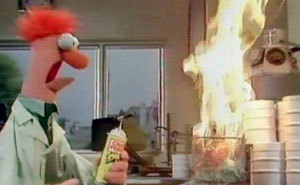
A banker dealing with bad news

So yes, it would be bad for the US to miss a payment but maybe the biggest problems would be caused indirectly by the market’s reaction, rather than from the direct problems of the person who didn’t receive the cash.

That’s America. Let’s move on….

Europe

Everyone has been talking about Greece. Greece’s situation is, I think, a lot worse than what’s going on in the US. Greece’s debt is only (!?) 19 Mount Everests of BVSSs but its economy is tiny in comparison with that of the US and there is a very real possibility of Greece not being able to make its debt repayments. The market realises this and unlike the US no one really wants to lend Greece any more money. This is why they are continually asking for bailouts to keep things going.

If Greece defaults on its debt then it will have serious implications for the rest of Europe. The Greek banks would all fail overnight but it’s worse than that. Most of the major European financial institutions have also lent a lot of money to Greece and some of them will most likely be in trouble. As we saw in 2008 when Lehman’s went bust, a major default causes the banks to completely lose trust in each other. As soon as they lose trust in each other, interbank lending stops and then they get into even more trouble:

  • Bank#1 needs to borrow some money from Bank#2 to pay back a loan to Bank#3.
  • Bank#2 has the cash available but doesn’t know if Bank#1 is ok or not so won’t lend it any money.
  • Bank#1 therefore can’t pay #Bank3
  • Bank#1 goes bust
  • Bank#3 didn’t receive their cash! Are they in trouble now too?
  • No one lends to Bank#3
  • etc etc etc

The other very shaky economies, Portugal, Spain, Ireland and Italy would be hit quickly afterwards because no one is going to risk pumping further money in there.

The European Central Bank would effectively be left holding the bomb when the ticking stopped and would only be able to stop those countries collapsing by printing lots of money (thus screwing the Euro) or by taking significant funding from the more healthy economies (Germany and France) which would screw them up quite a lot too.

The UK would probably be happy that it didn’t join the Euro but its banks would be severely hit and additionally, the EU is the UK’s biggest trading partner, so the UK economy would take a big hit too. I have no idea by how much but it wouldn’t be good.

Markets would react by everyone turning into Beaker from the muppets again.

So, in summary, I think the US is actually ok financially and its problems are caused more by its crazy politicians than by its debt. I am much more worried by Greece, Portugal, Ireland, Spain and Italy, a situation where there I think there is a significant risk of a second global financial crisis.

And if that happens we are not all going to be driving Bugatti Veyron Super Sports any time soon.

RedEaredRabbit
Flying Economy

In the cockpit, Captain Obama moved nervously in his seat. US Economy flight 2011 was about half way through its journey. After several hours of initial turbulence the ride had been smooth but Obama sensed that the excitement of the night was not yet over.

In the seat to his right sat Co-Pilot Mitch McConnell who was now starting on his fourth in-flight steak dinner. He had mashed potato on his nose and gravy on his collar. Captain Obama, observed him and sighed deeply. Since becoming Captain in 2008, Obama had been forced to work closely with Co-Pilot McConnell and he couldn’t help feeling that McConnell had been less focused on ensuring smooth flights for US Economy and more focused on being an asshole.

The jolt was sudden. McConnell’s steak dinner hit the cockpit roof and suddenly the plane was diving.

Captain Obama grabbed the controls and tried to pull the nose up.

“Mitch! Mitch! Help me pull up!”

Co-Pilot McConnel was trying to reach the remainder of his mashed potato which was now stuck to the flight controls above his head.

“Sorry, what?”

“We can pull out of this dive but I need your help. We just both need to pull on the controls together.”

McConnell thought for a moment. “Ok. I could help you stop this plane crashing, but what are you going to do for me?”

“What?”

“I mean, I could stop this plane crashing but I want something out of it too.”

Obama pulled hard on the controls. “What are you talking about? If the plane crashes it isn’t just bad for me, it’s bad for you and all of the people who put their faith in the two of us for being able to fly the plane.”

“Yeah, but it will be worse for you if it crashes.”

“What!!?” screamed Obama, “It will be disastrous for all of us.”

“Yeah, but history will show you were Captain when the plane crashed. It’s much worse for you – you will be remembered for this.”

“Well, what do you want?”

While McConnell considered, the plane lost another 20,000ft. “I want you to cut the price of our first-class tickets.” he said.

“Mitch, we’ve been over this. US Economy Airlines is losing money hand over fist. We need to raise our income, not reduce it.”

“No, we just need to spend less on plane maintenance.”

The plane continued to plummet towards the US Federal Reserve.

“Look,” said Obama, barely able to contain his frustration, “Could we not just stop the plane crashing now and talk about this afterwards. The two things aren’t even related.”

Co-Pilot McConnell engaged the intercom and addressed the panicking passengers:

“I want to help pull this plane up but Captain Obama won’t co-operate and cut the price of first-class tickets.”

Captain Obama engaged the intercom:

“I want to help pull this plane up but Co-Pilot McConnell wants me to make concessions which have no bearing on the current problem.”

McConnell re-engaged:

“I want to pull this plane up but Captain Obama is a poopey pants.”

Obama re-engaged:

“I want to pull this plane up but Co-Pilot McConnell is a poopey face.”

“I’m not a poopey face – you’re a poopey brain!”

“I’m not a poopey brain, you are!”

“You are!”

“No, you are!”

And as their plane dived closer and closer to the ground the passengers stopped screaming and wondered why they had asked these two to fly their plane in the first place.

RedEaredRabbit

Welcome to the USA

I went to the United States on Tuesday. I like the United States, or at least, I like most of the bits of it I’ve seen. I like New York and I think San Francisco is one of the most brilliant cities I’ve ever visited. Of course, like anywhere, it’s not all perfect (Camden, New Jersey was a particularly unfond memory) but although my experience of the country represents a tiny proportion of its entirety, I can say that my experience of what I have seen is overall very positive.

On Tuesday I went to Boston, which is also lovely. While Manhattan is like having America distilled into an ultra-concentrated espresso and then injected into your eyeballs, Boston is more like sipping a leisurely cappuccino on the seafront. It’s bustling but laid back and for a major city it is almost calming.

(Actually I don’t like cappuccinos (cappuccini?) so this is a stupid comparison but anyway I like Boston.)

Wherever I may visit in the USA, there is one thing of which I can be sure, will always be constant. It’s not the big portions of food. It’s not even the inefficient motor vehicles. It’s the welcome. But I’ll come back to that.

Tuesday was a hugely hectic day for me. I had spent most of the previous evening making this website (so visit it and buy some tickets please) and then had an early start to get across town to the City to attend a conference at which I had to present. My presentation was last on so I needed to pay attention to all of the other presentations throughout the day so that I didn’t contradict them without explaining why. I therefore had to make frantic notes all morning, and continually adapt my presentation to fit.

The other thing that was stressing me a bit was that the whole thing was starting to run a bit late. The event was due to finish two and a half hours before my flight was due to leave at Heathrow and while I couldn’t avoid presenting I definitely couldn’t miss my flight.

It all worked out ok in the end – it only overran by 15 mins and I got to my gate at Heathrow before they’d even started boarding. Still, it had been a manic dash across town and I was fucking knackered with a 7.5 hours on a plane to look forward to, during which I would have to write a second presentation that I would need to give in Boston the next day.

Then, when we were about to leave, they announced that someone hadn’t turned up for the flight and they had to take their luggage off the plane. We then remained at the gate for another hour and a half. By the time I reached Boston I had written my second presentation but if I’m honest was not in the best of moods. Bring on US Customs and Border Protection (CBP).

For those who haven’t visited the United States, the CBP are the people you have to talk to in order to get through the airport and into the United States. There are posters up everywhere in the arrivals hall showing their ‘pledge’. The first two points from their pledge are these:

  • We pledge to cordially greet and welcome you to the United States
  • We pledge to treat you with courtesy, dignity, and respect

A poster of Harold Shipman pledging to help the aged would reconcile more easily with reality.

Before you get to meet these people though, you have the queue. It is often big and on this occasion it was massive. When you get to the front of the main queue you are directed to stand in an individual line so you can queue to see a specific border protection guard. At the front of that queue is a yellow line that is policed by other angry border protection guards. If you step over or even on the yellow line before your turn then god help you – they aren’t exactly polite about it.

Anyway, after queuing for an hour I was finally face to face with a border protection guard. Let me make something clear at this point. I am well acquainted with the process of getting into the United States. I had double-checked my online ESTA, double-checked my customs declaration and knew 100% I had done everything required of me before I stepped across the yellow line.

I handed over my passport and customs declaration form to the border protection guard (BPG).

BPG: How long are you planning on staying in the US?

Me: I’m flying back tomorrow.

He recoiled.

BPG: That’s it?!?

He said it like I’d just claimed to have a gargantuan willy and then popped a tiny one onto his counter.

Me: Yes.

He composed himself once more.

BPG: What’s the purpose of your visit?

Me: Business

BPG: What kind of business are you in?

I politely said what I do. (What I do is fairly obscure. Most of my best friends don’t really know what I do. I prefer not to bother them with the details in any case.)

BPG: What kind?

Me: What kind?

BPG: Yes. What kind?

Was he really so knowledgeable about my field of work that he knew details of specific areas? No, he wasn’t. And so we indulged in a bizarre conversation for all of 5 minutes in which he interrogated me with questions about my line of work that made no sense whatsoever.

I did my best to answer them and knowing how this all works, I did my best to be polite and helpful throughout. The conversation though, was nonsense. While it was in full-swing I wondered what would have happened had I been a brain surgeon.

BPG: What’s your line of work?

Me: I’m a brain surgeon.

BPG: What kind of brain surgery do you do?

Me: Well, I err, sort out embolisms and aneurisms and such like.

BPG: Explain to me what an aneurism is.

Me: It is when one of those insect things off Wrath of Kahn has burrowed into someone’s brain and done mind control and shit and you have to kill it with Domestos.

BPG: Ok, Sir. Welcome to the United States.

When Stephen Hawking drives through does this guy decide to test his knowledge of Cosmology? I’ll bet he actually does but it is all a façade – a ridiculous pretence of creating a safe border by trying to quiz people who could, if they were lying, skip past the questions easily if they’d bothered with 60 seconds of preparation on Wikipedia.

So back to our conversation. He had conceded that I knew more than nothing about a subject about which he knew nothing.

BPG: You lose your passport?

Me: Excuse me?

BPG: You lose your passport?

What they fuck was he talking about now? I lose my passport? My passport was in his hand. Then it clicked that he was talking about my last passport – I’d lost it in March and had had to get it replaced.

Me: Oh yes, sorry. I lost my old one in March.

BPG: Where’d you lose it?

Me: Sorry, I don’t know.

BPG: Was it stolen?

I didn’t know that either. He sighed like a punctured football in a vacuum.

BPG: You see, for all I know there are two passports out there for you and I can’t tell whether this one is the valid one.

Me: Right, but I have the one that isn’t cancelled and it does have a photo of my face on it.

BPG: I’m gonna need to see your driver’s licence.

Me: I don’t have it with me.

BPG: Sir? Why don’t you have your driver’s licence with you?

Me: I am not planning on driving while in the United States.

I am calm on the outside. I know how this all works.. The reality of the situation is this:

  • He is going to let me into the US and knew he was from the moment I presented the correct documentation.
  • I know he is going to let me into the US and have been through this ridiculous charade before.
  • He once wanted to be a real policeman but was unsuccessful for one reason or another.
  • He will always be bitter about this fact.

BPG: I’m going to need to see some more ID.

I thought for a moment. I was pretty sure I didn’t have any other ID on me that was more appropriate for such a situation than the passport I had already given him.

Me: I really don’t have anything more.

BPG: Do you have a business card?

I handed him a business card and he held it in both hands, at arms length and directly towards my face. He looked back and forth between the business card and my face for a few moments. My business card doesn’t include a picture. What the hell was he doing? Then he stamped my form and my passport and told me to have a nice day.

What did he see in my business card that finally convinced him? Nothing. He knew from the moment he saw my passport that he was going to have to let me in but because he was a power-hungry twat with a massive “I want to be a real cop” complex, he had backed himself into a corner by requesting further validation for my entry into the US. My business card was just his way of getting out of his corner without having to say, “Ok, come in anyway.”

My business card could actually be recreated by anyone for almost no money at all. If this was really the key to getting into the US then they have their priorities on passports all wrong.

As I mentioned at the start of this post , the USA is, once you’re in, a lovely country to visit. There are many beautiful places with many amazing sights and in my experience the people are friendlier and more sociable than anywhere else I have ever been. The CBP, though is every visitor’s first experience of the US, so why be so unnecessarily rude to people who just want to come into your country?

While I’m sure many border protection guards do a good job there are just as many who don’t and, for want of a better phrase, are utterly useless, power-hungry knob-ends.

RedEaredRabbit

How the Yes was Lost

Why do X-Factor winners sell so many records? Why does JK Rowling sell so many Harry Potter books? Why do people drink Actimel or Stella Artois? Why do people wash their hair in Pro-Vitamin-A-Anticomplex-Regenerise-Maxi-Revitaliftium-4?

Ladies and Gentlemen – I give you Marketing.

Concentrate, here comes the science bit. There are two types of marketing:

Good Marketing

Good marketing is when a marketing message supremely shows off particular aspects of a product such that lots of people want to buy it. Importantly, good marketing must not omit any weaknesses in the product that the consumer would not reasonably expect.

It would not, for example, be good marketing to tell people that a new drug solved high blood pressure while at the same time omitting to tell them it would make them incontinent. It would not however, be a violation of good marketing if they didn’t mention that the drug tasted nasty. A consumer would not reasonably assume their potentially life-saving medicine would taste yummy but they might not expect to be continually pooing their pants.

Bad Marketing

Bad marketing is far worse than simply failing to mention that a drug might make you incontinent. Bad marketing is when the message gets so far ahead of the actual benefits of the product that is being marketed that is misleads people into thinking it has benefits that it does not.

Got it? Good because it’s quiz time.

Do people buy Harry Potter books because of good marketing or bad marketing?

I’ve never read a Harry Potter book. I’m sure they’re fine. I doubt though that they are hugely superior to every other book written in the last 1000 years, as their revenue would suggest. This phenomenon however, is because of good marketing.  Nothing was misleading; they simply did a much better job of getting the message out about their books than anyone else did about their equally good or better books.

Do people buy X-Factor records because of good marketing or bad marketing?

Hopefully most of you answered bad marketing. The music is always terrible but people buy it because millions of pounds are spent on making people believe it is good when it isn’t. If my mum sang Agadoo on primetime TV every Saturday night to applause from Simon Cowell she would sell records. It wouldn’t make it good.

I don’t want to sound like I’m superior and immune to marketing. I’m not. After all, I have an iPhone. When I bought it I never even looked at any other phones for comparison. There are much more affordable phones which are very similar. An iPhone costs something like £35 a month for 18 months plus £100 up front. £730! A logical thing to do would have been to compare it with a similar smartphone that cost £25 a month and nothing up front (a saving of £280). I didn’t though. Why? Marketing.

At some stage I have been subliminally convinced that iPhones are a billion times better than all other phones so I didn’t bother looking at the alternatives. The reality is that they are a little bit better but are they really £280 better than the second best phone?

In moments of clarity, I can grudgingly admit this to myself but if I had to get another phone tomorrow I would again go straight to the phone shop and buy an iPhone without looking at the alternatives. This is the power of marketing. It can make people who are otherwise rational completely irrational and if marketing were motor racing, Apple vs other phones would be Ayrton Senna racing against my mum.

(Yes, that’s the second time I’ve mentioned my mum. She gives me £1 every time she gets a mention in my blog.)

iPhones represent  good marketing though. Apple don’t make anything up but they tell the truth in such a clever way that people really, really want to have their products.

Actimel? Hmm. I don’t want to get sued. In my personal opinion, Actimel is an example of bad marketing. This is because I believe it (and Danone etc.) makes carefully worded claims from which people infer health benefits that I don’t believe are really what they will receive. This article goes into it in a bit more detail.

Stella Artois – good marketing. It doesn’t taste better than other lagers, in fact it’s not really particularly nice but it outsells everything. It doesn’t even claim to taste better; it claims to be more expensive, which it is. It’s “Reassuringly expensive.”

Now that’s clever. It might not taste great but be reassured that you paid more for it than the nicer tasting alternative. Rationality completely out of the window. I sincerely hope that the Head of Brewing at Stella Artois is stinking poor and the Head of Marketing is stinking rich. It is pretty clear who does the better job.

Onwards and downwards. Bullshit shampoos? Scientists in lab coats talking about imaginary scientific breakthroughs while computer simulations of imaginary molecules start miraculously rebuilding damaged hair, almost as if the imaginary recipient had stood on their head in an imaginary bath of imaginary stem cells for a month. Bad marketing.

So, we have seen examples of good marketing and we have seen examples of bad marketing. The above examples of bad marketing though, are the work of mere amateurs. When you become really good, no – when you become exceptionally good at bad marketing, you are given a job as a politician.

When I first wrote about AV in February my final conclusion was:

There will be a massive campaign of misinformation that will significantly influence the choice of voters.

There was too – on both sides. The politicians campaigning for Yes to AV made very little attempt to accurately reflect its benefits in comparison with FPTP. They resorted to bad marketing.

Unfortunately for them they were far worse at bad marketing than the No to AV campaign. The bad marketing on that side was truly something to admire. Honestly, if they put that much effort into sorting out the economy and the environment we’d all be laughing.

We were told that AV was so complicated that none of us would understand it. Amazingly lots of people took this at face value. There’s a bloke I work with who thought this and he’s really very intelligent. Are we all so challenged that we cannot put a few choices in order of preference? I would hope not.

In fact, I would go as far as to say that a person who can’t understand AV probably can’t understand the relative merits of the policies of the candidates between which they are choosing.

For example, I am told by David Cameron that I am too stupid to understand AV but, at the same time, it should be blindingly obvious to me that spending cuts, VAT rises and restructuring of the NHS are no-brainers. They aren’t though – they are really much more complicated. If I am too stupid to understand how to rank candidates in order of preference how could I possibly be clever enough to understand the overall impact on the economy of raising VAT to 20% vs keeping it at 17.5%?

We were told plenty of other things that were all a result of a brilliant use of bad marketing. I was impressed when looking at each one individually but if I take a step back and look at the whole thing together it truly is a work of art. It is abundantly clear that a huge number of people spent a huge amount of time working on one of the most intricate examples of bad marketing that our nation has ever seen.

Many people voted No to AV because bad marketing told them that AV would mean Nick Clegg in government. How brilliant is that?

You should all vote in favour of the current voting system (which put Nick Clegg in government) because otherwise it might mean Nick Clegg in government!

But people bought it. It didn’t make any sense but it didn’t matter – rationality is absolutely no competition against bad marketing.

Let me take a moment to make something clear. If you felt you had a good understanding of the good points and bad points of both electoral systems and voted No to AV then I have absolutely no problem with your decision. My gripe is not with you. My real gripe is that the majority of the public was not given enough information on the good points and the bad points of each system to make an informed decision.

The politicians agreed to allow the country to choose their voting system and then spent all of their time and effort concocting nonsense to confuse and mislead everyone.

It was truly shameful but it was nothing more than we have come to expect – just have a look at my previous blog on NHS reforms. Like it or not, we live in a society where a politician’s job title is firstly, Director of Bad Marketing and a distant second is Secretary of State for Something or Other.

I wrote this blog post simply to highlight this problem and I don’t have a solution. The politicians have no incentive to give us the real facts so solving the problem would mean everyone ignoring what politicians told us about their policies and forming our opinions independently. “I already do this!” you shout and perhaps you do but your vote is much trickier for them to spend time winning than that of a person who doesn’t.

And as long as a significant proportion of the electorate has their vote decided by bad marketing over rationality, a politician has no reason to change their behaviour. Unless, of course, we decided to change to a fairer electoral system.

Oh. Damn.

RedEaredRabbit

Indigestion and Electoral Reform

I have belly ache. Perhaps it was all that pizza. Perhaps I have just been fed a little too much misinformation by politicians in recent weeks.

In February I wrote Pizza and Electoral Reform – a blog post about the upcoming referendum to decide our voting system. In it I looked at an example of when First Past The Post (FPTP) and the Alternative Vote (AV) gave different outcomes to the same set of voters’ preferences. I concluded that AV was fairer than FPTP because it took a lot of useful information into account that FPTP ignored.

Some people who read it thought I hadn’t explained that point in enough detail. Reading it again, I think they were right. I was in a bit of a hurry when I wrote it. Sorry about that. I’m in a bit of a hurry writing this to be honest but I’ll try to be clear.

Let me give an example of why taking more information into account might be fairer than ignoring it.

You are getting married and deciding what meal to give your guests. The caterers give you the following options*:

  • Rump Steak
  • Fillet Steak
  • Chicken
  • Halibut

(*There is half a pepper stuffed with rice for the vegetarians but there is no voting option for them.)

Being the kind soul that you are you let people vote on their RSVPs for which meal they would most like to be served.

There is a bit of a quandary for the steak lovers here. By offering two different steak options, the caterers have unwittingly made both of them difficult to elect under a FPTP system.

Why? Well, supposing you have 50 guests coming to the wedding. 27 of them want steak, 18 of them want fish and 5 of them want chicken. If there were one steak option on the menu then both FPTP and AV would leave it the clear winner. There isn’t though – there are two. The FPTP votes come in like this:

  • Rump Steak – 12
  • Fillet Steak – 15
  • Chicken – 5
  • Halibut – 18

Under FPTP, halibut wins even though the majority wanted steak. Using AV, second choice votes would have ensured that steak won the day. It would have been a fairer outcome in my opinion and it would have happened simply because more information was taken into account.

I think FPTP has a massive weakness when the available options are not equally spread out. By that I mean – if there are two popular options that are similar, FPTP will penalise those choices by splitting the vote out between them.

Let’s look at another FPTP example that is relevant to politics. Supposing at the next election there are three major political parties. A large proportion of the electorate are pissed off with the main party because of say, high tuition fees.

Situation 1

The second biggest party puts down a policy to significantly reduce the fees and lots of people vote for that party and that party wins.

Situation 2

The second and third biggest parties both put down a policy to significantly reduce the fees and lots of people split their vote between those two parties and the existing government wins.

Which outcome better reflects the will of the people? We have been told by the No2AV campaign that FPTP is better at getting rid of unpopular governments. It isn’t though. When a government has unpopular policies, all of the alternative parties take the more popular view and split the vote, leaving us with exactly the result that we did not want.

When I wrote the Pizza and Electoral Reform post, I predicted a massive campaign of misinformation. That has certainly happened. Despite the well organised bullshit campaign though, I don’t think there is anything that I have found that suggests, when compared with FPTP, AV is less fair or too complicated for people to understand.

AV is not perfect but I think it’s better than what we have. Whichever way you vote for though – I urge you to ignore the “advice” of the politicians. It truly is a sorry state of affairs when not one politician has been bothered to try to explain the true benefits of the two options without resorting to misleading claims and scaremongering.

Perhaps the best piece of advice in all of this is to just ignore everything you’ve been told by a politician and just vote for the system you consider the fairer using your own judgment. That’s what I’m going to do.

I’m going to vote Yes to AV.

RedEaredRabbit

Pizza and Electoral Reform

Politicians have recently been spouting a lot about the inefficiencies of the public sector. Well if it’s true, no better example could surely be found than the politicians themselves. After literally months of hundreds of them pissing around at our expense they finally decided yesterday that there would be a referendum on electoral reform. In the referendum we will be given two choices and asked to vote for the one which we think is the fairer system of electing future governments. The choices will be:

  • First Past The Post (FPTP) – our current system
  • Alternative Vote (AV)

I will be honest – I don’t know which system is fairer and that is a bit of a problem. I don’t consider myself badly informed with what is going on in the world. I am reasonably good at maths yet still I don’t know off the top of my head which system is fairer.

This is a problem not because of my personal dilemma but because I strongly suspect that I am not alone in not knowing which system is fairer. I am fairly sure there are a large number of people in the country who, like me are going to be asked to decide something they don’t have the information to properly decide.

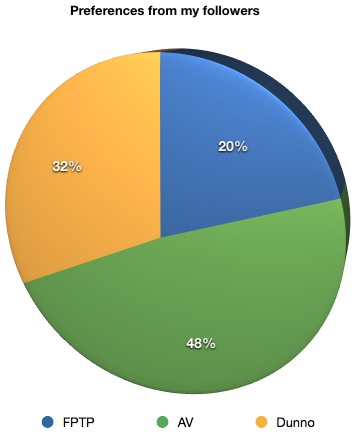
Yesterday, I asked my Twitter followers which system they preferred. It looked like this:

Wow – almost 1 in 3 of us don’t know. If you are one of those people then look no further. I am going to work it out here on this blog and then we’ll all know. Hoorah! So let’s do it with an example.

15 friends are ordering a pizza to share from The Very Big Pizza Company. There are three options:

  • Meat Feast
  • Pepperoni
  • Margherita

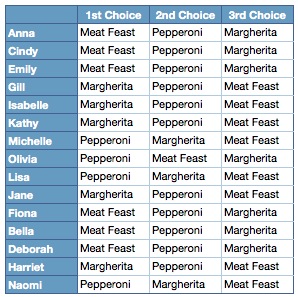
Between them they need to decide on which pizza to get and so they take a vote. Their preferences look like this:

The voters

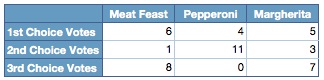
Summarised, their preferences look like this:

Voters

If they use a FPTP system then only their 1st choice preferences are taken into account so, with six votes, they will get a Meat Feast.

If they use AV however then it works like this:

Round 1

  • Meat Feast – 6 votes
  • Pepperoni – 4 votes
  • Margherita – 5 votes

In AV, Pepperoni with the fewest first choice votes at the end of round 1 gets eliminated and the Pepperoni lovers’ second choice votes are added in for round 2…..

Round 2

  • Meat Feast – 7 votes
  • Margherita – 8 votes

Margherita is the winner.

Two different systems – two different results. While we’re here though, let’s look at another system called the Borda Count. In this system 3 points are awarded for a first choice, 2 for a second and 1 for a third. Points are all added up to determine the winner. It’s a bit like what happens in the Eurovision Song Contest.

In this system we find the following:

Borda Count Results

Pepperoni, with 34 points has won.

Three different systems – three different results. So what does all this tell us? It tells us that the voting system we employ can make a big difference to the outcome of the election. With three different systems and the same set of preferences we observe 3 different outcomes.

You might think I intentionally set the group’s preferences such that this would happen. Yup, I did. But it may not be too far from reality. Imagine that it’s May 2010 and Meat Feast is the Conservatives, Pepperoni is the Lib Dems and Margherita is the Labour Party. The different outcomes here have essentially occurred because:

  • More people preferred the Conservatives as a first choice than preferred either of the other two (but importantly not an overall majority)
  • The Lib Dems are most often the second choice of both Conservative and Labour voters
  • Lib Dem voters are more likely to prefer Labour than Conservatives*

* I’m not sure whether this is actually the case but it doesn’t make it an implausible set of preferences.

So I have looked at three different voting systems and they produced three different winners but which is the fairest? Nope, I still don’t know. Let’s keep going.

First, let’s go back to the FPTP system where the group have decided to vote for Meat Feast.

They phone up The Very Big Pizza Company. Before they can place their order, they are informed that unfortunately there are no more Pepperoni pizzas left. Doesn’t matter, right? In the vote Meat Feast came first, Margherita second and Pepperoni came last. The fact that Pepperoni isn’t on the menu doesn’t cause a problem. Or does it?
Anna, on the phone relays this message to the group and they do the FPTP vote again based on Meat Feast or Margherita. Now Margherita wins on the FPTP method!

To me this seems like a big problem. In a fair electoral system, if people prefer Meat Feast to Margherita then the outcome should always reflect this, irrespective of whether or not Pepperoni is available.

FPTP says that if Pepperoni is on the menu then Meat Feast is better than Margherita and if Pepperoni is not on the menu then Margherita is better than Meat Feast!

So FPTP is cack then. Let’s look at the AV in comparison. After the AV vote they phone up The Very Big Pizza company to order their Margherita and find that Meat Feast is off the menu. Now Pepperoni wins. Bollocks.

If AV is a fair system then if it prefers Margherita to Pepperoni when Meat Feast is on offer, it should prefer Margherita to Pepperoni when Meat Feast is not on offer.

Aaargghh. All I have done so far is to find that neither is fair.

When you look at the summarised table of votes above, AV does have a clear problem. Pepperoni had loads of second place votes but these all got ignored because it was eliminated before they could be taken into account. 11 people liked Pepperoni second best but the system treated it the same as if no one had liked it second best.

When you look at FPTP though – it doesn’t just ignore all the second and third place votes for Pepperoni. It ignores, by definition, everything that wasn’t a first choice vote.

My view is that when you need to make a decision about something, you should take as much of the available information into account as possible. AV, while not perfect takes more information into account than FPTP and it is on that basis I think, a fairer system.

Let’s not though, forget about our third option – the Borda Count which we sadly will not get the option to vote for. That system takes every preference into account and I therefore think it is a fairer system than either of the two from which we can choose.

Formula 1 uses something not too far from the Borda Count to decide the world champion. Would Formula 1 be fairer if driver’s second places, third places etc were not taken into account when deciding the World Championship? Bernie Ecclestone thinks so but I don’t. I think a driver with 5 wins, 8 second places and 2 third places has more claim to be World Champion than a driver with 6 wins and 9 races that they didn’t finish.
The Borda Count system is by no means perfect but it allows us to take a lot more information into account than a simple FPTP.

This is not the whole picture though. Even if everyone agreed on the fairest system they would not all necessarily vote in the same way. For a start, some systems are more likely to benefit certain political parties. The Conservatives don’t really think FPTP is the fairest possible electoral system, they just think they will have a better chance of winning a majority than they would with the others. If the party you like the best is going to do better out of a particular system why would you want to vote for an alternative in which they would do worse?

Also, the best system may not be the fairest system. FPTP is the simplest system by far – one cross in one box and you’re done. The more complex the system becomes the harder it is for people to understand and cast their vote. A clever mathematician could come up with a brilliantly fair voting system but if a significant proportion of the electorate didn’t understand it or couldn’t work out how to fill in their ballot papers, it would be worthless.

Some people also praise FPTP for its strength in delivering a majority government with a minority of votes. That doesn’t necessarily sound like a good thing to me but if people really think it is a good thing then why should they not vote for a less fair system in order to achieve it?

Irrespective of these there is something much worse which will undoubtedly have a strong influence on the result of the referendum – the campaign of misinformation which I can see on the horizon, heading for our shores like a giant wave of bullshit. Political parties, unions and other groups will no doubt know which of the two systems benefits them the most and they will undoubtedly be feverishly preparing their campaigns to scare the public into believing that one system means 100 years of darkness to the UK.

On the Today Programme the other day, James Frayne who ran the successful campaign for the Conservative Party to vote No to a North East regional assembly said that because Nick Clegg is so unpopular, the best tactic for the No2AV campaign (yes, they’ve already made a name like a fucking X-Factor band) would be to say if you vote AV you will get Nick Clegg in government again.

It’s shameful that on one hand we will be given a chance to vote to change the electoral system and on the other hand we will be drowned in this kind of crap designed solely to mislead us. Will any political party in the next few months spend time and effort really trying to explain the underlying good points and bad points of each system in a bid to assist the voters into making an informed choice? I hope so but I don’t think so.

So – what have I concluded?

  • AV has big problems and probably isn’t a great system but it is fairer than FPTP
  • The Borda Count is fairer than either of them but isn’t available
  • A fair system is not necessarily the best if it is overly complex to understand
  • Even if people agree on what the fairest system is they will still not necessarily vote for it
  • There will be a massive campaign of misinformation which will significantly influence the choice of voters

Well, to be honest, I’m disillusioned by the whole thing now. Bollocks to this. Anyone for Pizza?

RedEaredRabbit

Facts Evasion

When I’m not tweeting or blogging, I sometimes have to do some real work. Last year, I was asked to put together a report to analyse the performance of a particular strategy my company was pursuing and then present it to my CEO and the board.

“That sounds well important,” I thought. So I did this:

  • I clearly set out what I was going to measure and why
  • I gathered as much information as possible and analysed it
  • I accounted for any uncertainties in my measurements
  • I accounted for any external factors which could have influenced the results
  • I summarised how the strategy was performing based on these factors and tied it back to the things I said originally that I would measure
  • I made recommendations as to how we should proceed based on the gathered evidence and uncertainties

While I would like to think I was the first to think of this nice structured way of doing things, in fact I wasn’t. This is just, at a high level, the way you approach changing anything important, even if you’re doing it subconsciously.

If for example you were buying a house, you would not do it this way:

  • Buy a house
  • Gather as much information about houses as possible
  • Selectively discard any evidence which suggested you’d bought the wrong house
  • Selectively include any evidence which suggested you’d bought the right house
  • Set out what your house buying criteria were based on the bits of evidence you had not discarded

Well, you wouldn’t do it this way unless of course, you were a politician. Politicians, you see, work in the opposite way to everyone else. Let me explain with an example.

At the moment, the government is proposing a reform of the NHS. This is the evidence they are putting forward for why such radical changes are necessary:

Health Secretary, Andrew Lansley, speaking on PM:

You are twice as likely to die of a heart attack in the UK as you are in France.

Prime Minister, David Cameron, on the same day:

We’ve fallen behind the rest of Europe. We spend similar amounts of money but we’re more likely to die of cancer or heart disease. I don’t think we should put up with a second rate… errrr… with coming second best.

Note he actually almost called the NHS a second rate health service but thought better of it.

Well it all sounds extremely scary. But is it?

John Appleby, Chief Economist at the Kings Fund, London thinks things aren’t quite as bleak as the government is making out and writing in the British Medical Journal he explained why.

Although statistics from the Organisation for Economic Cooperation and Development (OECD) confirm that in 2006 the age standardised death rate for acute myocardial infarction was around 19/100 000 in France and 41/100 000 in the United Kingdom, comparing just one year—and with a country with the lowest death rate for myocardial infarction in Europe—reveals only part of the story. Not only has the UK had the largest fall in death rates from myocardial infarction between 1980 and 2006 of any European country, if trends over the past 30 years continue, it will have a lower death rate than France as soon as 2012.

You see, the government selectively chose one data point on the graph and discarded the rest of the data. This is what the data looks like if you don’t discard the rest of it:

Heart Disease MortalityThis doesn’t look quite so scary, does it? You see, when you look at all the available data, you get a very different picture. The UK’s death rates from heart disease have been plummeting and if the trends shown in the graph continue, argues Appleby, then we will have a lower rate than France by 2012.

This looks to me, (and John Appleby) like things are going in the right direction with our current system. Also, as Appleby points out, Lansley and Cameron chose quite a tough comparison. France has the lowest death rate from heart disease in all of Europe. A lucky choice, or cherry-picking a number to support an argument?

Either way – good for France, right? Well, not yet. Something Lansley and Cameron didn’t take into account which is absolutely massively important is this:

Are France and the UK using the same criteria to determine their causes of death?

As it turns out, possibly not. Speaking on More or Less on Radio 4 on 21st January*, Dr. Pete Scarborough, a Senior Researcher at the British Heart Foundation Health Promotion Research Group at Oxford University (get a shorter job title) noted that in the UK, if a person with a record of high cholesterol or high blood pressure dies, the coroners are much more likely to record the cause of death as a heart attack in comparison to France where the cause of such a death unless a heart attack is clearly shown to have happened, is generally recorded as “unknown”.

An additional point which Lansley and Cameron failed to mention is death from heart disease has a lot to do with lifestyle. The best way of avoiding death from heart disease is to avoid getting heart disease in the first place. Diet, smoking rates and exercise were all omitted from their conclusion.

Appleby in his article stated:

The trajectory for many causes of death swoops up and down over decades—often linked to changes in lifestyle behaviours rather than spending on healthcare.

Which makes perfect sense. Perhaps due to lifestyle, a higher proportion of people in the UK turn up for treatment for heart disease than they do in France. If that’s the case we should hardly be blaming the NHS.

You’ll recall, David Cameron also brought cancer death rates into the equation. On that, Appleby noted this:

As Cancer Research UK has pointed out, although the Eurocare data often feed headlines that the UK is the “sick man of Europe” for many cancers, trends from Eurocare actually show improvements in survival rates for the UK. These are confirmed by the Office for National Statistics, which last year reported improvements in five year survival rates between 2001-6 and 2003-7 for nearly all cancers. But Eurocare is problematic; the latest study includes diagnoses only up to 2002, and coverage is patchy (French data cover around 10-15% of people with cancer, the UK, 100%). Furthermore, differences in survival rates may reflect variations in how early diagnoses are made, not the state of healthcare in different countries.

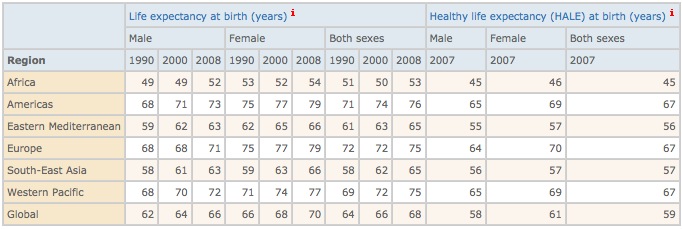
Overall, I think again, this doesn’t seem quite as clear cut as we were led to believe but there is yet another important statistic they failed to mention. If our substandard healthcare is really causing a significantly higher death rate then shouldn’t our life expectancy be significantly lower than France’s? I went to the World Health Organisation’s website to check this out and found this:

The most recent figures for average life expectancy they have are for 2008. In France it was 83 for women and 81 for men. In the UK it was 82 for women and 80 for men. Irrespective of what people are finally dying of, the average life expectancy between the two countries is extremely close.

The WHO also conveniently shows average life expectancy by global region and here we can see whether we are lagging behind the rest of Europe, as claimed by David Cameron:

Oh. As you can see, the average for Europe for 2008 was 79 for women and 71 for men.

So much for us lagging behind the rest of Europe but, anyway, if we truly are experiencing significantly higher death rates from heart disease and cancer than the rest of Europe it is a bit puzzling. If they aren’t dying of that but have lower life expectancy then what exactly is it that they are all dying of? Rabies?

My conclusion based on this data (which was by no means all of it but a lot more than Lansley or Cameron used) would be that we are doing well and heading in the right direction. So where is the big problem? Where is the big need for a radical NHS reform?

Let me move back to my initial example of the report I had to do at work. If I had made a conclusion in advance, backed it up with one or two pieces of cherry-picked data and gone in front of the board with it, my audience would have torn me to shreds.
My report was important to me but compared with the importance of the NHS to the UK it was really nothing at all. This is the NHS we’re talking about – people’s lives.

My audience wouldn’t have accepted such a poor analysis of the data for my crappy report – so don’t you dare do it either. You are the audience now and this is really important. Don’t accept these arguments as the complete story – understand them for what they are. A couple of cherry-picked, airbrushed, bullshit numbers selected to back up a plan that the government wanted to do anyway, regardless of the what the actual evidence suggested.

If I couldn’t get away with such behaviour in front of my board then why should the government get away with it in front of the British public?

Pulling basic information from the British Medical Journal and the World Health Organisation is not hard to do – I did it with no trouble at all. The government’s position is nothing more than pure deception and when we look at the real evidence – their position fucking stinks.

RedEaredRabbit

*More or Less’s excellent piece on this same subject helped a lot with putting this post together. It’s available as a free Podcast so have a look for it.

The Film is Mightier than the Book

It’s a fairly common event to be discussing a film and having someone say, “It’s not as good as the book”.
Conversely it is a pretty rare event to be discussing a book and having someone say “It’s not as good as the film.”

It seems as though taking a book and making it into a better film is a tricky undertaking but there must be some out there, mustn’t there?

Yesterday I asked you on Twitter to name films which were better than the books on which they were based. 105 of you responded with a total of 204 suggestions. So thanks for that.

A quick note before I move on to the results though – please bear in mind that the number of votes cast doesn’t necessarily indicate the gulf in quality between book and film. It’s also obviously a function of how many people have seen and read them.

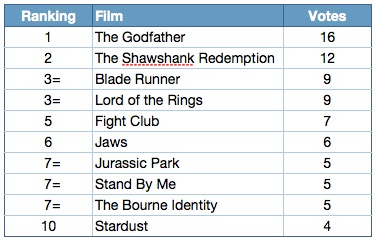
Anyway, here is the top 10:

The Top 10

Thoughts on the Top 10

These are my thoughts on the top 10. I’ve indicated on each film whether I’ve seen it and/or read the book on which it was based.

The Godfather (Saw it first, read it later)

Yes, I liked the films better too. The book was good but the films were brilliant. The book, if I recall correctly, covers the first film, plus the Don’s rise to power which is covered in the second film, (the Robert de Niro bit).

The two films benefit from some truly excellent acting performances. Marlon Brando, Robert Duvall, John Cazale, Diane Keaton and Robert de Niro are all excellent but it is Al Pacino’s transformation from goofy war hero to ruthless mafia boss which steals it. Forget that Scent of a Woman, “HOOOAAAAA” bollocks – this perfomance blows it out of the water.

The Shawshank Redemption (Read it first, saw it later)

Really? Admittedly I read the novella (Rita Hayworth and Shawshank Redemption) when I was a nipper but I remember feeling fairly non-plussed by the film of it. Apart from Morgan Freeman. He was good.

Blade Runner (Seen it. Never read it.)

The book was Do Androids Dream of Electric Sheep? I never read it. The film was excellent though

Lord of the Rings (Never seen it, never read it.)

I thought about reading it once but it looked massive and I couldn’t be arsed.

Fight Club (Seen it. Never read it.)

I don’t know what the book is like but I’m the only person I know who didn’t think the film was brilliant. It had a brilliant twist at the end but I was fairly bored up until that point. Still, the book might have been worse.

Jaws (Seen it. Never read it.)

The film was brilliant. I wish Steven Spielberg still made films like it, instead of Indiana Jones 4. God, that was awful.

I haven’t read it, but according to @danbeames the shark dies of old age or something in the book. Which sounds a bit less exciting than, “Smile, you son of a -” KAPOW!!!

Jurassic Park (Read it first, saw it later.)

The film has to take some credit for the truly groundbreaking special effects. I preferred the Richard Attenborough character in the book, who was a bit of a shit rather than a nice old grandpa with a dinosaur theme park. Michael Crichton obviously preferred the film since the Jeff Goldblum character died in the book but was still in the sequel. The two annoying brats spoiled the film though. On balance, the book wins.

Stand By Me (Saw it first, read it later)

This was a novella in the same book as Rita Hayworth and Shawshank Redemption. It was good but the film was brilliant. The Richard Dreyfuss narration is a bit cheesey but I could watch it again and again.

The Bourne Identity (Seen it. Never read it.)

ZZZZzzzzzz…….

Stardust (Never seen it. Never read it.)

Never even heard of it.

A Pie Chart

This shows everything with more than 1 vote. Everything with 1 vote is stuck together in the Other section.

Notable Others

These are the other nominations I have both read and seen…

Romeo and Juliet

Probably a lot of screen adaptations. I thought the play was dull but the film version I saw (The Leonardo di Caprio one) was the biggest pile of shit I think I’ve ever had to sit through. “Oooh, we’re setting a Shakespeare play in a modern setting. Aren’t we clever? Let’s all pat ourselves on the back.” A truly pathetic piece of film making.

The Silence of the Lambs

That’s a possibility. The book was quite good but I did think Anthony Hopkins was a brilliant bad dude. Still, everyone says Brian Cox was a better Hannibal Lecter, so what do I know?

Also, if I recall correctly, in the book he ate the guy’s liver with some fava beans and a nice Amarone. I think it’s a better pairing with a human liver. The books wins because of it.

The Beach

Fairly dull book. Turd film.

The Running Man

Rarely can a film have been so loosely based the book. I read the book when I was a nipper. In the book, the character signs up for the game in a bid to get out of the squalid life of poverty he has. Survive 30 days and win a fortune. The game is completely different as well, he gets released into the public with a head start and then the hunters come after him. And they’re not dressed as Christmas trees either. Hard to compare them since the stories are so different but I found the book more enjoyable.

Misery

Yeah, the film was probably better, mainly because of the performance of Kathy Bates. “You Dirty Bird!”

No Country for Old Men

Hard to decide on that because both were brilliant and the film does follow the book very closely, even down to the dialogue which is identical in a lot of places. The casting in the film was superb. From Anton Chigurh and Sheriff Ed Tom, to the old man in the gas station and the fat lady who ran the trailer park, every one of them, no matter how small their part, were brilliantly cast. Someone commented that the book had a protracted ending compared with the film. That’s probably a fair comment.
I’m glad no one mentioned another Cormac McCarthy book, The Road. That book was brilliant – I cried my eyes out at the end. I haven’t seen the film but I bet they fucked it up.

Trainspotting

No way. The book was 100 times better than the film. Robert Carlisle was brilliant as Begbie though.

Willy Wonka and the Chocolate Factory

Well, Gene Wilder definitely did a better job of playing Willy Wonka than Johnny Depp. Seriously, you wouldn’t let your kids near that guy. I can’t watch it though without wanting to brutally murder the insipid little shit that plays Charlie. “Granpwa Joe! Granpwa Joe!” Oh, fuck off.

Interestingly, it seems there is a pattern in my preferences. In general where I have read and seen both, I am preferring the version I experienced first. Perhaps it’s coincidence but it could be that reading the book after seeing the film doesn’t give you the same freedom to imagine it in your own way. I don’t know. To be honest, I’m not entirely sure what I have concluded from all of this but it was fun anyway. The full list of results is below. Thanks for playing.

RedEaredRabbit

The Full Listings

The Top 10


The Top 10

These films got 3 votes each

The Shining
Trainspotting
Apocalypse Now
One Flew Over the Cuckoo’s Nest
Starship Troopers
The Bourne Supremacy
The Bourne Ultimatum
The Green Mile
The Wizard of Oz

These films got 2 votes each

Romeo and Juliet
Silence of the Lambs
The Beach
The Running Man
2001: A Space Odyssey
Beauty and the Beast
Bridget Jones’s Diary
Carrie
Debbie Does Dallas
Don’t Look Now
Gone with the Wind
Kickass
Psycho
The Exorcist
The Mist

And these got 1 vote each

Misery
No Country For Old Men
Willy Wonka and the Chocolate Factory
101 Dalmations
25th Hour
30 Days of Night
Alien
All Harry Potter Films
All James Bond Films
American Psycho
Angel Heart
Atonement
Big Fish
Children of Men
Clear and Present Danger
Clockwork Orange
Cobra Verde
Das Boot
Fantastic Mr. Fox
Frankenstein
Gangbang Auditions 13
Gangs of New York
Hannibal
Hellraiser
High Fidelity
High Noon
Hunt For Red October
I Am Legend
I Robot
IT
Jackass
Jackie Brown
King Creole
Morvern Callar
Mystic River
Patriot Games
Pet Sematary
Pinocchio
Rear Window
Return of the Swamp Thing
Ringu
Schindler’s List
Se7en
Sense and Sensibility
Shrek
Snow White
The 39 Steps
The Da Vinci Code
The Devil Wears Prada
The Diving Bell and the Butterfly
The Englsh Patient
The Graduate
The Great Gatsby
The Iron Giant
The Jungle Book
The Last Temptation of Christ
The Lawnmower Man
The Little Mermaid
The Merchant of Venice
The Ninth Gate
The Princess Bride
The Snow Queen
The Third Man
The Time Traveller’s Wife
The Unbearable Lightness of Being
True Blood (TV)
Wanted
War and Peace
Water For Chocolate

Beating Up The Rich

In amongst the knob gags and poo jokes, someone occasionally writes something serious on Twitter. The other day someone wrote this:

The top 10% of earners pay more than 50% of all income tax. When can we stop beating up on the rich?

It got retweeted and found its way into my timeline. I did try to start a debate with the originator but they didn’t seem to want to take part. Twitter is a fairly clumsy medium for doing so in any case.

I hope I am not doing the originator a disservice but I think the case being made was one I have heard on several occasions – that because such a large proportion of tax is coming from a relatively small proportion of the population they must be more than paying their way and it would be unfair to ask them for even more.

The point I wanted to make was that this statistic on its own doesn’t really tell us enough to know whether we should stop beating up the rich or not.

(I think we are talking about a metaphorical beating up here. I want to make it explicitly clear that I do not condone the beating up of rich people irrespective of the income tax rate for high earners. Except perhaps Duncan Bannatyne and even then no more than a wedgie and a titty twister.)

So why does this statistic not tell us enough on its own?

Reason #1

Let’s look at two fictional economies:

Thatcherland

The country of Thatcherland has 10 residents. Nine of them earn £10,000 per year. One earns £10,000,000 per year.
Income tax is a flat 30% irrespective of salary.

=> In Thatcherland the richest 10% of earners pay 99% of the total income tax.

Getoffmyland

The country of Getoffmyland is populated by 10 farmers. Nine of them earn £10,000 per year. One earns £30,000 per year.
In Getoffmyland, income tax on salaries up to £20,000 pay income tax at 10%. For anything over £20,000 income tax is 40%.

=> In Getoffmyland, the top 10% of earners pay 40% of the total income tax.

If we simply assume that a higher proportion of income tax paid by the rich is equivalent to fairness then Thatcherland comes out as a brilliantly fair economy! Look, that lovely rich person is paying almost all the income tax. The other 90% of residents only have to find 1% between them!

Of course, it isn’t fair though because we just neglected to take into account the income gap between the rich and the poor: If the income is unevenly distributed in the first place then it should not be a big surprise to anyone that the income tax is too.

Reason #2

The statistic tells us only about income tax and we can’t make a valid judgment without taking into account all the other taxes we have to pay. e.g.

  • In Getoffmyland there is another tax which farmers have to pay based on the size of their farmhouse. The bigger it is the more they have to pay.
  • In Thatcherland, this tax has been replaced with a poll tax where all residents pay the same.

Even if the income tax were fair in Thatcherland we would be fairly rash to declare the whole tax system fair without taking the poll tax into account.

Let’s forget about our fictional economies and move to a real one. The UK government is currently in the process of implementing fiscal austerity. At the highest level they have two ways to do this:

  • Decrease Government spending
  • Increase Taxes

It seems to me they are a lot keener on adjusting the former than they are the latter and I do have a big concern about this. In August the IFS published an analysis of the government’s emergency budget and found that contrary to George Osborne’s claims the policies were not progressive. i.e. they proportionally penalised the poor more than the rich. (You can read the post I wrote about that here.)

This shouldn’t be a big surprise. If you hugely reduce the budget of local councils then libraries close, public transport services reduce etc and those services benefit the poor more than the rich who buy their own books and have their own cars. Additionally there have been much publicised cuts to both housing benefit and tax credits and despite what the Daily Mail says, people who claim benefits are not all millionaire hoodwinkers.

Strangely though, throughout all of this, no one has seemed to consider for 5 minutes financing any of this through a rise in income tax on the wealthy (metaphorically beating them up) and I really don’t for the life of me understand why. Austerity in the current climate is foolhardy but if you are dumb enough to want to implement it, why not start with the people who aren’t going to starve?

Prior to the downturn the UK economy had enjoyed 15 years of sustained growth and a great many people benefited because of this. Now the economy is in a bad way, why is a government hell bent on austerity, not considering going back to those who have benefited the most and asking them to contribute more? It seems especially odd when the alternative is asking the poor to foot the bill.

I must though, be fair to the government and highlight a progressive policy they are implementing – the freezing of the television license fee. It is just a shame that David Cameron had to get in bed with Rupert Murdoch to come up with one.

Leaving the rich untouched and taking it all from the poor just increases the income gap, pushing us still further towards the economy in Thatcherland.

And as we approach Thatcherland, the richest 10% will pay more and more of the income tax.

And things will be more and more unfair.

RedEaredRabbit

Crime Transference

Last week, after a fairly late night in the pub, a friend of mine (I’m going to call him Bill Smith) was making his way home across town. Bill Smith needed to catch the Piccadilly line from Hammersmith to Green Park, then transfer to the Victoria line to take him down to Brixton where he lives. It’s a simple enough journey in normal circumstances but unfortunately Bill Smith was a bit pissed up. Actually he really was quite pissed up indeed.

Somewhere between Hammersmith and Green Park he fell asleep and when he awoke he was in Cockfosters. I, like everyone in London, has heard the name Cockfosters spoken over a tube tannoy many times before – it’s the where the Piccadilly line goes. Until last week though, no one had ever actually been there; the temptation to get off the tube seemingly always overpowering the curiosity to find out what it might be like.

Last week though, aided by a full quota of booze, Bill Smith woke up in Cockfosters on an empty tube train. Not even the tube driver was still there, presumably having bailed out at Oakwood. It was at this point that Bill’s luck took a turn for the worse. Not only were there no more tubes back, but at some point while he’d soundly slept, a crook had reached inside his coat and taken his phone and wallet.

“So how did you get back home?” I asked, when he recounted his tale of woe.

“I had to walk,” Bill replied.

We checked the distance on Google Maps. According to Google Maps it’s 14.5 miles.

Cockfosters to Brixton on foot

Cockfosters to Brixton on foot

(Google Maps assumes he took the most direct route and had the ability to walk in a straight line, neither of which are likely in the circumstances.)

“You walked 15 miles in sub-zero temperatures? Are you insane?”

“What would you have done?”

It was a good question. He lives alone, so even if he found someone else who’d let him use their phone, who was he going to call in the early hours of the morning. Then a genius idea struck me:

“I’d steal someone else’s phone and wallet.”

Some of you may also just have been struck by the pure genius of this. In case you haven’t though, I will explain.

A crime has been committed. There is The Victim (Bill Smith) and The Crook, I’ll call him Jeffrey Archer. Jeffrey Archer is a wallet and a phone up. Bill Smith is a wallet and a phone down.

We can summarise this using maths:

NetCrimeJeffreyArcher = Wallet + Phone
NetCrimeBillSmith = – (Wallet + Phone)

Note in maths, negative crime = Victimhood

Bill Smith now cunningly steals a phone and wallet from an innocent passer by. I’ll call him Steve Davis. Bill lost a phone and wallet but now has replacements. He is now neutral in proceedings and is free to leave. Now the maths looks like this:

NetCrimeJeffreyArcher = Wallet + Phone

NetCrimeBillSmith = (Wallet – Wallet) + (Phone – Phone) = 0

NetCrimeSteveDavis = – (Wallet + Phone)

Note that Bill Smith’s net crime is zero and Steve’s and Jeffrey’s exactly offset each other. This demonstrates the First Law of Crime Transference:

“In a closed system, the sum of all crimes equals zero.”

This law is also known as The Conservation of Crime.

It is also important to note that Bill Smith is no longer referred to as The Victim. Having transferred the crime he is now The Intermediary and Steve Davis becomes The Victim.

Steve Davis can either choose to remain The Victim or cunningly steal the phone and wallet of another passer by in which case the victimhood is transferred once more and Steve becomes an Intermediary. Most importantly, however Jeffrey Archer remains The Crook.

This may proceed as many times as needed until Jeffrey Archer is caught. At that time Bill Smith’s wallet and phone are returned to whoever the current Victim happens to be and everyone is happy except for Jeffrey Archer and he shouldn’t be happy anyway because he is a Crook.

Let’s look at another situation. Imagine one morning you step outside your front door all prepared for your journey into work to find that your car has been stolen. You look up the road and see a car of equivalent value. Under my scheme, that’s yours!

Note it has to be of equivalent value. If your Nissan Micra got nicked you can’t steal your neighbour’s Ferrari. If you did that you would actually be a Net Crook for the theft of a car of the value of a Ferrari minus the value of a Nissan Micra:

NetCrimeJeffreyArcher = Nissan Micra

NetCrimeYou = (Ferrari – Nissan Micra) = Porsche

(Note in this scenario we are making the reasonable assumption that your car was stolen by Jeffrey Archer.)

This demonstrates The Second Law of Crime Transference:

“To finish criminally neutral, the sum of the crimes a Victim may commit be must exactly equivalent to the one which was inflicted upon him or her. Otherwise they will finish a net Crook or a net Victim.”

It is important to note it is the sum of the crimes. Therefore you could steal your neighbour’s Nissan Micra, or you could steal several things of lesser value which add up to the same overall amount e.g. two motorbikes.

The final law of crime transference deals with the type of crimes to which crime transference can be applied. Some crimes are non-transferable. If someone beats you up, simply beating someone else up does not make things neutral as you are still all beaten up.

Example. Jeffrey Archer beats up Jimmy Krankie. Jimmy Krankie then beats up Audley Harrison. Here are the maths:

NetCrimeJeffreyArcher = Beating Someone Up

NetCrimeJimmyKrankie = Beating Someone Up

NetCrimeAudleyHarrison = – (Beating Someone Up)

Note that because this crime is non-transferable, Jimmy can’t take the fact that he was beaten up into account – he is a Net Crook. This scenario is also an obvious violation of the First Law of Crime Transference.

(Note also that this refers to a standard beating up – if Jeffrey Archer had simply stolen a kidney from Jimmy Krankie and Jimmy then stole one from Audley Harrison then it would be classified a transferable crime and Jimmy Krankie could go free.)

Therefore The Third Law of Crime Transference is:

“A crime is only transferable if the state of the Intermediary will remain unchanged after transference.”

And so concludes the three laws of Crime Transference – “But wait!” I hear you cry, “Crime transference does NOT reduce overall crime!”

No. It doesn’t. I never claimed it did. Crime transference just makes our lives easier if we’re caught in a tricky situation and I’ll explain how. At each stage of the crime transfer the Intermediary can decide if:

  • The crime really inconvenienced them and they need to transfer it
  • They fucking hated their Micra anyway, have an excuse not to turn up to work and can get the insurance money and buy a Cinquecento instead

In Bill Smith’s case there would be a great benefit to him to transfer the crime. He transferred it onto Steve Davis. Perhaps Steve Davis lived a 5 minute walk away in which case he wouldn’t have bothered transferring it. If he too lived a 5 hour walk away then he would simply have transferred it and we’d have kept going until it landed on someone for whom it was a lesser inconvenience.

Government cuts are only going to push overall crime in one direction. In circumstances such as these, wouldn’t we all rather have this choice?

RedEaredRabbit