Politicians & Petitions

Where I live in London it is free for someone to park a car on the street. My local council however, has recently been debating whether or not they should start charging people for this privilege. A couple of months ago a man knocked on my door. He was asking people to sign his petition to say “No” to paid parking. I didn’t sign it. I will explain why but not immediately. I never explain myself immediately. First I want to philosophise.

Democracy is the worst form of government. Except for all the others that have been tried.

I don’t know who said that but it’s quite good and I hope they gave themselves a big pat on the back afterwards.

I haven’t bothered looking up the definition of democracy but I suspect that if I did it would say something about everyone’s opinions being equal. If that’s the case then no country should really consider themselves a true democracy. The United States, for example, markets itself as the greatest democracy in the world. It isn’t though. It is sort of a democracy in that everyone is allowed to vote but are their opinions really equal? No. They’re not even close.

We can see a good example of this by looking at the US sugar subsidy. The US government guarantees American sugar producers a minimum price for sugar. This guaranteed price is way above prices on the world market. Why can’t people just buy sugar from overseas producers? The US slaps a big import tariff on imported sugar to ensure it can’t be cheaper than the home grown alternative. This means that US citizens pay much more for sugar than they should. A 2006 Department of Commerce study estimated the cost to US consumers was about $2bn per year. This is great if you own a sugar manufacturer in the US but bad if you live in the US and don’t own a sugar manufacturer (that’s most people who live in the US).

This subsidy gives benefits to a few at a cost to many. So why is it in place? The reason is fairly simple – the people who stand to gain from this are a well-organised group who will gain a lot each. The people who stand to lose (the American public) are a much bigger but less well-organised group who will lose a small amount each.

The well-organised people lobby the government, fund political campaigns and offer block-votes from their unions. A presidential candidate would be a bit silly to say they were going to repeal the subsidies if it meant that their opponent got lots of extra funding to their campaign plus some block votes from a few thousand union members in a swing state like Florida.

A democratic approach would be to ask Americans if they wanted to pay twice as much for sugar as everyone else does. I suspect the outcome would be different.

We can therefore see that even in the world’s largest economy, a true superpower which prides itself on the democratic basis of its constitution, people do not get an equal say in things. Their voting system is completely manipulated by organisations. I use the word “organisations” here because the real problem is that an organised group of people wield far more power than a disorganised group of people. It’s essentially how trade unions unfairly skew things in their own favour at the cost of everyone else.

Dave “Web” Cameron’s new policy of e-petitions is very susceptible to this problem. Get 100,000 signatures on a petition and it will automatically be considered for debate in the House of Commons. Does this make it the will of the people?

100,000 is equal to 0.16% of the UK population. That’s right – get 0.16% of the UK population behind you and suddenly your cause is being debated in Westmister’s highest echelons. A petition is often considered to be a reflection of public opinion but it is nothing of the sort. Petitioners have already decided the opinion they want their petition to reflect and therefore they:

  • Only reflect one side of the argument when asking people to sign it
  • Discard opinions of people who disagree with them

There are in fact very few proposals for which you could not get 100,000 signatures if you are organised. You just need to ask enough people and you’ll get there. If you want to save time by asking fewer people you can certainly help yourself along the way.

Do you remember when I proved a correlation between people who like jazz and people who like sushi? As I subsequently admitted, I had in fact proved nothing at all. Although my data appeared to show a statistically significant correlation, I had in fact achieved this brilliant result by violating some simple survey rules:

  • I did not have a random sample
  • I influenced the results of voters by telling them what I hoped to achieve.

I achieved a statistically significant correlation from a couple of hundred responses, just by violating these rules. I didn’t discard votes that went against my favoured result though so it was still better than a petition.

The government though, by promoting e-petitions, think that they are somehow opening a channel to hear the voice of the people. Petitions don’t do that though. A successful petition has little to do with the will of the people and a lot to do with the strength of the organisation behind the campaign. To get 100,000 votes (0.16% of the UK population) on your petition you could have a good argument but you could very easily obtain this with a bad argument as long as you knocked on enough doors.

So, why didn’t I sign the petition for free parking that the nice man brought to my door? He didn’t provide enough information. I asked how much the council would raise through this proposed initiative. He didn’t know. If the council raises money through the scheme then it might mean a lower council tax or better services for me. How could I possibly sign such a petition? I would have no idea whether it was good or bad for me.

It didn’t matter though. In his survey, people who wanted parking charges, people who didn’t know whether they wanted parking charges and people who were not at home on the day they called were all treated in the same way – ignored.

Please don’t misunderstand me. There are many very worthwhile campaigns which petitions help to promote. My argument is simply that I have a lot of trouble taking a petition’s argument into account because, when relying on petitions, I have no way to distinguish a worthwhile campaign from a non-worthwhile campaign. Petitions simply don’t provide enough information for me to tell if it is the will of the people or not.

If, as the government would like, we all decide to put our faith into e-petitions then all we are doing is putting our faith into the best organised purveyors of public campaigns. You already know who they are – the tabloids. And when do they ever give you a balanced argument? If The Sun did a ‘Death to Peados’ petition it would get 100,000 signatures. If the Daily Mail did a ‘No Jobs for Foreigners’ petition it would get 100,000 signatures. If the Daily Express made a ‘Clone Diana from her DNA’ petition, it would get 100,000 signatures.

The promotion of e-petitions as the voice of the people is not a vote for democracy; it is quite the opposite – a transfer of power from the people to small organised groups with an agenda. All this is doing is putting our faith into The Sun, The Express and the Daily Mail to make our arguments for us.

If you think that’s a good idea then please – don’t sign here.

RedEaredRabbit
Flying Economy

In the cockpit, Captain Obama moved nervously in his seat. US Economy flight 2011 was about half way through its journey. After several hours of initial turbulence the ride had been smooth but Obama sensed that the excitement of the night was not yet over.

In the seat to his right sat Co-Pilot Mitch McConnell who was now starting on his fourth in-flight steak dinner. He had mashed potato on his nose and gravy on his collar. Captain Obama, observed him and sighed deeply. Since becoming Captain in 2008, Obama had been forced to work closely with Co-Pilot McConnell and he couldn’t help feeling that McConnell had been less focused on ensuring smooth flights for US Economy and more focused on being an asshole.

The jolt was sudden. McConnell’s steak dinner hit the cockpit roof and suddenly the plane was diving.

Captain Obama grabbed the controls and tried to pull the nose up.

“Mitch! Mitch! Help me pull up!”

Co-Pilot McConnel was trying to reach the remainder of his mashed potato which was now stuck to the flight controls above his head.

“Sorry, what?”

“We can pull out of this dive but I need your help. We just both need to pull on the controls together.”

McConnell thought for a moment. “Ok. I could help you stop this plane crashing, but what are you going to do for me?”

“What?”

“I mean, I could stop this plane crashing but I want something out of it too.”

Obama pulled hard on the controls. “What are you talking about? If the plane crashes it isn’t just bad for me, it’s bad for you and all of the people who put their faith in the two of us for being able to fly the plane.”

“Yeah, but it will be worse for you if it crashes.”

“What!!?” screamed Obama, “It will be disastrous for all of us.”

“Yeah, but history will show you were Captain when the plane crashed. It’s much worse for you – you will be remembered for this.”

“Well, what do you want?”

While McConnell considered, the plane lost another 20,000ft. “I want you to cut the price of our first-class tickets.” he said.

“Mitch, we’ve been over this. US Economy Airlines is losing money hand over fist. We need to raise our income, not reduce it.”

“No, we just need to spend less on plane maintenance.”

The plane continued to plummet towards the US Federal Reserve.

“Look,” said Obama, barely able to contain his frustration, “Could we not just stop the plane crashing now and talk about this afterwards. The two things aren’t even related.”

Co-Pilot McConnell engaged the intercom and addressed the panicking passengers:

“I want to help pull this plane up but Captain Obama won’t co-operate and cut the price of first-class tickets.”

Captain Obama engaged the intercom:

“I want to help pull this plane up but Co-Pilot McConnell wants me to make concessions which have no bearing on the current problem.”

McConnell re-engaged:

“I want to pull this plane up but Captain Obama is a poopey pants.”

Obama re-engaged:

“I want to pull this plane up but Co-Pilot McConnell is a poopey face.”

“I’m not a poopey face – you’re a poopey brain!”

“I’m not a poopey brain, you are!”

“You are!”

“No, you are!”

And as their plane dived closer and closer to the ground the passengers stopped screaming and wondered why they had asked these two to fly their plane in the first place.

RedEaredRabbit

How the Yes was Lost

Why do X-Factor winners sell so many records? Why does JK Rowling sell so many Harry Potter books? Why do people drink Actimel or Stella Artois? Why do people wash their hair in Pro-Vitamin-A-Anticomplex-Regenerise-Maxi-Revitaliftium-4?

Ladies and Gentlemen – I give you Marketing.

Concentrate, here comes the science bit. There are two types of marketing:

Good Marketing

Good marketing is when a marketing message supremely shows off particular aspects of a product such that lots of people want to buy it. Importantly, good marketing must not omit any weaknesses in the product that the consumer would not reasonably expect.

It would not, for example, be good marketing to tell people that a new drug solved high blood pressure while at the same time omitting to tell them it would make them incontinent. It would not however, be a violation of good marketing if they didn’t mention that the drug tasted nasty. A consumer would not reasonably assume their potentially life-saving medicine would taste yummy but they might not expect to be continually pooing their pants.

Bad Marketing

Bad marketing is far worse than simply failing to mention that a drug might make you incontinent. Bad marketing is when the message gets so far ahead of the actual benefits of the product that is being marketed that is misleads people into thinking it has benefits that it does not.

Got it? Good because it’s quiz time.

Do people buy Harry Potter books because of good marketing or bad marketing?

I’ve never read a Harry Potter book. I’m sure they’re fine. I doubt though that they are hugely superior to every other book written in the last 1000 years, as their revenue would suggest. This phenomenon however, is because of good marketing.  Nothing was misleading; they simply did a much better job of getting the message out about their books than anyone else did about their equally good or better books.

Do people buy X-Factor records because of good marketing or bad marketing?

Hopefully most of you answered bad marketing. The music is always terrible but people buy it because millions of pounds are spent on making people believe it is good when it isn’t. If my mum sang Agadoo on primetime TV every Saturday night to applause from Simon Cowell she would sell records. It wouldn’t make it good.

I don’t want to sound like I’m superior and immune to marketing. I’m not. After all, I have an iPhone. When I bought it I never even looked at any other phones for comparison. There are much more affordable phones which are very similar. An iPhone costs something like £35 a month for 18 months plus £100 up front. £730! A logical thing to do would have been to compare it with a similar smartphone that cost £25 a month and nothing up front (a saving of £280). I didn’t though. Why? Marketing.

At some stage I have been subliminally convinced that iPhones are a billion times better than all other phones so I didn’t bother looking at the alternatives. The reality is that they are a little bit better but are they really £280 better than the second best phone?

In moments of clarity, I can grudgingly admit this to myself but if I had to get another phone tomorrow I would again go straight to the phone shop and buy an iPhone without looking at the alternatives. This is the power of marketing. It can make people who are otherwise rational completely irrational and if marketing were motor racing, Apple vs other phones would be Ayrton Senna racing against my mum.

(Yes, that’s the second time I’ve mentioned my mum. She gives me £1 every time she gets a mention in my blog.)

iPhones represent  good marketing though. Apple don’t make anything up but they tell the truth in such a clever way that people really, really want to have their products.

Actimel? Hmm. I don’t want to get sued. In my personal opinion, Actimel is an example of bad marketing. This is because I believe it (and Danone etc.) makes carefully worded claims from which people infer health benefits that I don’t believe are really what they will receive. This article goes into it in a bit more detail.

Stella Artois – good marketing. It doesn’t taste better than other lagers, in fact it’s not really particularly nice but it outsells everything. It doesn’t even claim to taste better; it claims to be more expensive, which it is. It’s “Reassuringly expensive.”

Now that’s clever. It might not taste great but be reassured that you paid more for it than the nicer tasting alternative. Rationality completely out of the window. I sincerely hope that the Head of Brewing at Stella Artois is stinking poor and the Head of Marketing is stinking rich. It is pretty clear who does the better job.

Onwards and downwards. Bullshit shampoos? Scientists in lab coats talking about imaginary scientific breakthroughs while computer simulations of imaginary molecules start miraculously rebuilding damaged hair, almost as if the imaginary recipient had stood on their head in an imaginary bath of imaginary stem cells for a month. Bad marketing.

So, we have seen examples of good marketing and we have seen examples of bad marketing. The above examples of bad marketing though, are the work of mere amateurs. When you become really good, no – when you become exceptionally good at bad marketing, you are given a job as a politician.

When I first wrote about AV in February my final conclusion was:

There will be a massive campaign of misinformation that will significantly influence the choice of voters.

There was too – on both sides. The politicians campaigning for Yes to AV made very little attempt to accurately reflect its benefits in comparison with FPTP. They resorted to bad marketing.

Unfortunately for them they were far worse at bad marketing than the No to AV campaign. The bad marketing on that side was truly something to admire. Honestly, if they put that much effort into sorting out the economy and the environment we’d all be laughing.

We were told that AV was so complicated that none of us would understand it. Amazingly lots of people took this at face value. There’s a bloke I work with who thought this and he’s really very intelligent. Are we all so challenged that we cannot put a few choices in order of preference? I would hope not.

In fact, I would go as far as to say that a person who can’t understand AV probably can’t understand the relative merits of the policies of the candidates between which they are choosing.

For example, I am told by David Cameron that I am too stupid to understand AV but, at the same time, it should be blindingly obvious to me that spending cuts, VAT rises and restructuring of the NHS are no-brainers. They aren’t though – they are really much more complicated. If I am too stupid to understand how to rank candidates in order of preference how could I possibly be clever enough to understand the overall impact on the economy of raising VAT to 20% vs keeping it at 17.5%?

We were told plenty of other things that were all a result of a brilliant use of bad marketing. I was impressed when looking at each one individually but if I take a step back and look at the whole thing together it truly is a work of art. It is abundantly clear that a huge number of people spent a huge amount of time working on one of the most intricate examples of bad marketing that our nation has ever seen.

Many people voted No to AV because bad marketing told them that AV would mean Nick Clegg in government. How brilliant is that?

You should all vote in favour of the current voting system (which put Nick Clegg in government) because otherwise it might mean Nick Clegg in government!

But people bought it. It didn’t make any sense but it didn’t matter – rationality is absolutely no competition against bad marketing.

Let me take a moment to make something clear. If you felt you had a good understanding of the good points and bad points of both electoral systems and voted No to AV then I have absolutely no problem with your decision. My gripe is not with you. My real gripe is that the majority of the public was not given enough information on the good points and the bad points of each system to make an informed decision.

The politicians agreed to allow the country to choose their voting system and then spent all of their time and effort concocting nonsense to confuse and mislead everyone.

It was truly shameful but it was nothing more than we have come to expect – just have a look at my previous blog on NHS reforms. Like it or not, we live in a society where a politician’s job title is firstly, Director of Bad Marketing and a distant second is Secretary of State for Something or Other.

I wrote this blog post simply to highlight this problem and I don’t have a solution. The politicians have no incentive to give us the real facts so solving the problem would mean everyone ignoring what politicians told us about their policies and forming our opinions independently. “I already do this!” you shout and perhaps you do but your vote is much trickier for them to spend time winning than that of a person who doesn’t.

And as long as a significant proportion of the electorate has their vote decided by bad marketing over rationality, a politician has no reason to change their behaviour. Unless, of course, we decided to change to a fairer electoral system.

Oh. Damn.

RedEaredRabbit

Indigestion and Electoral Reform

I have belly ache. Perhaps it was all that pizza. Perhaps I have just been fed a little too much misinformation by politicians in recent weeks.

In February I wrote Pizza and Electoral Reform – a blog post about the upcoming referendum to decide our voting system. In it I looked at an example of when First Past The Post (FPTP) and the Alternative Vote (AV) gave different outcomes to the same set of voters’ preferences. I concluded that AV was fairer than FPTP because it took a lot of useful information into account that FPTP ignored.

Some people who read it thought I hadn’t explained that point in enough detail. Reading it again, I think they were right. I was in a bit of a hurry when I wrote it. Sorry about that. I’m in a bit of a hurry writing this to be honest but I’ll try to be clear.

Let me give an example of why taking more information into account might be fairer than ignoring it.

You are getting married and deciding what meal to give your guests. The caterers give you the following options*:

  • Rump Steak
  • Fillet Steak
  • Chicken
  • Halibut

(*There is half a pepper stuffed with rice for the vegetarians but there is no voting option for them.)

Being the kind soul that you are you let people vote on their RSVPs for which meal they would most like to be served.

There is a bit of a quandary for the steak lovers here. By offering two different steak options, the caterers have unwittingly made both of them difficult to elect under a FPTP system.

Why? Well, supposing you have 50 guests coming to the wedding. 27 of them want steak, 18 of them want fish and 5 of them want chicken. If there were one steak option on the menu then both FPTP and AV would leave it the clear winner. There isn’t though – there are two. The FPTP votes come in like this:

  • Rump Steak – 12
  • Fillet Steak – 15
  • Chicken – 5
  • Halibut – 18

Under FPTP, halibut wins even though the majority wanted steak. Using AV, second choice votes would have ensured that steak won the day. It would have been a fairer outcome in my opinion and it would have happened simply because more information was taken into account.

I think FPTP has a massive weakness when the available options are not equally spread out. By that I mean – if there are two popular options that are similar, FPTP will penalise those choices by splitting the vote out between them.

Let’s look at another FPTP example that is relevant to politics. Supposing at the next election there are three major political parties. A large proportion of the electorate are pissed off with the main party because of say, high tuition fees.

Situation 1

The second biggest party puts down a policy to significantly reduce the fees and lots of people vote for that party and that party wins.

Situation 2

The second and third biggest parties both put down a policy to significantly reduce the fees and lots of people split their vote between those two parties and the existing government wins.

Which outcome better reflects the will of the people? We have been told by the No2AV campaign that FPTP is better at getting rid of unpopular governments. It isn’t though. When a government has unpopular policies, all of the alternative parties take the more popular view and split the vote, leaving us with exactly the result that we did not want.

When I wrote the Pizza and Electoral Reform post, I predicted a massive campaign of misinformation. That has certainly happened. Despite the well organised bullshit campaign though, I don’t think there is anything that I have found that suggests, when compared with FPTP, AV is less fair or too complicated for people to understand.

AV is not perfect but I think it’s better than what we have. Whichever way you vote for though – I urge you to ignore the “advice” of the politicians. It truly is a sorry state of affairs when not one politician has been bothered to try to explain the true benefits of the two options without resorting to misleading claims and scaremongering.

Perhaps the best piece of advice in all of this is to just ignore everything you’ve been told by a politician and just vote for the system you consider the fairer using your own judgment. That’s what I’m going to do.

I’m going to vote Yes to AV.

RedEaredRabbit

Pizza and Electoral Reform

Politicians have recently been spouting a lot about the inefficiencies of the public sector. Well if it’s true, no better example could surely be found than the politicians themselves. After literally months of hundreds of them pissing around at our expense they finally decided yesterday that there would be a referendum on electoral reform. In the referendum we will be given two choices and asked to vote for the one which we think is the fairer system of electing future governments. The choices will be:

  • First Past The Post (FPTP) – our current system
  • Alternative Vote (AV)

I will be honest – I don’t know which system is fairer and that is a bit of a problem. I don’t consider myself badly informed with what is going on in the world. I am reasonably good at maths yet still I don’t know off the top of my head which system is fairer.

This is a problem not because of my personal dilemma but because I strongly suspect that I am not alone in not knowing which system is fairer. I am fairly sure there are a large number of people in the country who, like me are going to be asked to decide something they don’t have the information to properly decide.

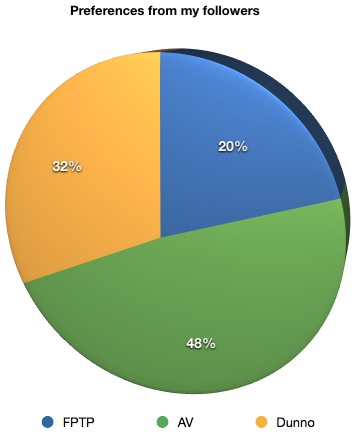
Yesterday, I asked my Twitter followers which system they preferred. It looked like this:

Wow – almost 1 in 3 of us don’t know. If you are one of those people then look no further. I am going to work it out here on this blog and then we’ll all know. Hoorah! So let’s do it with an example.

15 friends are ordering a pizza to share from The Very Big Pizza Company. There are three options:

  • Meat Feast
  • Pepperoni
  • Margherita

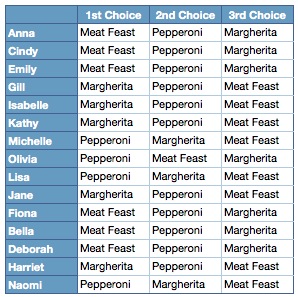
Between them they need to decide on which pizza to get and so they take a vote. Their preferences look like this:

The voters

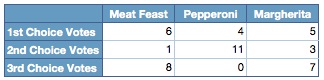
Summarised, their preferences look like this:

Voters

If they use a FPTP system then only their 1st choice preferences are taken into account so, with six votes, they will get a Meat Feast.

If they use AV however then it works like this:

Round 1

  • Meat Feast – 6 votes
  • Pepperoni – 4 votes
  • Margherita – 5 votes

In AV, Pepperoni with the fewest first choice votes at the end of round 1 gets eliminated and the Pepperoni lovers’ second choice votes are added in for round 2…..

Round 2

  • Meat Feast – 7 votes
  • Margherita – 8 votes

Margherita is the winner.

Two different systems – two different results. While we’re here though, let’s look at another system called the Borda Count. In this system 3 points are awarded for a first choice, 2 for a second and 1 for a third. Points are all added up to determine the winner. It’s a bit like what happens in the Eurovision Song Contest.

In this system we find the following:

Borda Count Results

Pepperoni, with 34 points has won.

Three different systems – three different results. So what does all this tell us? It tells us that the voting system we employ can make a big difference to the outcome of the election. With three different systems and the same set of preferences we observe 3 different outcomes.

You might think I intentionally set the group’s preferences such that this would happen. Yup, I did. But it may not be too far from reality. Imagine that it’s May 2010 and Meat Feast is the Conservatives, Pepperoni is the Lib Dems and Margherita is the Labour Party. The different outcomes here have essentially occurred because:

  • More people preferred the Conservatives as a first choice than preferred either of the other two (but importantly not an overall majority)
  • The Lib Dems are most often the second choice of both Conservative and Labour voters
  • Lib Dem voters are more likely to prefer Labour than Conservatives*

* I’m not sure whether this is actually the case but it doesn’t make it an implausible set of preferences.

So I have looked at three different voting systems and they produced three different winners but which is the fairest? Nope, I still don’t know. Let’s keep going.

First, let’s go back to the FPTP system where the group have decided to vote for Meat Feast.

They phone up The Very Big Pizza Company. Before they can place their order, they are informed that unfortunately there are no more Pepperoni pizzas left. Doesn’t matter, right? In the vote Meat Feast came first, Margherita second and Pepperoni came last. The fact that Pepperoni isn’t on the menu doesn’t cause a problem. Or does it?
Anna, on the phone relays this message to the group and they do the FPTP vote again based on Meat Feast or Margherita. Now Margherita wins on the FPTP method!

To me this seems like a big problem. In a fair electoral system, if people prefer Meat Feast to Margherita then the outcome should always reflect this, irrespective of whether or not Pepperoni is available.

FPTP says that if Pepperoni is on the menu then Meat Feast is better than Margherita and if Pepperoni is not on the menu then Margherita is better than Meat Feast!

So FPTP is cack then. Let’s look at the AV in comparison. After the AV vote they phone up The Very Big Pizza company to order their Margherita and find that Meat Feast is off the menu. Now Pepperoni wins. Bollocks.

If AV is a fair system then if it prefers Margherita to Pepperoni when Meat Feast is on offer, it should prefer Margherita to Pepperoni when Meat Feast is not on offer.

Aaargghh. All I have done so far is to find that neither is fair.

When you look at the summarised table of votes above, AV does have a clear problem. Pepperoni had loads of second place votes but these all got ignored because it was eliminated before they could be taken into account. 11 people liked Pepperoni second best but the system treated it the same as if no one had liked it second best.

When you look at FPTP though – it doesn’t just ignore all the second and third place votes for Pepperoni. It ignores, by definition, everything that wasn’t a first choice vote.

My view is that when you need to make a decision about something, you should take as much of the available information into account as possible. AV, while not perfect takes more information into account than FPTP and it is on that basis I think, a fairer system.

Let’s not though, forget about our third option – the Borda Count which we sadly will not get the option to vote for. That system takes every preference into account and I therefore think it is a fairer system than either of the two from which we can choose.

Formula 1 uses something not too far from the Borda Count to decide the world champion. Would Formula 1 be fairer if driver’s second places, third places etc were not taken into account when deciding the World Championship? Bernie Ecclestone thinks so but I don’t. I think a driver with 5 wins, 8 second places and 2 third places has more claim to be World Champion than a driver with 6 wins and 9 races that they didn’t finish.
The Borda Count system is by no means perfect but it allows us to take a lot more information into account than a simple FPTP.

This is not the whole picture though. Even if everyone agreed on the fairest system they would not all necessarily vote in the same way. For a start, some systems are more likely to benefit certain political parties. The Conservatives don’t really think FPTP is the fairest possible electoral system, they just think they will have a better chance of winning a majority than they would with the others. If the party you like the best is going to do better out of a particular system why would you want to vote for an alternative in which they would do worse?

Also, the best system may not be the fairest system. FPTP is the simplest system by far – one cross in one box and you’re done. The more complex the system becomes the harder it is for people to understand and cast their vote. A clever mathematician could come up with a brilliantly fair voting system but if a significant proportion of the electorate didn’t understand it or couldn’t work out how to fill in their ballot papers, it would be worthless.

Some people also praise FPTP for its strength in delivering a majority government with a minority of votes. That doesn’t necessarily sound like a good thing to me but if people really think it is a good thing then why should they not vote for a less fair system in order to achieve it?

Irrespective of these there is something much worse which will undoubtedly have a strong influence on the result of the referendum – the campaign of misinformation which I can see on the horizon, heading for our shores like a giant wave of bullshit. Political parties, unions and other groups will no doubt know which of the two systems benefits them the most and they will undoubtedly be feverishly preparing their campaigns to scare the public into believing that one system means 100 years of darkness to the UK.

On the Today Programme the other day, James Frayne who ran the successful campaign for the Conservative Party to vote No to a North East regional assembly said that because Nick Clegg is so unpopular, the best tactic for the No2AV campaign (yes, they’ve already made a name like a fucking X-Factor band) would be to say if you vote AV you will get Nick Clegg in government again.

It’s shameful that on one hand we will be given a chance to vote to change the electoral system and on the other hand we will be drowned in this kind of crap designed solely to mislead us. Will any political party in the next few months spend time and effort really trying to explain the underlying good points and bad points of each system in a bid to assist the voters into making an informed choice? I hope so but I don’t think so.

So – what have I concluded?

  • AV has big problems and probably isn’t a great system but it is fairer than FPTP
  • The Borda Count is fairer than either of them but isn’t available
  • A fair system is not necessarily the best if it is overly complex to understand
  • Even if people agree on what the fairest system is they will still not necessarily vote for it
  • There will be a massive campaign of misinformation which will significantly influence the choice of voters

Well, to be honest, I’m disillusioned by the whole thing now. Bollocks to this. Anyone for Pizza?

RedEaredRabbit

Facts Evasion

When I’m not tweeting or blogging, I sometimes have to do some real work. Last year, I was asked to put together a report to analyse the performance of a particular strategy my company was pursuing and then present it to my CEO and the board.

“That sounds well important,” I thought. So I did this:

  • I clearly set out what I was going to measure and why
  • I gathered as much information as possible and analysed it
  • I accounted for any uncertainties in my measurements
  • I accounted for any external factors which could have influenced the results
  • I summarised how the strategy was performing based on these factors and tied it back to the things I said originally that I would measure
  • I made recommendations as to how we should proceed based on the gathered evidence and uncertainties

While I would like to think I was the first to think of this nice structured way of doing things, in fact I wasn’t. This is just, at a high level, the way you approach changing anything important, even if you’re doing it subconsciously.

If for example you were buying a house, you would not do it this way:

  • Buy a house
  • Gather as much information about houses as possible
  • Selectively discard any evidence which suggested you’d bought the wrong house
  • Selectively include any evidence which suggested you’d bought the right house
  • Set out what your house buying criteria were based on the bits of evidence you had not discarded

Well, you wouldn’t do it this way unless of course, you were a politician. Politicians, you see, work in the opposite way to everyone else. Let me explain with an example.

At the moment, the government is proposing a reform of the NHS. This is the evidence they are putting forward for why such radical changes are necessary:

Health Secretary, Andrew Lansley, speaking on PM:

You are twice as likely to die of a heart attack in the UK as you are in France.

Prime Minister, David Cameron, on the same day:

We’ve fallen behind the rest of Europe. We spend similar amounts of money but we’re more likely to die of cancer or heart disease. I don’t think we should put up with a second rate… errrr… with coming second best.

Note he actually almost called the NHS a second rate health service but thought better of it.

Well it all sounds extremely scary. But is it?

John Appleby, Chief Economist at the Kings Fund, London thinks things aren’t quite as bleak as the government is making out and writing in the British Medical Journal he explained why.

Although statistics from the Organisation for Economic Cooperation and Development (OECD) confirm that in 2006 the age standardised death rate for acute myocardial infarction was around 19/100 000 in France and 41/100 000 in the United Kingdom, comparing just one year—and with a country with the lowest death rate for myocardial infarction in Europe—reveals only part of the story. Not only has the UK had the largest fall in death rates from myocardial infarction between 1980 and 2006 of any European country, if trends over the past 30 years continue, it will have a lower death rate than France as soon as 2012.

You see, the government selectively chose one data point on the graph and discarded the rest of the data. This is what the data looks like if you don’t discard the rest of it:

Heart Disease MortalityThis doesn’t look quite so scary, does it? You see, when you look at all the available data, you get a very different picture. The UK’s death rates from heart disease have been plummeting and if the trends shown in the graph continue, argues Appleby, then we will have a lower rate than France by 2012.

This looks to me, (and John Appleby) like things are going in the right direction with our current system. Also, as Appleby points out, Lansley and Cameron chose quite a tough comparison. France has the lowest death rate from heart disease in all of Europe. A lucky choice, or cherry-picking a number to support an argument?

Either way – good for France, right? Well, not yet. Something Lansley and Cameron didn’t take into account which is absolutely massively important is this:

Are France and the UK using the same criteria to determine their causes of death?

As it turns out, possibly not. Speaking on More or Less on Radio 4 on 21st January*, Dr. Pete Scarborough, a Senior Researcher at the British Heart Foundation Health Promotion Research Group at Oxford University (get a shorter job title) noted that in the UK, if a person with a record of high cholesterol or high blood pressure dies, the coroners are much more likely to record the cause of death as a heart attack in comparison to France where the cause of such a death unless a heart attack is clearly shown to have happened, is generally recorded as “unknown”.

An additional point which Lansley and Cameron failed to mention is death from heart disease has a lot to do with lifestyle. The best way of avoiding death from heart disease is to avoid getting heart disease in the first place. Diet, smoking rates and exercise were all omitted from their conclusion.

Appleby in his article stated:

The trajectory for many causes of death swoops up and down over decades—often linked to changes in lifestyle behaviours rather than spending on healthcare.

Which makes perfect sense. Perhaps due to lifestyle, a higher proportion of people in the UK turn up for treatment for heart disease than they do in France. If that’s the case we should hardly be blaming the NHS.

You’ll recall, David Cameron also brought cancer death rates into the equation. On that, Appleby noted this:

As Cancer Research UK has pointed out, although the Eurocare data often feed headlines that the UK is the “sick man of Europe” for many cancers, trends from Eurocare actually show improvements in survival rates for the UK. These are confirmed by the Office for National Statistics, which last year reported improvements in five year survival rates between 2001-6 and 2003-7 for nearly all cancers. But Eurocare is problematic; the latest study includes diagnoses only up to 2002, and coverage is patchy (French data cover around 10-15% of people with cancer, the UK, 100%). Furthermore, differences in survival rates may reflect variations in how early diagnoses are made, not the state of healthcare in different countries.

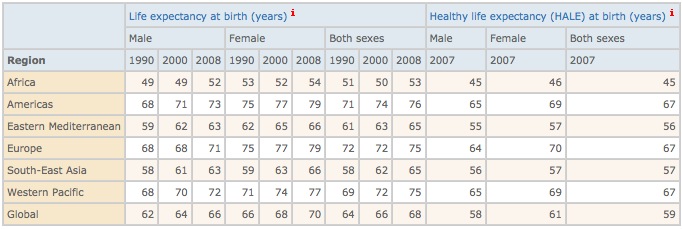
Overall, I think again, this doesn’t seem quite as clear cut as we were led to believe but there is yet another important statistic they failed to mention. If our substandard healthcare is really causing a significantly higher death rate then shouldn’t our life expectancy be significantly lower than France’s? I went to the World Health Organisation’s website to check this out and found this:

The most recent figures for average life expectancy they have are for 2008. In France it was 83 for women and 81 for men. In the UK it was 82 for women and 80 for men. Irrespective of what people are finally dying of, the average life expectancy between the two countries is extremely close.

The WHO also conveniently shows average life expectancy by global region and here we can see whether we are lagging behind the rest of Europe, as claimed by David Cameron:

Oh. As you can see, the average for Europe for 2008 was 79 for women and 71 for men.

So much for us lagging behind the rest of Europe but, anyway, if we truly are experiencing significantly higher death rates from heart disease and cancer than the rest of Europe it is a bit puzzling. If they aren’t dying of that but have lower life expectancy then what exactly is it that they are all dying of? Rabies?

My conclusion based on this data (which was by no means all of it but a lot more than Lansley or Cameron used) would be that we are doing well and heading in the right direction. So where is the big problem? Where is the big need for a radical NHS reform?

Let me move back to my initial example of the report I had to do at work. If I had made a conclusion in advance, backed it up with one or two pieces of cherry-picked data and gone in front of the board with it, my audience would have torn me to shreds.
My report was important to me but compared with the importance of the NHS to the UK it was really nothing at all. This is the NHS we’re talking about – people’s lives.

My audience wouldn’t have accepted such a poor analysis of the data for my crappy report – so don’t you dare do it either. You are the audience now and this is really important. Don’t accept these arguments as the complete story – understand them for what they are. A couple of cherry-picked, airbrushed, bullshit numbers selected to back up a plan that the government wanted to do anyway, regardless of the what the actual evidence suggested.

If I couldn’t get away with such behaviour in front of my board then why should the government get away with it in front of the British public?

Pulling basic information from the British Medical Journal and the World Health Organisation is not hard to do – I did it with no trouble at all. The government’s position is nothing more than pure deception and when we look at the real evidence – their position fucking stinks.

RedEaredRabbit

*More or Less’s excellent piece on this same subject helped a lot with putting this post together. It’s available as a free Podcast so have a look for it.

Beating Up The Rich

In amongst the knob gags and poo jokes, someone occasionally writes something serious on Twitter. The other day someone wrote this:

The top 10% of earners pay more than 50% of all income tax. When can we stop beating up on the rich?

It got retweeted and found its way into my timeline. I did try to start a debate with the originator but they didn’t seem to want to take part. Twitter is a fairly clumsy medium for doing so in any case.

I hope I am not doing the originator a disservice but I think the case being made was one I have heard on several occasions – that because such a large proportion of tax is coming from a relatively small proportion of the population they must be more than paying their way and it would be unfair to ask them for even more.

The point I wanted to make was that this statistic on its own doesn’t really tell us enough to know whether we should stop beating up the rich or not.

(I think we are talking about a metaphorical beating up here. I want to make it explicitly clear that I do not condone the beating up of rich people irrespective of the income tax rate for high earners. Except perhaps Duncan Bannatyne and even then no more than a wedgie and a titty twister.)

So why does this statistic not tell us enough on its own?

Reason #1

Let’s look at two fictional economies:

Thatcherland

The country of Thatcherland has 10 residents. Nine of them earn £10,000 per year. One earns £10,000,000 per year.
Income tax is a flat 30% irrespective of salary.

=> In Thatcherland the richest 10% of earners pay 99% of the total income tax.

Getoffmyland

The country of Getoffmyland is populated by 10 farmers. Nine of them earn £10,000 per year. One earns £30,000 per year.
In Getoffmyland, income tax on salaries up to £20,000 pay income tax at 10%. For anything over £20,000 income tax is 40%.

=> In Getoffmyland, the top 10% of earners pay 40% of the total income tax.

If we simply assume that a higher proportion of income tax paid by the rich is equivalent to fairness then Thatcherland comes out as a brilliantly fair economy! Look, that lovely rich person is paying almost all the income tax. The other 90% of residents only have to find 1% between them!

Of course, it isn’t fair though because we just neglected to take into account the income gap between the rich and the poor: If the income is unevenly distributed in the first place then it should not be a big surprise to anyone that the income tax is too.

Reason #2

The statistic tells us only about income tax and we can’t make a valid judgment without taking into account all the other taxes we have to pay. e.g.

  • In Getoffmyland there is another tax which farmers have to pay based on the size of their farmhouse. The bigger it is the more they have to pay.
  • In Thatcherland, this tax has been replaced with a poll tax where all residents pay the same.

Even if the income tax were fair in Thatcherland we would be fairly rash to declare the whole tax system fair without taking the poll tax into account.

Let’s forget about our fictional economies and move to a real one. The UK government is currently in the process of implementing fiscal austerity. At the highest level they have two ways to do this:

  • Decrease Government spending
  • Increase Taxes

It seems to me they are a lot keener on adjusting the former than they are the latter and I do have a big concern about this. In August the IFS published an analysis of the government’s emergency budget and found that contrary to George Osborne’s claims the policies were not progressive. i.e. they proportionally penalised the poor more than the rich. (You can read the post I wrote about that here.)

This shouldn’t be a big surprise. If you hugely reduce the budget of local councils then libraries close, public transport services reduce etc and those services benefit the poor more than the rich who buy their own books and have their own cars. Additionally there have been much publicised cuts to both housing benefit and tax credits and despite what the Daily Mail says, people who claim benefits are not all millionaire hoodwinkers.

Strangely though, throughout all of this, no one has seemed to consider for 5 minutes financing any of this through a rise in income tax on the wealthy (metaphorically beating them up) and I really don’t for the life of me understand why. Austerity in the current climate is foolhardy but if you are dumb enough to want to implement it, why not start with the people who aren’t going to starve?

Prior to the downturn the UK economy had enjoyed 15 years of sustained growth and a great many people benefited because of this. Now the economy is in a bad way, why is a government hell bent on austerity, not considering going back to those who have benefited the most and asking them to contribute more? It seems especially odd when the alternative is asking the poor to foot the bill.

I must though, be fair to the government and highlight a progressive policy they are implementing – the freezing of the television license fee. It is just a shame that David Cameron had to get in bed with Rupert Murdoch to come up with one.

Leaving the rich untouched and taking it all from the poor just increases the income gap, pushing us still further towards the economy in Thatcherland.

And as we approach Thatcherland, the richest 10% will pay more and more of the income tax.

And things will be more and more unfair.

RedEaredRabbit

How Tony Screwed Vince

Tony Blair has a lot to answer for. I’m not talking about Iraq though – not quite that bad but I’m still talking about something pretty terrible:

I believe that Tony Blair was personally responsible for David Cameron and Nick Clegg.

I’d better explain. Blair’s annihilation of IDS and Michael Howard convinced the Conservative party that they had to fight fire with fire. Wheeling out old people with poor communication skills wasn’t working. The Lib Dems had also tried it with Sir Menzies Campbell… but not for very long.

And so it came to pass that the other parties each created a leader in Blair’s image and lo, they were shit.

One politician who was not created in Blair’s image, however, is Vince Cable. On Twitter this week I wrote this:

I do feel sorry for Vince Cable. He looks like a man who ordered steak and chips but a turd sandwich arrived and his boss made him eat it.

Worse still, after he ate it, his boss made him go on TV and say, “Yum yum.”

(I would like to take a moment to apologise for saying “turd sandwich”. I shouldn’t have said that. I should have said “turd baguette” as a turd would fit much better in a baguette.*)

I do wonder how far Nick Clegg’s approval ratings have fallen since the heady days of the party leaders’ debates in the run up to the election. He did well in those debates, not because he had better policies but because he did the best job of articulating the problems with the policies of the other two. He did such a good job that I, and I’m sure many others, thought he believed in what he was saying.

A picture of Nick Clegg before the election

A picture of Nick Clegg before the election

Just a few weeks later it became clear this could not have been further from the truth. Once Cameron dangled his mouldy carrot of power in front of Clegg’s mouth, there was no turning back. Since that day pretty much everything that Clegg preached before the election has been swept under the carpet and while I can understand the lure of power I am still, in equal measure, impressed and horrified at how easily he has forgotten everything he put into his party manifesto.

Vince on the other hand hasn’t found his turd sandwich quite so easy to stomach. I think, in fact, he would be a happier man today if the general election had resulted in a decent gain of seats for the Lib Dems but no coalition. Vince was impressive in opposition. I also think he would be impressive as Chancellor in a Lib Dem government. He is distinctly unimpressive, however, when it comes to maintaining a smile whilst implementing policies with which he doesn’t agree.

This phenomenon reached a whole new level this week though when Vince announced that he might not vote for “his own” policy on university tuition fees. “His own” policy, by the way, is to allow universities to charge tuition fees of up to £9,000 per year.

I will now take a step back. I was lucky enough to attend university shortly before tuition fees came into being. I received the maximum student grant and had a huge amount of help from my parents but it was still a colossal task to pay off the £9,000 of debt I had when I left. If I did the same today under the proposed scheme I would likely have around £40,000 of debt. I have no idea how I would pay that off.

An argument often used in favour of hiking up tuition fees is that the mean lifetime earnings of people with degrees is higher than the mean lifetime earnings of people without one. While this is true it is pitting a simplistic argument against a complex problem. For a start, if you plot earnings vs number of people earning that wage you will see a skewed distribution – i.e. there are a small number of people earning huge wages which pushes the mean up to be higher than what most people actually earn.

Additionally there are of course, careers which require higher educational training which pay well below the mean. If I were selecting a university course today I would not, as I did 14 years ago, choose the subject in which I was most interested. I would instead choose between:

  • Which subject gives me the best chance of being able to repay a debt of £40,000?
  • I am not going to go to university

Tuition fees are not right and tuition fees are not wrong. I could write a whole other post on what I think about that subject and still only skim the surface. This blog post is not about what the best policy is though – it is about Vince and I must bring it back to that subject.

My belief is that Vince is more or less a good bloke but is currently in a position of terrible inner conflict. Does he go with what he believes or does he go with what David Cameron believes? I think he is one of the most capable politicians in the current government but sadly, I have serious doubts as to whether he will be able to stick it out in his cabinet role and a resignation before the next election would not surprise me.

I don’t know the reasons why Vince Cable decided to get into politics but I suspect his current predicament wasn’t in the plan. He is caught between two Tony Blair clones when he never wanted to have anything to do with Tony Blair at all.

When the labour leadership election was going on I wanted Ed Miliband to win. Not just because he had a better understanding of the important issues than his brother did but also that David would have been a third Tony Blair chucked into the mix and I couldn’t have voted for any of them. Ed will now have the problem of trying to break the “let’s all be Blair” stranglehold on British politics but I sense that most of us are more than ready to put that behind us so maybe he might just stand a chance.

You will have noted above when I said Vince might vote against his own policy I put “his own” in quotes. I did that because although it was widely reported in the media as being his own, I actually don’t class it as his own policy at all – it’s David’s. Vince’s own policy was the one under which the Lib Dems fought the last election and it’s interesting because it is more than a little bit different. It goes like this:

We will abolish tuition fees.

Think about his position for a moment. He wanted tuition fees abolished and yet he is now expected to be the one who takes responsibility for increasing them. It’s not easy to reconcile those two policies is it?

I mean – the difference between them would cause a pretty fucking massive problem for anyone, right?

Anyone that is, except for Nick Clegg.

RedEaredRabbit

*Yes, blatantly stolen from Alan Partridge’s “infected spinal column in a bap”.

The Baroness, The Cark Park and The Smell of Burning Pants

I started this blog back in May. Prior to that, although I enjoyed reading other people’s blogs, I had never seriously considered bothering to do one myself.

Then one day, something came along which was so utterly stupid I felt like I needed to tell the world. The country’s finances were in a big mess, we were about to go through a general election and no party standing for election had told us what they were going to cut in order to sort this out.

In all of this the thing which really got my goat, the thing which frustrated me into setting up a free WordPress account and typing – actually typing, was the Conservative policy on raising the inheritance tax threshold. In the circumstances probably the most mind-numbingly stupid thing that could conceivably have been conceived.

You can read that first post here but to summarise it, the ONS had published very clear figures showing the state of the nation’s finances. The IFS had published a very clear paper showing that each of the three main parties required significant, unidentified spending cuts in order to make their sums add up and despite this, the Conservative party were advocating a tax cut which would only benefit very rich people and, in order to pursue their agenda of lower public spending would have to be funded by even more cuts elsewhere.

The IFS’s paper showed that the Conservative Party, in their manifesto, had identified a mere 17.7% of the spending cuts they would actually need to make to in order for their figures to balance. This was well known, clearly calculated and in the public domain.

Now, before I continue, I want to make something absolutely clear. I did not hack into a top secret government server to get this information. I did not take it off a laptop I found on a train, I just downloaded some reports from the websites of the two most bloody obvious places to look for it.

Fast-forward to Thursday last week and that evening’s episode of Question Time on which, representing the Conservative Party, was Baroness Warsi.

“Why didn’t you tell the public you were going to cut Child Benefit?” she was asked.

Pop Quiz, assholes. Was her answer:

  • Well, we had no idea how bad the financial mess that Labour left behind would be.
  • We didn’t want to tell anyone before the election in case they didn’t vote for us but it’s too late for that now! We won! Ha Ha!

Sadly, she went with a). This is very strange though because everyone else did know very accurately how bad the financial mess was and furthermore, I seem to recall a certain political party making it the major point of their election campaign.

If Baroness Warsi says she didn’t realise our finances were a big mess then I conclude that either:

  • She is not taking her job very seriously.
  • Her pants are on fire.

Judging by the audience’s reaction they were opting for answer b).

Later, Baroness Warsi got onto the subject of Big Society. Big Society is the coalition’s spoon full of sugar to help the cuts go down and if you don’t think too hard about it, it has a lot going for it. The idea is that the state will motivate society into taking responsibility for their own lives and get involved in building and improving the community. Such will be the Utopia that we create that no one will even remember spending cuts. It does have a fairly big down side though – no one will actually bother to do it.

Warsi was asked what the Big Society initiative would actually achieve. She recounted a charming tale of some people who had once cleaned up a car park. The next step for Big Society, she said, would be reforming our educational system, our police force and our health service.

Hmmm…..

That does seem like rather a big next step. Just because the average group of people possesses the skills to clean up a car park does not mean that the average group of people knows how to set up and run a school or a hospital. In fact, I would go as far as to say these things are in no way related.

If you didn’t see the episode and think I am misrepresenting things, I urge you to have a look at it on iPlayer. This bizarre extrapolation really was done.

When Labour came to power in 1997 they enjoyed a long “Honeymoon” period. Judging by Baroness Warsi’s performance, the coalition’s is over as quickly as it began. I actually don’t believe the government could possibly be as incompetent as you’d believe from watching her but they do seem to put her on TV a lot so their judgment at least is fairly awful.

Her claim regarding the economy, essentially ‘we didn’t know what we were getting in to’, is frankly no better than Bob Crow using the fact that tube drivers have to work underground a lot of the time as one of the reasons that they should be paid more. Call me a cynic but I’m pretty sure they knew that when they applied for the job and probably they thought the hugely inflated salary, minimal working hours and generous holiday allowance made up for it. Or maybe they really didn’t already know this when they applied for the job of tube driver on the London Underground.

In truth the state of the nation’s finances were well known by everybody. Any party seeking election knew exactly what they were taking on and as such the elected government should be able to stand behind their policies, not hide behind a lie.

The claim that these cuts weren’t expected and are just the result of not realising that our economy is weak, is frankly insulting because it is so easily shown to be false. The current government will no doubt have more, as yet, unidentified cuts ahead. If they have even the tiniest amount of respect for their electorate then they will learn to be accountable for their policies. If they think their electorate is a bunch of idiots then we have this excuse to look forward to for the next four and a half years.

This all sounds hugely depressing but I assure you – it’s not all bad. Somewhere, wherever it may be, we have a clean car park.

RedEaredRabbit

When the History Grad took on the IFS…..

It was interesting to read today’s publication from the Institute for Fiscal Studies regarding their analysis of George Osborne’s emergency budget. At the budget, you may remember, George Osborne presented his policies and stated that they would proportionally impact the poor less than the rich.

I like the IFS because it is independent of any political party but is extremely well equipped to analyse their economic policies and give us a viewpoint unbiased by any political persuasions.

The IFS have spent lots of time looking at George Osborne’s policies and doing their own sums. They have included lots of things that George Osborne didn’t include in his model. Things like the cost of mortgage payments do actually affect poor people, as do cuts in housing benefits and tax credits. They have also included the years 2013 and 2014 in their analysis which were missing from George Osborne’s.

At this point, I would have liked the government to thank the IFS for their analysis, review it in detail and decide, based on this review, whether or not they should change their policies. This wasn’t what happened. Within hours, the government had given a press release stating that the IFS had missed some important things from their analysis, such as economic growth and if they had included these they would have come to a different conclusion. This is a bit odd, because the IFS have included more things in their analysis than the government did in theirs. They haven’t as far as I can see missed out anything which they government included in their model, they have just added things the government forgot to include. To my mind, this doesn’t make it a worse analysis, it makes it a better analysis.

If George is going to get into a verbal ruck with the IFS about economics, I worry his modern history degree won’t help him out much but there is a bigger concern that I have. For the government to have so quickly found a the flaw in the data presented by the IFS they would have had to take the IFS model, incorporate the things they felt had been missed and then recalculate everything on that basis. i.e. they would have to have an even better analysis already prepared and ready to go. If they have this analysis then they should publish it so the IFS, you, me and everyone else can read it and respond. I suspect this analysis has not been done and their reaction is purely a defensive one.

In an ideal world a government would form policies by gathering the available evidence, analysing it and then determining the best policy based on that analysis. Before they implemented it they would determine the way in which they would measure its success or failure and if it were not behaving as expected they’d adjust the policy accordingly. This might seem an unattainable idealism but actually we are all doing such an exercise in our every day lives all of the time.

Supposing you live in Wimbledon and you get a new job in Canary Wharf. You now have to decide how you will get all the way across town and back every day. There is nothing direct so you have lots of combinations of options. You could take buses, tubes, mainline trains or even river boats.

You start off by typing your journey into your iPhone app. It suggests that the quickest route is taking the District Line through Earl’s Court, changing at Monument and taking the DLR. You try this for a while but realise that every morning you get stuck outside Earl’s Court for 20 minutes because the people who manage the arrivals and departures there are half-witted. The model on your iPhone app didn’t take this into account so in this situation you would try a couple of the other suggested journeys a few times and after a while, based on your experience, you’d settle on the route which worked the best for you.

The government equivalent is to decide that on the first day of work, they need an emergency iPhone app journey plan. After this, no matter how inconvenient it becomes they will stick to the route they took on the first day and claim it is the best.
When newer better apps become available they accuse them of not including something their original model had never included anyway like “leaves on the line” and stick to sitting outside Earl’s Court for 20 minutes every morning, pretending they meant to do it.

No one would go in for this nonsense with their journey to work so why do politicians insist on it for something as important as the economy? The difference is this:

How much would it cost you to admit you were wrong?

Sadly we live with a political system which overly punishes this natural human trait. When the apple fell on Newton’s head his reasoning didn’t go like this:

I need an emergency gravity law. It is very important to get this out asap. Thinking it through would be an unnecessary waste of time.

…and then…

My emergency gravity law is that apples are attracted to heads, through a strange new force.

And then refuse to change his law when someone pointed out it was a bit more generic than that and in fact everything was attracted to everything else.

Of course he didn’t. Science would hardly be where it is if all scientists were to all insist that the first thing they ever thought of were the absolute truth. Politics a bit different though. For one there is the opposition. Imagine there were someone employed for the sole purpose of taking your job off you. If there were, would you want to admit you’d got something wrong? Also there is the press. Every newspaper has a political agenda, and while I think being able to learn from experience and adjust accordingly is a good trait, the press seem to call it a “U-Turn” and think it makes you a weak politician, not fit to do the job. All this gives an incentive for governing politicians to refuse to admit their mistakes and pretend the policy they first thought of was the best one.

I admit though, the comparison with Newton was harsh because politicians are under a lot more time pressure than Newton was. As important as Newton’s theory of gravity turned out to be, it wasn’t as though anyone at the time was having a terrible time directly because they didn’t have an equation to explain why they were sticking to the Earth. The new government didn’t have that luxury. When they came to power they were under immense pressure to put in place some policies to start addressing their finances – after all they had promised to do so and been elected on that basis. I don’t have a problem with them doing this, as long as they could have a process to continually review what they were doing, take on board other people’s opinions where necessary and adjust their strategy accordingly when they were wrong.

The reality is a long way from this though and the best model available to us today, from the IFS, suggests that our current economic policies are punishing the poor more than the rich. The government deny this but haven’t produced a better model to show how they can be so sure.

Would it be so bad to have a political system where a government could take constructive criticism of their policies into account and improve upon them because of it?

Wouldn’t that benefit to the country as a whole?

Would it really be so terrible of them to at least read the IFS publication with an open mind before responding?

I don’t think it would be terrible. In fact, I think they should read it. It is rather good.

RedEaredRabbit