Blessed are the Rich

Excessive travelling for work has meant little blogging of late. The coalition’s cutting of the highest level of income tax has not failed to catch my eye though.

The main arguments for these type of tax cuts always seem to be that we are unfairly penalising the wealthy, that we are making the UK a terrible place for the rich who will all leave and (even more bizzarely) that tax cuts on rich people will mean higher tax revenues overall.

The OECD recently published a report on income inequality. You can read the whole thing here but this is a graph from the report showing how the share of the income received by the richest 1% has changed between 1990 and 2007 (data for the UK is to 2005, see footnote).

Income inequality 1990 - 2007

Income inequality 1990 – 2007

So, of the countries featured, the UK has the second highest level of inequality between the top 1% and the bottom 99% after the US and has seen that measure of inequality rise from 9.8% of total income in 1990 to 14.3% in 2005.

The income of the rich has been diverging from the income of everyone else for a long time and cutting their income tax is not really a brilliant idea in these circumstances. The Osborne fans will tell me it will boost the economy and help sort out the economic mess they inherited from the last government. I’ll respond pre-emptively – the current economic problems were really not caused by the rich not being rich enough.

If you want to believe that tax cuts for the rich is a good thing then fine, we’ll agree to disagree but can you honestly look at the graph and say that the richest 1% have been getting a raw deal or that the UK is a bad place for rich people?

If you answered “Yes” to those two questions then you probably also think we are all in this together.

RedEaredRabbit

The Austerity Fairy

Today I’ve been playing with the greatest toy ever created. It’s not a Sony Playstation and it’s not a Pokemon. It’s a Rubik’s Cube.

The Problem

The Problem

One of the things that makes a Rubik’s Cube so great is that the problem you are trying to solve is very easy to understand. From the time you first picked one up, you understood exactly what you had to do – arrange it such that each face of the cube was the same colour.

The Solution

The very best people in the world have solved it in under 10 seconds, putting through around 5 moves per second.

I’ve just tried making 5 moves per second and I couldn’t even get close.

Let’s imagine taking someone who could move the cube this fast but didn’t know what they were aiming at, that is they know there is a single arrangement of the cube they are aiming for but don’t know what it is so they need to try every possible permutation. I done a sum and by my reckoning, assuming they were able to go at 5 moves per second and were able to keep track of every permutation they had tried so that they never hit the same one twice, it would take them around 274 billion years to get through them all and be sure to have hit the solution.

6 seconds vs 274 billion years – the importance of understanding the problem you are trying to solve.

So anyway, the economy is shrinking again – down 0.2% in the final quarter of 2011 😦

George Osborne was not worried though:

We have the right plan and we’re going to stick with it!

In fairness to him he was half-right. We are going to stick with it.

George thinks the problem is spending. He thinks that as long as we spend less, at some stage the Austerity Fairy will show up and magic the economy back to health.

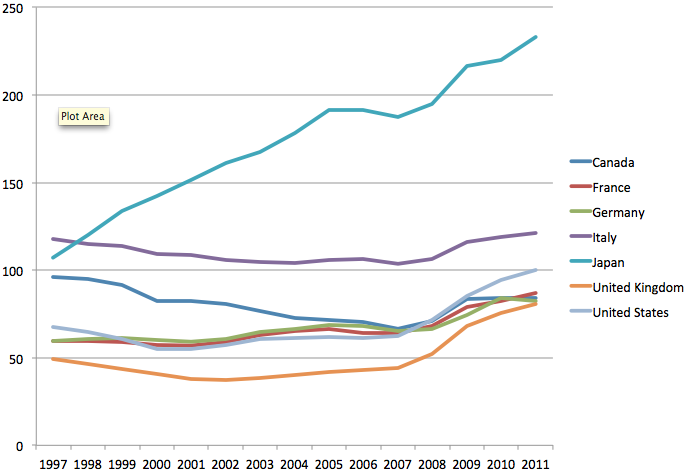
He blamed firstly, the reckless spending of the Labour government. Let’s get this one out of the way quickly with the IMF data I’ve put on here before. Between 1997 when Labour came to power and 2007, the year before financial meltdown, the UK’s debt as a proportion of its GDP was the lowest in the G7. In every single year:

Government debt as a percentage of GDP (Source IMF)

Government debt as a percentage of GDP (Source IMF)

Yes, the UK is the orange line at the bottom.

Next he blamed Europe. Wait a moment – is that the same Europe who are also awaiting the arrival of the Austerity Fairy? How’s that working out for them? Oh.

Much as George would like it, it’s actually not all everyone else’s fault. The reason George has not solved the problem is because, like the poor bugger spending eternity on a Rubik’s Cube he doesn’t understand the problem he is trying to solve.

The problem isn’t that we currently have too much spending. The problem is a lack of growth and high unemployment. Let me explain further.

In normal economic times when employment is high, if the economy starts looking a little shaky the Bank of England can cut interest rates. Lower interest rates make people want to save less money and spend more. When people spend more the economy picks up. Even Robert Peston knows that.

We are not in normal economic times though. Interest rates have been at an all time low for almost three years and you know what? No one is spending. For the rising number of unemployed this is understandable but for the people who kept their jobs why would they be saving more and spending less with such low interest rates?

It’s fairly simple. In an economic depression, even those people with jobs are scared that they might not have jobs at some time in the not so distant future. What would happen if they were made unemployed? Probably they wouldn’t walk straight into another job so they save. Even with crappy interest rates they save.

We have reduced interest rates pretty much as far as they can go but have still not got people spending again and we have therefore become stuck in something that economists call a liquidity trap. We have nowhere to go with interest rates so as long as the economy is weak no one will spend and as long as no one will spend, the economy will be weak.

This is the problem. Understand that much and the solution is a bit easier to grasp – you plug the gap with government spending until employment goes back up to healthy levels and people are spending again. When people are spending again, then you reduce it.

Even if George were able to grasp the economic problem, it would lead immediately him to a political one. How would he possibly explain to the public that for the past 20 months he had pursued exactly the opposite strategy of the one he should have? It would be political suicide. He’s not going to do that.

Better to take David by the hand and skip off together down the road to nowhere in search of the Austerity Fairy.

RedEaredRabbit

Economic Bloodletting

In older times bloodletting was a common medical practice. A doctor would treat a poorly patient by pumping out a few glugs of blood in the hope that it would cure them. The patient would then decline a bit and the doctor would say, “It’s more serious than we thought!” And he’d pump out some more blood. The patient would then get even worse and this bizarre cycle would continue, often until the patient died, at which point the doctor would say, “Well we did our best but they were clearly beyond saving.”

In 2010, the coalition government inherited a poorly economy. (Can you see where I am going with this?) They decided that what it needed was less spending. Less spending they claimed, would have the economy back on its feet in no time.

They predicted that with some much needed spending cuts, economic growth in 2011 would be 2.6%. Then a couple of months later with an even more sickly economy they predicted that with some more spending cuts, 2011 would enjoy economic growth of 2.3%.

November 2010 came though and the patient had deteriorated. 2011 economic growth was now predicted at 2.1% – despite economic bloodletting things were looking bleak. What this patient really needed was… bloodletting.

By March 2011 they had downgraded the annual growth from 2.1% to 1.7% but maintained that the patient’s only hope was spending cuts.

By November, the annual growth prediction was downgraded to 0.9%. We’ll soon see what the real figure was but it is clear that like the quacks of ancient times, the government is unwilling to recognise that there is any link between the treatment and the illness.

Some will disagree that this policy had anything to do with the worsening economy. What is indisputable however, is that the government’s policy of austerity has not led to the economic benefits that they predicted it would.

So let’s think about an alternative policy. Another option is that when the economy is weak we should pursue policies that encourage economic growth and employment. When unemployment rises, there are two immediate consequences. Tax revenues drop and government spending on benefits increases. Then public spending decreases because fewer people have money to spend, and those in employment save more because they are worried about rising unemployment. When public spending decreases, the economy weakens further, the whole thing becomes self-perpetuating and if unchecked we end up where we are today in an economic depression.

The government would say that you can’t spend your way out of recession. They say it all they time. It’s entirely incorrect though – government spending increases economic growth. So a better way of doing things might be to increase spending during a recession and then cut it back once the economy had recovered, employment had gone back up and tax revenues had gone back up. You could also supplement this with some taxes on the wealthy. So we have found a policy that is better than the government’s. Great! Let’s get ’em!

Oh, hold on. Where’s the opposition gone?

Oh dear.

The Labour party it seems, have decided not to take a stance against the spending cuts. Well, I think they have decided that. If I’m honest I’m not absolutely sure. For the past 18 months they have sort of said that they oppose them but have never really laid out a clear alternative. Now Ed Balls has decided that they would not commit to reversing spending cuts whilst maintaining that the government is cutting “too fast and too hard”.

Well I am confused. If they think we are cutting “too hard” but wouldn’t change the policy of cutting exactly this hard then what exactly are they proposing? Labour seems to have moved from a bit wishy-washy to some bizarre conflict of agreeing with government policies whilst saying they are bad.

If I were Ed Miliband, every time David Cameron said during PM’s Questions, “you can’t spend your way out of recession!” I would stand up and read bits out of a first year Macroeconomics text book to him.

And it doesn’t stop at economic policy. Opposition to the government’s proposed health care reforms have come more from doctors than they have from the Labour party despite the government’s argument being shown to be based on completely false statistics. We have a Secretary of State for Education who thinks we should fire more teachers for poor performance. If I were in opposition I think my criteria for firing secretaries of state would include trying to spend £60m on a boat for the Queen and £400,000 on personally inscribed bibles.

In my frustrated state, I am quickly running out of parties to vote for:

  • The Conservatives –  Implementing poor policies with no end in sight
  • The Labour Party – Unable to convey an alternative
  • The Lib Dems – Presumably I don’t need to explain
  • UKIP – Xenophobic
  • BNP – Racist
  • Green Party – In no way prepared for government but might have to look at them now

Ed Miliband’s time is running out to provide coherent opposition to what is going on. He was a good politician in government but for whatever reason he has been positively ineffective in opposition. A recent poll said that the UK public trusted the coalition more on economic policy than they did the Labour Party. I am in no way surprised by this. While I think the coalition policy is bad, it is at least coherent and clearly communicated. Rather than think of a better one, Labour seems to have given up and said, “That’s popular, let’s say that too!”

And say it they did. In a completely incoherent way.

The Conservatives might be poor when it comes to forming policies to gain economic growth, put people into jobs, or improve education and the NHS but never underestimate their brilliance when it comes to making a crap policy sound like common sense.

It is a fragile brilliance though and as their dumb marketing machine rolls forward we can see quite a few gaping holes at which to aim our wrath. I really do believe that a few carefully placed, well-argued policies could derail the whole thing but sadly I see no sign of them on the horizon.

And so, I am making one last, desperate, heartfelt plea:

Could the real opposition please stand up?

RedEaredRabbit

How Not to Organise a Referendum

Another week, another cow pat for David Cameron to create, position, and step in up to his neck. This week’s cow pat is of the Aberdeen Angus variety and it is of such depth that his comb-over is barely visible above the crust.

Yes, you’ve guessed it, it’s the subject of Scottish independence and David has decided that this week is a good week to dictate to the Scottish Parliament exactly how and when the vote should happen. If Scotland tries to do it at a non-Westminster approved time, or use a non-Westminster approved phrasing of the questions, then he will see them in court.

If David had phoned up Alex Salmond and conveyed this message in a private conversation then I imagine Alex would have become a bit cross. Fortunately David decided to announce this through the media, thus avoiding any possible dispute or anger on the matter.

Shockingly, it didn’t go well.

Alex, after he finished laughing and estimating the huge swing towards Scottish independence that David had just caused, announced that he would hold the vote on his terms and it would be in 2014 to coincide with the 700th anniversary of the battle of Bannockburn.

If I were a skateboard driver I think I might say that David had just been “pwned.” I don’t drive a skateboard though so I think I’ll settle for him being made to look like a half-witted colonialist.

What was David thinking? He has unpreparedly set himself up against a man who, throughout his entire political career has been preparing for one thing and one thing only – Scottish independence. Additionally he has decided to try to put this man in his place by using the tactic of a posh Englishman in London telling him exactly how his referendum for the Scottish people is going to work. In a debate that could last for the next two and a half years, David has put himself on extremely shaky ground from the start.

Let me move on to talking about Alex Salmond.

Firstly, he looks like Baron Greenback from Dangermouse:

Baron Greenback from Dangermouse

Baron Greenback from Dangermouse

Alex Salmond

Alex Salmond

That is not critical in this debate but I thought I should mention it.

Secondly, although I do not support Scottish independence, I do have to admit that Alex, unlike David, is an extremely competent politician and David taking him on at his specialist subject through some dogma in the media is like me and my mum taking on Manchester United at football.

Every poll I have seen in my lifetime has shown that the majority of the Scottish electorate would prefer to remain part of the UK. If David keeps on his current course however, he may well reverse this in time for the referendum, whenever it may happen. The cynics among you may have spotted another reason for this perceived incompetence. Following the 2010 UK general election, from Scottish constituencies the Labour party had 41 MPs in Westminster. How many did the Conservative party win? Give yourself a pat on the back if you answered 1.

A UK general election without Scottish seats would make a Labour victory much, much harder than it would be otherwise. Although Cameron can’t be seen to be the man trying to break up the union, could it really be that he is more cunning and competent than he is letting on? Could it really be that he is exercising a campaign to actually encourage Scottish independence through a massive double-bluff? If so I was wrong earlier and he is truly a politician of unparalleled skill.

Oh but wait a moment – how would you explain these?

In complicated situations such as these we should look to Occam’s Razor. And that strongly suggests that on this and other important matters – David Cameron has no idea what he is doing.

RedEaredRabbit

Crappy New Year

As far as the economy goes, 2011 was a bit of a poo. It was also the year in which my already extremely shaky faith in politicians hit an all time low and so, as we enter a new year it is natural for us all to look forward and wonder what 2012 might bring.

So where better place to look than David Cameron’s new year speech? I’ve just watched it on YouTube. If you’d like to you can do so here or read the full transcript here. If you can’t be bothered then don’t fear, I have a selection of the best bits below.

On 2012, David says this:

It must be the year we go for it – the year the coalition government I lead does everything it takes to get our country up to strength.

I’d kind of assumed he was already going for it in 2011 but it seems as though he wasn’t. It does beg the question as to what exactly he was doing. Was he perhaps biding his time? Was he just waiting for the economic depression* to reach a certain level of calamity before calmly springing into action? Or perhaps he was just lulling it into a false sense of security?

Anyway, let’s not dwell on that. We are “going for it” now so let’s look forward:

The coming months will bring the global drama of the Olympics and the glory of the Diamond Jubilee.

It gives us an extraordinary incentive…to look our best: to feel pride in who we are and what – even in these trying times – we can achieve.

I know that there will be many people watching this who are worried about what else the year might bring…The search for work has become difficult… I get that… I know how difficult it will be to get through this – but I also know that we will.

This all sounds deeply uplifting until you think about it – at which point it makes absolutely no sense whatsoever.

I’ll start with the Olympics. I am glad that we have the Olympics and I even have some tickets for the tennis. I’ll also watch loads of it on the TV and cheer on the UK’s athletes all the way. Having said that, I don’t really understand the link David is making. What has getting excited about the Olympics got to do with finding a job? Is he implying that unemployed people just need some motivation? I hope not but either way I don’t understand it.

About the Diamond Jubilee I’ll be honest and concise – I don’t care. I absolutely could not possibly care about anything any less. The country’s most privileged family celebrating another milestone for the length of time they have been living a life of ridiculous luxury is I think, if anything, demotivating. If I were unemployed and having severe difficulty in making ends meet I’m not sure the royals having another party at the country’s expense would be the motivational catalyst that propelled me back to employment.

Back to David:

Too often our schools aren’t up to scratch, our hospitals aren’t always clean enough and our police don’t catch criminals. Brilliant and committed people work in public services – but somehow the system stops them doing their job. So we’ll change it.

Ok, but tell me how. The current government has cut funding for education and the police without providing any coherent policy on how, with less funding, those services will be improved. We’ve heard the big society idea about parents running schools but I don’t think too many people found it coherent. I find the policy of changing schools into “academies” to be at best confusing. The news is full of teachers’ concerns about this policy and rather than offer a clear explanation to ease these concerns, the government instead chooses to label the teachers as “ideologues happy with failure“.

If a government chooses to cut funding for education and the police whilst at the same time maintaining that education standards will rise and crime will go down, then the public deserves a very clear explanation of exactly how this will be achieved.

(I do appreciate though, that in 2011 the government hadn’t started going for it yet, so perhaps a good explanation is just around the corner.)

The NHS on the other hand does have a protected budget but the government’s justification for reform is one of the most shameful examples of misleading the public I have ever seen. I wrote about that here.

Onwards and downwards:

I will be bold about working to cure the problems of our society. While a few at the top get rewards that seem to have nothing to do with the risks they take or the effort they put in, many others are stuck on benefits…

David said exactly the same thing many times in the run up to the election but in the 20 months since he took over he has done nigh on nothing about the former problem of the few at the top (other than attempt to cut inheritance tax on the very rich) and in dealing with the latter has responded by cutting benefits and public services. In this respect, not only has he not been going for it, he has been going for the exact opposite.

So none of his speech so far made sense. What rabbit was he going to pull out of the hat that would possibly address all of the glaring holes in his arguments?

I profoundly believe that we can turn these things around. That’s what I mean by the Big Society…

I lost the will to live at that point.

RedEaredRabbit

* Yes, I said “depression” – the word that politicians around the world have been avoiding like the plague. It’s been three and a half years. Perhaps in 2012, their New Year’s resolution should be to wake up and call it what it is.

The French Disconnection

Today, Christian Noyer, the chairman of the French Central Bank called for the credit rating agencies to focus on downgrading the UK before looking at France. His comments came in response to S&P placing France on “CreditWatch” – essentially monitoring it closely and considering an imminent downgrade.

The UK, Noyer argued, should be ahead of France in the queue for downgrades because it has:

  • a higher deficit
  • higher inflation
  • lower growth

Now, I have no love for rating agencies but he has missed the point a bit. If the factors he mentioned were the only factors then fine but he forgot to mention anything to do with the reasons S&P gave for putting France on CreditWatch, namely that the countries using the Euro are in a massive pickle and their politicians have proved unable to decide upon a way to depickle themselves.

I understand why he’s upset with the UK. David Cameron’s performance last week of refusing any attempt of negotiation in favour of showing his backbenchers that he is tough on Europe and tough on the causes of Europe was probably not our proudest moment.

Even so, Noyer should have a bit more compassion. He might have to deal with Cameron every now and then but in the UK we have to deal with the guy every day, and it’s hard enough without foreign central banks petitioning the rating agencies for a UK downgrade.

Yes, our finances are in bad shape but we are a long way from risking default. How he could compare the UK’s credit worthiness with France’s without mentioning the Euro-shaped elephant in the room shows he is either clouding his judgment because he is in a big huff with David Cameron or he is simply disconnected with reality.

We might have equally incompetent politicians running our country but while we are not using the same currency as Greece or Italy and while we have the ability to determine our own monetary policy, it should be no surprise to Noyer or anyone else that when it comes to worries about debt repayments, all eyes are on Europe.

RedEaredRabbit

We need to talk about Europe

In the run-up to the last election, much was made of the UK’s poor financial situation. We were told repeatedly  by the Conservatives that after years of irresponsible borrowing, our finances were the worst in the developed world, that we were on the point of bankruptcy and that if we didn’t immediately reduce the deficit then no one would lend to us.

18 months on, we’ve achieved nigh on no economic growth and despite the government’s cuts have continued to increase our debt at more or less the same rate.

This leads me to wonder – if our finances were so bad then and have got worse since, why is it that we can continue to borrow money so cheaply when no one will lend two Drachmas to all of those struggling economies in the Eurozone? Something doesn’t add up.

First, let’s look at whether our finances were really the worst in the developed world. This is a graph of government debt as a percentage of GDP for each country in the G7. The data is taken from the IMF website.

Government Debt as a Percentage of GDP (source IMF)

Government Debt as a Percentage of GDP (source IMF)

You see that orange line at the bottom? That’s the UK. Were we really borrowing so irresponsibly for all of those years under Labour? That’s a matter of opinion but if we’re on the naughty step then it’s pretty crowded.

On a side-note, Japan’s is quite impressive, isn’t it? They seem to be in a Ponzi scheme with their own public but Japan could be a million blog posts on its own so I’m not going down that avenue.

Turning our attention to the Eurozone, you will have noticed in recent weeks that Angela Merkel has blamed the current crisis on the irresponsible fiscal policy of certain member nations – i.e. that they have screwed the Euro by living beyond their means.

Here’s some more data from the IMF website showing some Eurozone economies’ borrowing as a proportion of GDP from the adoption of the Euro up until 2007, the year before the financial crisis.

Government debt as a percentage of GDP (Source IMF)

Government debt as a percentage of GDP (Source IMF)

Ireland and Spain reduced their debt significantly in this period. Italy reduced theirs a bit and although it was pretty awful in 2007, it was even worse when they joined the Euro so I don’t understand the sudden surprise now.

Anyway, it’s fairly clear that while Italy and Greece maintained high levels of borrowing throughout this period, Ireland and Spain did not. Merkel’s claim that each of these nations brought it on themselves purely through their government borrowing is not backed up by the figures. Ireland arrived on the eve of the financial crisis with much lower borrowing rates than they’d had historically but their economy imploded spectacularly nonetheless. Saying that the problems are purely down to fiscal policy is quite bizarre.

Another factor, which Merkel hasn’t wanted to mention, is monetary policy. In the UK when our economy got into difficulty the Bank of England cut interest rates and they have been sitting at a tiny 0.5% for the last two and a half years. Conversely, in April, egged on by Germany, the European Central Bank started to increase interest rates in the Eurozone and perhaps it should not come as a surprise that this coincided with the start of the current crisis.

The fragile Eurozone economies didn’t want higher interest rates but they could do nothing about it. Germany wanted higher interest rates because they were worried about inflation and so the weaker economies had to pay for this through lower growth and higher unemployment.

When the fragile Eurozone economies want to borrow money, lenders look at them and see that they are powerless to control this basic facet of monetary policy and therefore have lower confidence in their ability to respond to changes in their economies. If I want to invest some money shall I do it with a country who can respond to economic problems or one who can’t? Not a difficult decision.

There is though, another branch of monetary policy that is perhaps even more concerning. There is a reason that no one in the market really worries about the UK or the US being able to repay its debt but do worry about the economies in the Eurozone.

If the UK ever gets into a real pickle and needs some more Pounds to repay a loan they always have the option of going to the printer and just printing it. The UK controls its own currency. Ireland doesn’t. Italy doesn’t. Spain doesn’t. If they run out of money they go bust.

In the first recession they have faced, the Eurozone members’ lack of control over their own monetary policy has been a key factor in the crippling of several economies. Angela Merkel now wants to take things further and take away their control over their fiscal policy. Forcing the weak economies into crazy austerity measures will simply lead to many more years of high unemployment and no economic growth.

If it’s that simple though, why would Merkel be advocating a clearly bad policy? The problem Merkel has is that if she did the sensible thing and told the ECB to cut interest rates and buy up lots of government bonds from the weak economies, the German people would get cross and she would not be re-elected. Sadly, these are the things that matter most to politicians.

So what will actually happen? This is my prediction:

  • Germany will implement some rules to restrict fiscal policy of the Euro member states which will keep German voters happy but screw up the weak economies for years to come
  • Having done this Germany will then, finally, allow the ECB to buy up some government bonds, allowing the fragile economies breathing space to avoid short term default
  • The underlying problems will remain

Do you remember when William Hague fought his 2001 election campaign with pretty much one policy? “Keep the Pound,” he bleated incessantly for several months before losing in a landslide against a government who, err, kept the Pound.

He was right to want to keep the Pound though. Ok, he was right for the wrong reasons – nationalism and xenophobia have little place in macroeconomics but in hindsight, I shudder at the thought of where we would be now if we’d adopted the Euro too.

There is a certain romance in the single currency. It feels like it brings us all closer together, working with our neighbours in one financial union and it’s a marvellous two-fingered salute to the sickening xenophobia peddled by Nigel Farage and The Daily Mail.

Sadly, romance and economics don’t mix either and whatever transpires, one thing is abundantly clear – in an era of many bad ideas, the worst one of all was the Euro itself.

RedEaredRabbit

Rod Construction for Backs

When I was 17, one of my friend’s parents bought a video camera and we immediately decided to make a horror film. It was called “Day of the Leprechaun.” I’ve no idea why we called it that but the “Leprechaun” was a genetic experiment gone wrong. In the film’s first scene the “Leprechaun” was created in a lab and immediately killed the scientist who had created it. That scene was brilliant – we’d got some off-cuts from the butcher that he couldn’t use and was going to bin anyway and while the scientist was being killed we filmed a white wall and took it in turns to hurl bits of offal at the wall as hard as we could.

I actually played the “Leprechaun” in the film and recall killing someone by throwing a corn-on-the-cob through their head. Somewhere there is a VHS of that sitting in someone’s attic.

Anyway. It seems the big news story of the day is the Tory Rebellion – 81 Conservative MPs defying the whips and voting in favour of a referendum on whether the UK should stay as part of the EU.

Having this referendum would be fairly pointless. Do you remember the waste of time and money we had on the AV referendum? Multiply it by 10. If we did this, all the political parties would forget the economy, health care, education etc. and all focus on their bad marketing campaigns for the next however many months.

If ever there were the perfect opportunity for a bad marketing campaign it would be this. We would soon be bombarded with the usual nonsense, “Our bananas have to be a certain shape according to EU law!”, “90% of our laws are made in the EU!” etc. It would make the “illegal immigrant who couldn’t be deported because of his cat,” seem like a plausible story.

Although I don’t want to have a referendum on EU membership, there is something about this whole thing that I have found spectacularly funny.

This vote came about because someone made an ePetition on the government’s website and it got 100,000 signatures. Regular readers will know my view on ePetitions. I think they are an example of ill thought through, Big Society nonsense. In that post I talked about how easy it would be for any well organised campaign to get 100,000 votes on their ePetition and that getting 100,000 votes told us nothing useful at all about the will of the people. Giving a green light for a debate in the House of Commons in such circumstances is a bit daft.

Of course, David Cameron and I disagree on a lot of things but I think after the past couple of days he might be starting to wonder if he got this one right. In the same week that he is sitting around with other European leaders trying to work out an exit from the latest financial cow-pat, his party is in the news for trying to work out an exit form Europe.

“It’s the wrong question at the wrong time,” said William Hague.

Perhaps it is but surely he must appreciate the irony of the situation. You concoct a daft idea in a desperate attempt at trying to promote your Big Society thing and the first thing it delivers to you is a severe kicking.

When I look at the ePetitions thing it seems blindingly obvious that it has big, underlying problems. I therefore cannot, for the life of me, understand why William Hague or David Cameron thought such a policy would consistently deliver them the “right question at the right time”.

The ePetitions are nothing more than a marketing campaign by the government to make the people think that they are the ones with the power. If the government were really backing this scheme they wouldn’t have spent the last week bullying their own MPs into voting in a certain way. By the government’s definition, Big Society wants a vote on EU membership. Why therefore impose a three-line whip on your MPs telling them they have to reject the will of Big Society?

Of course, ePetitions are daft and Big Society is daft but if “Day of the Leprechaun” taught me one thing, it’s that if you create a dumb monster, its first action will probably be to bite you on the arse.

RedEaredRabbit

Creationist Economics

Evolution is truly amazing.

The are two reasons I think this. Firstly, just look at the wonderfully diverse range of organisms to which it has lead. Elephants, dolphins, giant redwoods, kangaroos, scorpions, sharks, squid, salmonella, venus fly traps, honeybees and naked mole-rats. They are all stunning examples of what evolution has caused.

The second reason I find it amazing is that it is so simple:

  • An individual’s offspring will share similar traits with that individual
  • An individual with beneficial traits is more likely to have offspring
  • Therefore more beneficial traits are more likely to be passed on from one generation to the next than less beneficial ones

That is pretty much it and all you need to add is a bit of time.

A friend of mine disputed evolution recently, on the basis that the species we see today are just too complex to have come out about through such a process. This is how I thought about it. (This is probably why I don’t have many friends.)

Suppose that a particular species has a one year lifecycle and on average each new generation is about 0.001% better than the previous generation. It’s a very small amount – one one-thousandth of one percent better.

Over a period of 1000 years you would notice little difference – the current generation would be about 1% better than they were 1000 years ago. It’s very similar to compound interest – invest £1 for 1000 years at a rate of 0.001% and you will get £1.01 back at the end. Look at this though:

After 10,000 years it will be worth about £1.11
After 100,000 years it will be worth about £2.70
After 1,000,000 years it will be worth about £22,000
After 2,000,000 years it will be worth about £485 million
After 3,000,000 years it will be worth about £10.7 trillion
After 4,000,000 years it will be worth about £235 quadrillion

Back in terms of our evolutionary example, our species that improved at a thousandth of a percent per generation is 235 quadrillion times better than its ancestor of 4 million years ago whilst being virtually indistinguishable from its ancestor of a few thousand years ago. Pretty cool.

Of course, like my friend, not everyone believes in evolution. Some favour Creationism. In Creationism you assume that there is a supremely intelligent being who made a supremely brilliant strategy for the development of species at the start of things and everything worked out from that brilliant strategy.

Now, I can hear you all saying, “That rabbit has really lost it this time, what the hell is he talking about now? I was expecting some sexy economics shit not a biology lesson.”

I am coming to that. I am a big fan of something that has come to be known as evolutionary economics. It works like this:

Suppose you want to achieve a certain outcome over a period of time in an environment with many unknowns. One way of doing it would be to work out the perfect strategy at the start and then run with it. Evolutionary economics would suggest that a better way of doing it would be to continually monitor and adapt your strategy, keeping the things that are working well, and replacing the things that are working badly with new things. Some of the new things will work and they’ll be kept. Some of the new things won’t work and they’ll be binned and replaced. Perhaps some of the things that worked well a while ago will stop being beneficial later. That’s fine, they’ll be adapted too. By doing this, the strategy continually evolves, adapting to the successes and failures along the way in order to ultimately succeed.

I strongly believe that in a complex environment the very best way to achieve success is by continually reviewing and adapting strategy. I do not believe that the very best way to achieve success is to come up with a strategy at the start and never adapt it in spite of how well it does.

Some people do though and they’re called politicians. When the Conservatives won the last election they did so partly based on the promise that they could cut spending and also achieve economic growth. The economic growth though, for one reason or another, has not materialised.

Some people will say, “You big muppet, George Osborne! You said we’d have economic growth and we didn’t! Your strategy was all wrong!”

I don’t agree with this way of looking at things. Sure, he’s a muppet but we are talking about the deployment of a strategy in a complex environment. The behaviour of the UK economy is not easily predictable – a huge number of unpredictable factors influence it. It is complex. His failure is not in his initial strategy, it is in being unable to adapt his strategy based on how well it is actually doing.

Imagine you are watching a horse race and horse number 3 is in the lead. You might say, “I think horse number 3 will win this race.” It would be a fair prediction. Horse number 3 might then take a fence badly and be overtaken by horse number 5. You might then say, “I think horse number 5 will win this race.”

You give your best judgment at a particular point in time and if the situation changes, you adapt your judgment. A politician does not do that though. When horse number 3 was overtaken, a politician would still back horse number 3 because that was what they said first. Horse racing is a brutal industry – when horse number 3 fell at the next fence, broke its foot and was shot by a vet, the politician would still back it to win.

In contrast to evolutionary economics, I have developed my own term for this kind of thinking – Creationist Economics. It’s impossible to get everything perfect first time around but politicians it seems, believe their strategies represent some kind of intelligent design.

At last week’s Conservative Party conference the general economic theme seemed to be, “We must keep doing what we’re doing because you can’t borrow your way out of recession.” (That’s actually not really true. You can borrow your way out of recession you are just left with more debt afterwards. What you can’t do is cut your way out of recession.) Either way, I am moving away from my point. George Osborne, favouring Creationist Economics, refuses to accept that his strategy has not realised the growth that he forecasted and instead stands by his policies through what I can only interpet as a matter of faith.

Of course, George isn’t the only disciple of the church of Creationist Economics. The Health Secretary, Andrew Lansley has an idea to reform the Health Service. Because the communicated benefits of his policy turned out to lack any basis in fact he had to work hard on a campaign of misinformation. (This is always preferred by creationist economists over accepting their strategy was wrong which is considered blasphemy.) Lansley found a couple of facts that if taken out of context he could use to make his strategy look like a good one. He didn’t exactly lie but he did intentionally mislead people, which I think is every bit as bad.

Let’s have a look now at Theresa May. Theresa’s new policy is scrapping the Human Rights Act. Unsurprisingly, this has come in for a huge amount of criticism from all sides. Like Lansley before her, Teresa was forced into telling a fib in order to maintain her creationist ideals. See if you can spot the fib:

What Theresa said:

We all know the stories about the Human Rights Act… about the illegal immigrant who cannot be deported because, and I am not making this up, he had a pet cat.

What Theresa said minus fib:

“We all know the stories about the Human Rights Act… about the illegal immigrant who cannot be deported because, and I am making this up, he had a pet cat.”

Let me summarise my thoughts:

  • It is not possible within a complex environment to devise a perfect initial strategy.
  • It is therefore necessary to monitor and adapt a strategy in order for it to be ultimately successful.
  • Politicians deny these things as they are creationist economists

You may not have realised this but most likely you are an evolutionary economist. Suppose you are making your first ever Sunday roast and when making the gravy you decide how much corn flour to add and it all goes thick and lumpy. Next time you do it you learn from your failed strategy and add less corn flour. Congratulations, you are an evolutionary economist. Would you ignore the evidence and continue to put the same amount of corn flour in your gravy forever? If so then you are a creationist economist.

To me it seems clear that our politicians are not governing our country in a particularly efficient way. It’s not just the current government – the opposition parties would and do embrace their own creationist themes. My complaint is with no particular political party it is with our system. If a politician tried evolutionary economics the media would crucify them for “flip-flopping”. It is much more beneficial for a politician to just get it wrong to start with, never waver from being wrong and spend their time and effort on misleading people into thinking they are right.

And while this is the case, we will all have to endure poor political strategies and politicians will have lumpy gravy every Sunday.

RedEaredRabbit

The Greatest Democracy on Earth

The United States is often marketed as the Greatest Democracy on Earth. I’m not sure I agree.

A couple of months ago there was a lot of worry in the global markets that the US was about to default on its debt. As I wrote about here, this was a very different situation to that of Greece who is very much in danger of default at the moment.

So, why is it different? After all, both of them need money. Let’s take a look.

The USA

Investors are banging on the door to lend the US more money.

Greece

Finding someone who wants to lend to Greece at the moment is harder than finding a dodo who can simultaneously breakdance, juggle six elephants and recite its seven times table in Welsh.

While both countries need money, investors believe that the US will be able to pay it back and Greece won’t. It is probably not a bad judgment.

So if the US isn’t a risk to lend to, if people are queuing up to lend it money – why was there ever talk of a default?

To understand this we need to look at US politicians. In the US (to all intents and purposes) there are just two parties, the Democrats and the Republicans and things are always very close between the two. With nothing to back this up, I am going to lazily say that 45% of the US public always vote Republican and 45% always vote Democrat. The remaining 10% decide who is in government and even they are often fairly evenly split.

Because of this the US always has a fairly evenly split Senate, which in turn leads to both parties needing to agree in order to pass changes to US policy. There’s nothing wrong with this in theory; in some ways it is quite good but it does require that to get anything done the two parties need to work together in a reasonably constructive manner.

That’s where the problem lies – they can’t. Or at least they don’t.

The President of the United States, is often referred to as the most powerful person in the world. Evidence clearly shows this is far from true. Take that “almost default” example. Without the Senate agreeing, Obama couldn’t even make the decision to take the money that the US needed and not default on their debt repayments.

Instead the decision went to the Senate.

Defaulting on your debt when people want to lend you money very cheaply would be more than a bit daft. In fact it would be so daft that even the Republicans knew it would be much worse for the US than just borrowing the money that people wanted to lend it.

The Republicans also know though, that their votes are needed for the decision to pass so instead of just saying “Fine borrow the money, let’s move on to something important.” They instead said, “You can borrow the money only if you do something totally unrelated that we want.”

(For more on that read my charming, metaphorical story about Obama flying an aeroplane. Or should that be an “airplane”?)

Had the bill not passed, the people who would have lost out would firstly have been the US citizens as their economy went down the pan. Then everyone else in the world would have been in trouble (as the health of the US economy affects us all).

Although there was a lot of posturing and political bravdo thrown around by both sides, that situation can be neatly summarised like this:

The Republican Party held the US government to ransom with the American people as the hostages.

I’m not being theatrical, this is simply what happened. The Republicans wanted some spending cuts and held the country ransome to get them and it was truly shameful. A far better way of doing things (without causing global economic chaos) would have been to say:

“We all agree that we need to borrow some more and while we would like to discuss other fiscal measures we will do so once this is sorted out. After all whatever we agree on those items, paying our bills is essential.”

Unfortunately this isn’t a one off. Obama has recently announced a new bill aimed at boosting the US economy through closing tax loopholes for the wealthy and increasing government spending. It is actually a very sensible bill but it doesn’t matter – it will be shot down by the Republicans and it won’t pass.

Is that stupid? No, it is ludicrous. Republicans, hate taxes on rich people and hate government spending. Their political campaigns are funded by the rich and that is of more interest to them than doing something sensible to actually help sort out the problem.

The US government needs to act decisively but can’t because of their politicians and sadly, their economy will experience far lower growth than it should do and we’ll all be worse off because of it.

Have you ever wondered why the US can’t bring in public health care or cut greenhouse gas emissions? Same reason – any sensible policy can be easily blocked by a few right-wing half-wits with their own agenda.

In light of this, is the US the greatest democracy on Earth or a bit of a fucking mess?

It’s not just the US though. Europe is in a big mess too. Do you see any sign of some decisive action from European politicians to put forward a clear plan to sort their mess out? If you’ve spotted one then let me know, it must have passed me by.

Politicians just don’t seem to realise that part of the remit we gave them when we elected them was to be able to sort this stuff out. In the US, Obama is trying but he’s ultimately powerless in achieving anything. In Europe they’re doing nothing and hoping it blows over. (It won’t.)

So what of the UK? The UK government has favoured spending cuts and austerity over any attempt to boost the economy. With interest rates at the zero lower bound and unable to be cut further to offset the cuts, this is at best a dangerous game. Basic economics shows that spending cuts in such a situation will harm growth but the government crossed their fingers and hoped that the economy would somehow sort itself out on its own. In the long run it probably will but that’s hardly a reason to dismiss opportunities to sort things out now.

The IMF has said that if the UK is not going to meet the government’s 2011 economic growth targets (it doesn’t have a chance by the way) that it should reconsider its policy of spending cuts and look instead at a policy of stimulating the economy.

After the election in 2010 it would have been very difficult for any political party to forsee the future and build the perfect fiscal policy to cope with such unknowns. In such circumstances, the elected government should:

– Have used macroeconomic theory as the foundation for their policies. (They didn’t)

– Absolutely be prepared to adapt their policies to match the continually changing and unpredictable economic climate. (They aren’t.)

The government based their policy of spending cuts on the hope that economic growth would happen anyway. It hasn’t and now is the time for them to understand that blindly pursuing this will only cause further harm to the economy.

When looked at objectively, the ability to assess and adapt seems like common sense but asking a politician to consider changing policy is not so simple. A lot of that is our own fault. When a government changes its policy we all say, “It’s a U-turn! You got it wrong! You’re rubbish!”

That really is missing the point. An effective government will not be made up of fortune tellers. Therefore an effective govrnment needs to be able to continually adapt their policies to fit with a volatile and unpredictable world. If, next week, George Osborne says that he is going to scrap some cuts and instead focus on some policies to stimulate the economy, we should not all be criticising him as a weak policitian for changing his mind. If he does this we should be commending him as a strong politician – someone who is able to adapt their policies to fit the situation in which they find themselves.

Of course this is all wishful thinking. In reality what will happen next week is that:

  • Obama will bang his head against a wall because the Republicans will block his sensible policies
  • Angela Merkel will keep her head in the sand and hope it all goes away
  • George Osborne will fly in the face of logic and stick with spending cuts

The really sad thing is that now, more than any time in the last three years, it is easier to know what a good fiscal policy is.

It just seems harder than ever for a politican to spot one.

RedEaredRabbit