The Worst Speech Ever Made

Yesterday, George Osborne became the latest Tory politician to be sent out to demonise the poor and made, I think, one of the worst speeches I have ever heard. You can read the full transcript here if you like.

All done? Well then – allow me to retort.

Let’s look at what George said:

For too long, we’ve had a system where people who did the right thing – who get up in the morning and work hard – felt penalised for it, while people who did the wrong thing got rewarded for it.

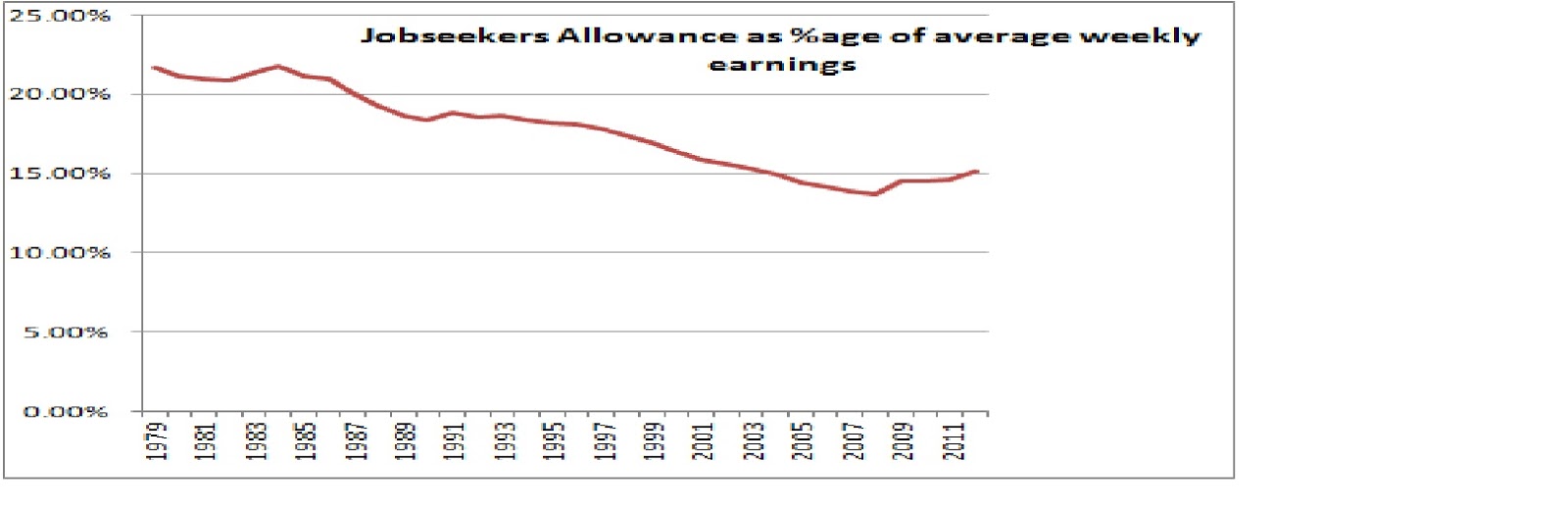
Ok, so let’s get this out of the way quickly. If this were the case then why would people ever have had any incentive to work at all? If people were penalised for working and rewarded for avoiding work, people would not work. Something doesn’t add up and we can see that the statement from the chancellor is purely wrong by comparing how the value of job seeker’s allowance has faired relative to wages over the past 30 years. Jonathan Portes does just that here. As you can see, with JSA being pegged to inflation, and earnings increasing on average significantly quicker, that JSA has steadily fallen from 22% of average earnings in 1979 to 15% today. Work is more attractive relative to JSA today than at any time in the past.

Now, those who defend the current benefit system are going to complain loudly. These vested interests always complain, with depressingly predictable outrage, about every change to a system which is failing. I want to take the argument to them. Because defending every line item of welfare spending isn’t credible in the current economic environment. Because defending benefits that trap people in poverty and penalise work is defending the indefensible. The benefit system is broken; it penalises those who try to do the right thing; and the British people badly want it fixed. We agree – and those who don’t are on the wrong side of the British public.

I think this intentionally misrepresents what those of us who oppose benefit cuts are actually saying. I am not defending every line item of welfare. I don’t even know every line item. I’m sure it is not perfect and could be improved. I do dispute though that the benefit system is a significant factor in the reason that we have high unemployment. I don’t believe the reason that we do is that people who would otherwise be working are trapped, for the reasons I gave above.

But! I have vested interests!

Well let me divest them now.

I don’t receive any benefits. I am lucky enough to have a job. I “get up in the morning and work hard” and have never felt that the welfare system penalises me for doing so. My interests are:

  • I would like to live in a society that looks after the poor and the vulnerable
  • I believe that something as important as welfare should not be reformed based on misrepresentations and lies
  • I believe that pushing the poor and vulnerable further and further into poverty is more likely to trap them there than the alternative

But I’m on the wrong side of the British public!

Well, as FiatPanda points out here – the government’s way of measuring this is to say the least, underhand, misleading and dishonest. But should we be surprised that a large section of the public believes that benefits are evil? We have a government and a right-wing press who have mounted a huge campaign to convince the public that people on benefits are lazy scroungers. You’ve probably all seen the Daily Mail today right?

We’re facing more and more competition from vast new economies like China and India. There are quite literally billions of people who are joining the world economy. That’s human progress. If we’re not careful, Britain risks being out-worked, out-competed and out-smarted by those hungry for a better life.

Oh no! Jonny Foreigner is going to take all our jobs again! Except they won’t. When developing countries become developed countries we all benefit through increased trade and more jobs are created and we are all better off. China and India’s development is a huge opportunity for us to increase exports to those markets and boost growth. Well it would be if we had a government who could understand that, rather than thinking of these countries as foreign rivals who must be beaten at all costs.

By taking hard decisions in the last few years to save money, this Government has cut that deficit by a third.

I would phrase it as. “By making bad decisions coupled with dodgy accounting sleight-of-hand we have reduced the deficit by much less than we said we would and missed yet another economic target.”

Some politicians seem to think we can just wish away Britain’s debt problem. They want to take the cowardly way out, let the debt rise and rise and just dump the costs onto our children to pay off. I don’t think that would be fair. And I don’t think we’d get away with it. The interest charges would soar. Interest rates would rocket. People with mortgages would struggle. Businesses with loans would go bust. Jobs would be lost.

Again, George is intentionally misrepresenting his critics. There are countless people who have made very strong economic arguments as to why the government’s economic policy is flawed and have described sensible alternatives. Paul Krugman, Joseph Stiglitz, Jonathan Portes, David Blanchflower, Brad de Long, Martin Wolf etc. etc. are not “wishing debt away” when they use the discipline of economics to analyse the mess the government has created.

Oh, and interest rates would not soar – I covered that here and there is absolutely no economic basis for such a claim. Until recently we were told interest rates would soar if we were to lose our AAA credit rating. What happened when we did?

…one in every six pounds of tax that working people like you pay was going on working age benefits. To put that into perspective – that’s more than we spend on our schools. That’s one reason why we’ve got such a big deficit.

No it isn’t. The Labour government was running a surplus between 1997 and 2003 with the same benefits system. The reason we have such a big deficit is because the banks caused a huge financial crisis. Still, can’t blame the rich can we? Not when the poor are such easy targets.

So our reforms have one simple principle at their heart – making sure people are better off in work than on benefits.

But they already were! Just look at the figures! A million people didn’t decide when the financial crisis hit that unemployment benefit suddenly looked good and therefore quit their jobs.

When I took this job, I discovered there were some people who got £100,000 a year in Housing Benefit.

No evidence is given for this claim. No figures to show who they were, what their circumstances were or if they even really existed. But even if we take that claim at face value, it is hardly a reason to cut benefits for every single person who receives them. This again, is a thinly-veiled attempt to demonise the poor by taking the Daily Mail line that every one of them is a rich scrounger.

Some have said it’s the end of the welfare state. That is shrill, headline-seeking nonsense. I will tell you what is true. Taxpayers don’t think the welfare state works properly anymore. When did this start to happen? When we created a system that encouraged people to stay out of work rather than find a job.

Another gross misrepresentation of the facts. As we know, the system has over time seen unemployment benefit falling further and further behind working wages. The line about taxpayers not thinking it works is just more rhetoric designed to divide the country. I am a taxpayer and I don’t believe that the system encourages people to be out of work. If it did I would have chosen to be out of work.

Our reforms are returning welfare to its most fundamental principles – always helping the most vulnerable, but giving people ladders out of poverty.

So pay the vulnerable less money and they’ll just see the error of their ways and go out and get one of those freely available jobs? If you want to help people get back to work, fix the economy so there are some jobs for them to go to. The idea that people are just choosing to be unemployed at the moment is plainly stupid. There are no jobs because of a financial crisis caused in the banking sector but George seems to think it’s “fair” that the poor and vulnerable should foot the bill.

And here’s another change we’re making. On Saturday, the top rate of tax will be reduced from 50p to 45p… In a modern global economy, where people can move anywhere in the world, we cannot have a top rate of tax that discourages people from living here, setting up businesses here, investing here, creating jobs here. If you don’t believe me, ask France. They’re planning to whack up their top rate of tax – and you know what’s happening? Job creation is down as people are leaving the country. The opposite is happening here because we are welcoming entrepreneurs and wealth creators – and the jobs they bring with them.

So let me get this right. With income tax for rich people at 50%, the rich all go and live in Monaco but with income tax at 45% lots of rich people are all moving to the UK? That sounds suspicious. Perhaps we could have some evidence to back that claim up? Err…. no.

So this all seems like smoke and mirrors for something more sinister. Fortunately George went on to explain exactly what that was.

I’m a low tax Conservative. I believe what you earn is your money, not the Government’s money. So I want to take away less of it in tax, and leave you to spend it how you wish. Give me the choice between people choosing how to spend their own money, or a politician choosing how to spend it, and I know who I would pick. That’s good for the economy. That’s good for society – the more people get to keep from what they earn, the more likely they are to work, the more independent and responsible they will be.

As much as George would have you believe it, tax is not a fundamentally bad thing. It’s true we could do away with it and just pay for everything directly but where would that leave us?

A couple of months ago there was a massive pot-hole in my road. The council came along and filled it in, (paid for by taxes). Now we could say that we won’t pay taxes to cover road maintenance and when a pot-hole opens up in my road the residents will all club together and pay to repair it….

Oh, but wait a minute, I don’t have a car – I don’t care. I’m not going to pay for it. And actually most of the traffic coming down my road probably isn’t from people that live on it anyway. I receive the tiniest share of the pain from the pot-hole in my road, so why am I going to put money towards it? But then everyone will have this attitude and the pot-hole won’t get fixed and over time my road will fall to bits without anyone doing anything about it.

At the moment the council collects my rubbish, (paid for by taxes). We can pay for it individually ourselves but I suspect a lot of people, rather than pay individually to arrange to have it transported to the local landfill are just going to go out in the middle of the night and wang it in each other’s hedges.

Or how about the armed forces, (paid for by taxes)? The next time that there is a need for a peace-keeping force to protect citizens in a third world country beset by civil war, are we all going to have a whip round and see what kind of private army we can muster?

This is, of course, all nonsensical government spin. While it is easy to make it sound good that I should get my wages and then choose how it is spent, I don’t want to spend 100 hours a day deciding on how much I should be spending on the armed forces and how much I should spend on a hole in my road. Taxes have an absolutely essential place in any society and they are not just something that we can do without.

Taxes have another important benefit though, and it is this one that I think the chancellor was hoping to curb. The overall tax system is set so that someone who is rich pays more than someone who is poor. This allows redistribution of wealth within our society. Although through taxes we all paid for the pot-hole repair, or the peace keeping mission, or the NHS, or the police, the richest amongst us did contribute more and the the poorest amongst us did contribute less.

After a big speech on why we should cut benefits for the poor and vulnerable and why we should cut income tax on the richest few, (neither of which, as we’ve seen, had any factual basis), this point is really what it came down to:

The multi-millionaire George Osborne would like to prevent redistribution of wealth from the rich to the poor.

And this man has the gall to say that I have a vested interest.

RedEaredRabbit
Economic Insanity

Earlier this week I wrote the short story, George’s Magical Mystery Tour, in which a bus driver called George refused to acknowledge the reason that his bus wouldn’t get up a hill, preferring instead to implement superficial changes to his bus in order to make it look like he was doing something.

Some of you may have spotted the subtle metaphor in my story. I was in fact making a hugely clever reference to the economy and the budget. So metaphor aside, why do I think this budget was so bad?

Let’s quickly recap the problem that we should be trying to solve. The UK is experiencing an economic depression. This means that the economy is operating significantly below potential for a sustained period without any sign of recovery.

Now you’d think that having presided over a depression that has already gone on significantly longer than the Great Depression of the 1930s this budget would be all about restoring growth. You’d think that but it wasn’t. In fact there was pretty much nothing in there at all that even attempted economic growth.

As the OBR pointed out in their budget report:

The Government has announced a number of policy measures that are expected to have a broadly neutral fiscal impact in aggregate between 2012-13 and 2017-18, with ‘giveaways’ almost exactly offsetting ‘takeaways’ over this period. Correspondingly, we also assume that they will have a broadly neutral effect on the economy, with no impact on the level of GDP at the end of the forecast horizon.

It seems incomprehensible but it really is the case. The government chose to implement a budget that would have no overall effect on economic growth.

That’s not to say it was entirely made up of bad ideas. The raising of the personal allowance to £10,000 will help out low earners and will increase economic growth because a large part of the extra cash in their pockets will be spent. It’s a very small amount though. The OBR forecast an effect on GDP of less than 0.1% and that, they pointed out, would be offset by other GDP reducing elements of the budget in any case.

Another good idea is giving tax breaks for child care. Lowering the cost of child care makes it more attractive for parents to work rather than stay at home looking after the kids themselves. However, at the moment the economy is suffering from a lack of jobs rather than a lack of people who want to work. Increasing the number of people who want to work will have a positive effect when the economy starts to recover but won’t do much to effect that recovery.

There was also a mind-numbingly bad idea in there called the Help to Buy scheme, which as Jonathan Portes from NIESR points out is nothing more than a taxpayer funded bank subsidy:

The government will offer banks a guarantee on high loan-to-value mortgages – mortgages for between 80% and 95% of property value – on existing as well as new houses, both for new borrowers and those wishing to refinance. If a borrower defaults, the first loss will fall not on the bank that made the loan, but on the taxpayer. And it is for banks to decide which of the qualifying mortgages they want to keep and which they think are sufficiently risky that they want to pass the first slice of credit risk on to taxpayers.

The economic rationale for designing a mortgage market intervention in this way is almost impossible to understand. There are well-known market failures in both the retail and wholesale markets for mortgages, so there’s plenty of scope for radical reform. But, instead of explaining what problem it is trying to solve and how, the Treasury has created yet another subsidy for banks. Worse still, the structure of the subsidy will weaken competition even further by propping up incumbent banks and perpetuating an unreconstructed housing finance market with fundamental weaknesses.

A bad economic idea from George Osborne is hardly big news these days though and although this one is particularly bad there was something far worse in the budget. Although no effort had been made in putting any sensible growth strategy in place, there was clearly a huge effort put into dodgy accounting tricks to make the deficit look smaller than it really is. Tim Harford does an excellent job of breaking that down here.

This really is the political equivalent of telling people that you’re cooking them a slap-up Sunday roast and then placing a small parsley sprig on top of some putrified road-kill. For George Osborne it is clearly the priority to put all efforts into making a failed strategy appear less of a failure than it really is, rather than diverting any effort into actually addressing the underlying problem.

Economically this is pure insanity – a budget that makes no attempt to move things in the right direction and every attempt to use every accounting fiddle to make it look like it actually is.

It’s abundantly clear that the government are now pinning all hopes on the economy just sorting itself out on its own. In spite of their policies that will happen one day but why not do something to make that day come sooner? Or more to the point, why didn’t they do it three years ago?

To be honest, after three years, I don’t know why this stuff still surprises me. Politically astute, economically insane – welcome to the UK.

RedEaredRabbit

George’s Magical Mystery Tour

One day a bus driver, we’ll call him George, was driving a bus full of people up a steep hill but unfortunately his bus had a broken engine.

George had taken on driver duties near the bottom of the hill when the fault with the engine was already in place – as George liked to point out, it had developed under the previous bus driver.

George had known about the fault from the start but had told his passengers it would go away in time if he just kept on driving. Unfortunately driving on in the same way with a busted engine had made the engine fault worse. Progress was sluggish at first but for the past two years the bus had remained static – the failing engine doing just enough to prevent the bus rolling back down the hill into oblivion but not enough to move it any further forward up the hill.

When George first took on bus driver duties many of the passengers were willing to believe his assurances that driving along with a busted engine was better than fixing it but having spent two years looking out of the windows at the same depressing scenery they had reached the point of mutiny.

And so in March 2013, George addressed his passengers:

To get this bus up the hill, we will start by washing the windows – the weight of that dirt is clearly hampering our progress. Additionally we will paint go-faster stripes on the side of the bus. We will follow this up by cutting the price of the journey for the people in the posh seats at the front, which will by magic, generate more money – money that we will use to fit a big spoiler to the back of the bus to make it look like it’s a fast bus, thereby giving you all confidence that we will get up the hill.

The passengers were not convinced.

But what about the, erm… you know, the problem with the engine?

The problem with the engine was inherited from the previous bus driver.

Ok, but you do seem to have made it worse and anyway, even if it were all the previous bus driver’s fault shouldn’t we, you know.. fix it anyway? You know… in the interest of getting up this hill?

George pretended not to hear and gunned the engine some more. It made a sickly, spluttering sound.

He pretended not to hear that too.

RedEaredRabbit

When Markets Don’t Attack

As I wrote recently, last week was going to be the real test of whether George Osborne’s policy of pursuing a AAA credit rating above all else was justified. Although he lost that rating anyway we would at least see whether, as he’d repeatedly warned us, the rate at which the government can borrow money would go through the roof as the markets lost all that “hard-won confidence”.

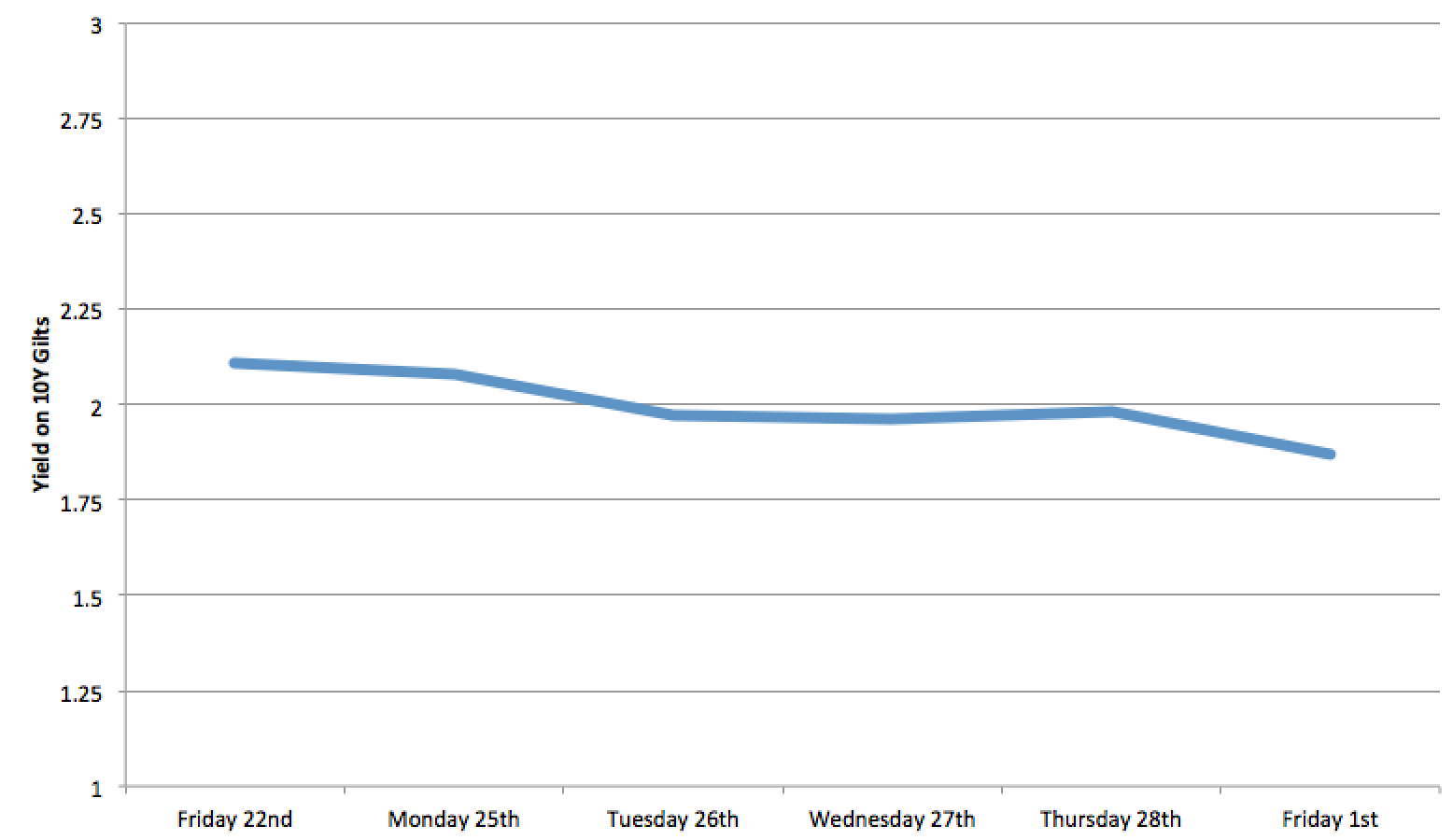
He has continually used this threat to justify austerity so it’s important to see whether or not there was any merit in his argument. So let’s see what happened to our borrowing rates last week. Make sure you have a cushion ready to hide your face, this is going to be scary:

Rates on 10Y UK Government Bonds

Rates on 10Y UK Government Bonds

It’s ok, you can put the cushion down now – nothing happened. I told it wouldn’t but how could I be so sure? Am I a soothsayer? Am I the modern day Nostradamus? No, not at all. I took the revolutionary step of applying the discipline of economics to the situation.

The government seems to believe that economics and evidence are dangerous things because they might encourage people to look for an alternative to their failed policy. The thing is though, that over the last three years economics has done a much better job of predicting these sort of things than a government who chose to ignore it. While far from perfect, economics is still the best tool we have to help guide our way back towards a healthy economy.

At the moment though we have a government who dismisses economics as if it were witchcraft and why is that? Because it’s simply more convenient than admitting that they got everything so massively wrong.

RedEaredRabbit

The Unteachable

As I wrote over the weekend, today was the day we’d find out what the markets thought of the UK’s credit rating downgrade. For the last three years George Osborne has been arguing that maintaining the UK’s AAA rating was crucial and used that as the primary reason why we should pursue austerity. Were we to lose our AAA credit rating we would be attacked by the bond vigilantes! No one would want to lend to the UK any more! Interest rates would soar ! We would be the next Greece!

Those people who understood a tiny bit about how sovereign debt works disagreed though. They said that interest rates were not low because of everyone loving the opinions of the credit rating agencies and instead offered another explanation. They said that long-term interest rates were low because the markets expected future short-term interest rates to be low. And they expected that because they expected the economy to remain weak. (Full explanation of that here.)

Throughout this debate, those people who whipped up fears of soaring interest rates in the event of a downgrade could get away with their scare-mongering because we still had a AAA credit rating. Today was the first day they couldn’t do that though so today we can put this argument to rest. If the government was right then today we should have seen a huge rise in government borrowing rates as the panicking markets attacked the UK.

So what did happen? Did the bond vigilantes attack? Did the rates at which the UK government could borrow go through the roof?

*Drum roll*

…..No.

They didn’t go through the roof. They didn’t go up at all. They actually went down a little. Five year rates went down from 0.86% to 0.83%, ten year rates went down from 2.11% to 2.08%.

So what does all of this mean? I’ll tell you and it is not good. It means that not only did the government’s economic strategy fail, it means it was based on a false pretence all along. Maintaining the AAA credit rating should never have been a priority. The priorities should always have been employment and growth.

You’d hope that with the cutting of the last thread by which the government’s economic policy was dangling, they would have come out today, apologised and agreed to listen to those people who had been telling them this all along. What did they say? Sadly they said what they always do when their economic policy explodes in their faces. That’s right – the news on the rating downgrade is even more evidence that they need to keep doing what they’re doing.

It makes me want to weep. Why not for a moment, reassess the policies that have continually got these things wrong and instead listen to the people who have continually got this stuff right? In the face of such evidence, would it really be that hard?

Sadly, it seems as though it would. A government getting things this wrong is bad enough on its own but their refusal to learn anything from it is simply staggering.

RedEaredRabbit

P.S. As of Wednesday, five year rates are down to 0.78% and 10 year rates down to 1.96%. Still no sign of those panicking markets, George.

From Triple ‘A’ to Triple Dip?

A few months ago I wrote a post, in which I talked about the real reason that the UK can borrow at such low rates. To summarise it, the main reason is that the markets expect the UK economy to remain weak for the foreseeable future and are therefore prepared to accept low long-term rates now. In that post I did also talk a bit about the UK’s AAA credit rating:

…Despite the government claims that austerity is the barrier against a downgrade, I fully expect the UK to be downgraded next year…

And sure enough, yesterday exactly that happened as Moody’s downgraded the UK from AAA to Aa1. There’s been a lot in the press about it today but what does this downgrade actually mean? Is it even important? The answer to that is both yes and no.

Let’s start with the ratings agencies themselves. Ratings agencies have consistently proven themselves to be among the least reliable sources of useful information. They played a major part in causing the financial crisis by  handing out AAA credit ratings to the dodgy packages of sub-prime mortgages that the banks were selling and then failed to spot the banks themselves were credit risks until it was too late. While it’s perfectly reasonable to want an opinion on whether or not the UK is a credit risk (it isn’t), no one with any sense is going to listen to these people. Their opinions are not important anymore.

So if that’s the case, the downgrade shouldn’t matter, right? Well not quite. For that reason it doesn’t matter but for another reason it really does.

For the past three years David Cameron and George Osborne have used the UK’s AAA credit rating to justify austerity. Maintaining this rating, we’ve been told time after time, is crucially important. Why couldn’t we postpone spending cuts until the economy had recovered? We’d lose our AAA credit rating! Why couldn’t the government follow what basic economics suggests and provide a fiscal stimulus to create an economic recovery? We’d lose our AAA credit rating!

And we were all told what would happen if we did lose that rating. No one would want to lend to the government any more. Interest rates would soar and we’d be the next Greece. Well if that does happen on Monday then perhaps there was something to what George has been saying but I don’t think it will. What I think will happen is this:

Nothing.

Our borrowing rates will not soar because, firstly no one cares what the ratings agencies think and secondly the reason that rates are low is that the outlook for the UK economy is weak. This news is hardly going to change that – borrowing rates will more likely go down than up. And when the UK economy doesn’t implode on Monday morning, people are going to wonder what the fuss of keeping the AAA credit rating was all about in the first place. They’ll emerge from their bomb-shelters and say, “Was this really what we have spent the last three years living in fear of?”

The government has kept the threat of losing the AAA credit rating hanging over the UK public like the sword of Damocles and this was no accident. By convincing us that disaster would strike if we were to lose it they have been able to push through the economic policy they wanted to use anyway. But shortly that game will be up and then it will be clear for all to see that chasing credit ratings at the expense of jobs and growth wasn’t just a strategy that dismally failed, it was a strategy that had no justification all along.

RedEaredRabbit

U-Turn

Nursey: Oh, that’s another good idea. You’re so clever today, you better be careful your foot doesn’t fall off.

Queen Elizabeth: Does that happen when  you have lots of brilliant ideas? Your foot falls off?

Nursey: It certainly does. My brother had this brilliant idea of cutting his toenails with a scythe and his foot fell off.

(From Blackadder II)

One suspects from this conversation that Nursey’s brother was a bit thick but there could be an alternative. It could be that he was a politician who had realised that his initial plan was terrible but thought it better to go ahead with than be seen to change his mind.

Yesterday Michael Gove scrapped his policy to replace GSCEs with the English Baccalaureate. “U-Turn!” cried the media. “U-Turn!” cried The Opposition. I didn’t. I saw it and thought, “A politician has admitted they got something wrong and scrapped a bad idea. I wish they’d do that more often.”

I have lots of ideas at work. Some of them turn out to be good but not all of them. Quite often I’ve overestimated the benefits that an idea would bring or underestimated the amount of work it would entail. When that’s the case I will try to adapt the idea based on my new information or I might even scrap it altogether. This is just the way things work in all walks of life outside politics.

For example, Adrian Newey is widely considered to be the greatest Formula 1 engineer of his generation. If Newey puts a new bit on one of his cars he expects it to make the car faster. If it doesn’t and it turns out that it makes the car slower he will take it off or change its shape. He won’t leave it as it is and then put lots of effort into a campaign that pretends it is making the car faster. (I’m fairly sure he wouldn’t have won nine constructer’s titles that way.)

Although that sounds obvious, we seem to have some in-built expectation that politicians must get everything right from the outset and never adapt or abandon their ideas. If they do they are “Weak” and they are “Flip-Floppers” and they are “U-Turners”. I have no love for politicians but treating them in this was leads to a very big problem because it continually makes them refuse to adapt or abandon bad ideas. Essentially we put them in a situation where the consequences of scrapping a bad idea is usually worse than just continuing with it and pretending it’s good.

Take the economy for example. I have (as you might have noticed) been fairly vocal about the government’s austerity policy. I believe that since taking power they have been pursuing the exact opposite of what was required. The initial policy though, while flawed, was not the main problem. The main problem was that for almost three years the government has refused to adapt that policy in light of a continual stream of damning evidence that has shown, time after time, that it just isn’t working.

But last week I wrote of my optimism:

One of these days, and probably sooner than you think, those people who stuck by the government when they said austerity would mean growth are going to run out of patience…when this happens the government will have no choice but to do something sensible instead.

Seems it might be sooner than I thought as well. Although the Gove story took centre stage yesterday there was another apparent change of plan as the government announced it was to borrow £2.3bn and invest it in improvement of our flood defences. This really is good news. Improving flood defences is something we need to do anyway and there is no better time to do it when there are lots of unemployed people waiting for work and when we can borrow that £2.3bn at extremely low rates.

This is exactly the kind of thing the government should be doing. Ok, this policy on its own is far too small to solve the overall problem but it does suggest that the government might have finally admitted to themselves that they need to spend in order to create growth.

Over the coming weeks and months I hope to see more policies like this and if they do materialise let’s all promise that we won’t shout, “U-Turn!” If we do that, we risk the government immediately fleeing back to austerity and back to the pretence that their initial policy is working.

And if that happens we’re going to spend the next two years as we’ve spent the last three – cutting spending, cutting the economy and cutting our toenails with a scythe.

RedEaredRabbit

Depression and Optimism

George W. Bush once famously said:

Fool me once, shame on you. Fool me… errr… twice…. errr.. umm…..

He was great, wasn’t he? I suppose the irony of that statement was that there are probably very few people in the world that you could fool more times than George W. Bush.

Just over a year ago I wrote a post called Economic Bloodletting in which I made a comparison between the government’s economic policy and the ancient medical practice of bloodletting, where doctors would try to cure an illness with a treatment that made the patient worse. Each time the patient had a a few glugs of blood removed their condition would deteriorate and in response the doctors would prescribe more bloodletting.

Fortunately our health service has moved on a lot since those days but what of the other side of that comparison? How has the government’s austerity policy served us over the twelve months since I wrote that? Do I have egg all over my face now? Have I been shown to be a scaremongering charlatan?

Let’s find out by updating the Depression Tacker!

Depression Tracker

Depression Tracker

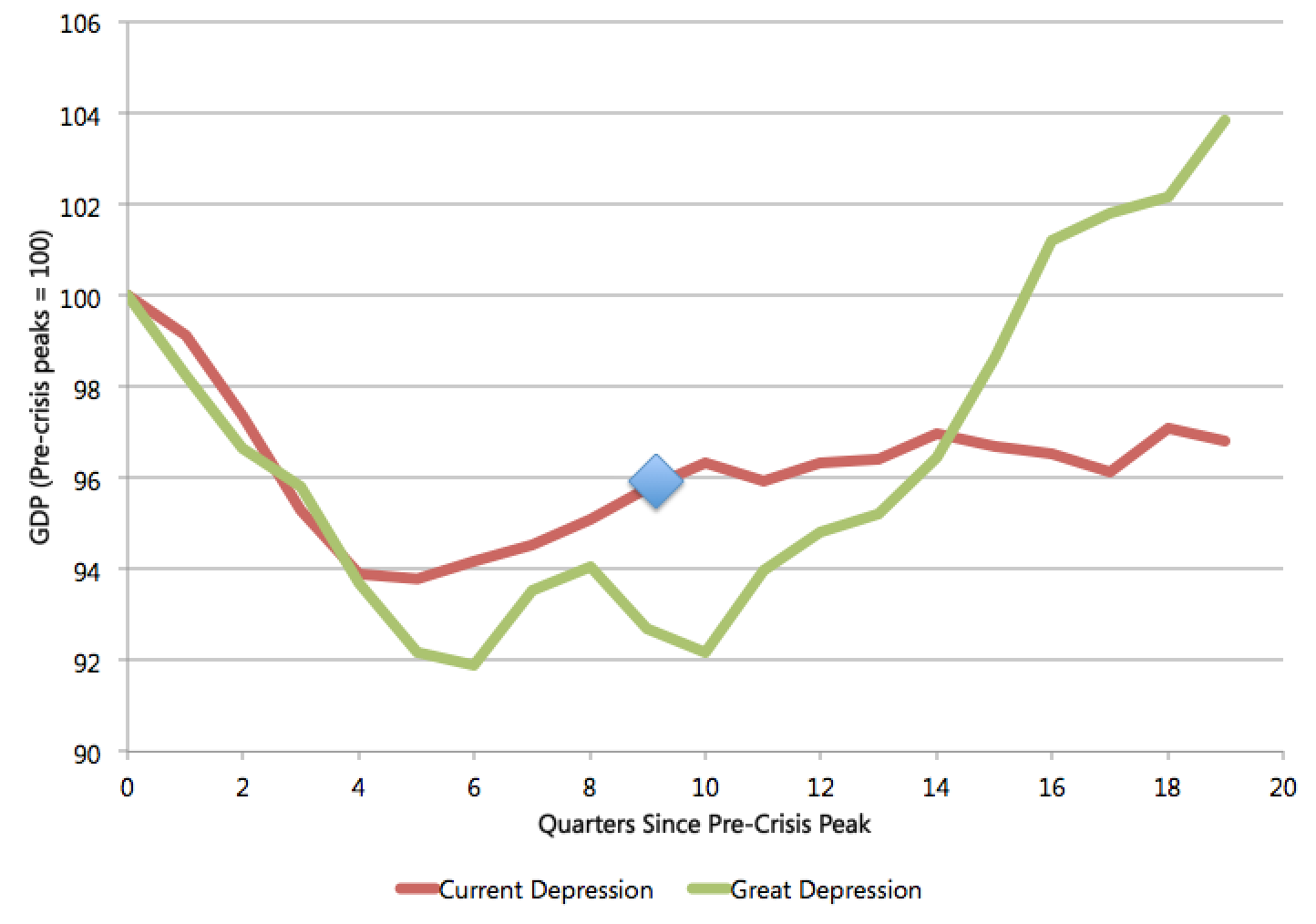
For those of your unfamiliar with the Depression Tracker – I am comparing the current UK depression with the one from the Great Depression of the 1930s (until recently the benchmark for economic catastrophes). What’s worth noting is the position of the blue diamond on the graph. That’s when David Cameron came to power. You can see that at that time, the UK economy was doing much better than the equivalent period in the Great Depression, having never sunk as far and having been in recovery for the previous 12 months. After that point you can see that the recovery ground to a halt and in comparison, the economy during the Great Depression caught us up, passed us and kept on going. Five years after the economic collapse that started the Great Depression, the UK economy had not only recovered but was 4% larger than it was before the depression started. In comparison, our economy today is still 3.2% smaller than it was five years ago.

Now that’s a pretty stark difference and it’s not like I’m comparing things with a small economic hiccup – that green line is The Great Depression.

So what did the government do back in the 1930s to achieve the recovery? Yep – government spending. The government built a load of houses, employing a huge number of otherwise unemployed workers in order to do so. With the prospect of war on the horizon they increased military spending and built tanks and guns and planes and things. What they spent money on back then is not really important to the comparison, (I’m not suggesting we start a world war to end the depression). The important thing was the government spent money and when the government spends money in a depression they will get an extremely good return on it in terms of economic growth.

Since I wrote that post on Economic Bloodletting though, our current day government has done the opposite. They have continued to maintain their belief that decreasing spending during a depression will somehow magic up lots of growth. As you can see in the Depression Tracker above that has not happened and all they have actually achieved is the setting of a new benchmark to replace the Great Depression as the darkest point in our economic history.

Last week the ONS released its quarterly report showing that the economy is shrinking again. As I’ve said before, the results of one individual quarter is not the story here. The story is the longer term picture and when we look at that we can see that our economy has basically flatlined since the current government took office almost three years ago.

If the subject matter that I am discussing were something of a trivial nature then I would now be happily strutting around and saying, “I told you so!” but this subject is anything other than trivial. This failed experiment has meant a million people sitting at home waiting for work when there were no jobs for them. It has meant businesses going bust that could have otherwise continued and thrived. It has meant hundreds of thousands of students graduating into an economy that has no use for them. When you look at it like that you can understand why I would rather have been wrong.

Yet, I said in the title of this post there was optimism too and for the first time in years I do feel some. This is why:

One of these days, and probably sooner than you think, those people who stuck by the government when they said austerity would mean growth are going to run out of patience. Nick Clegg and Boris Johnson have both made comments in the last week to say that we need more government spending to get a recovery. They didn’t seem to want to expand too much on why they had been directly opposing it until last week but I have a theory on that – rats leaving a sinking ship.

Despite weak opposition, those who previously believed that austerity would create growth will not believe it for much longer and when this happens the government will have no choice but to do something sensible instead. Every quarter since the government came to power they have expressed solemn disappointment at the latest set of weak growth figures and sagely told us that more bloodletting is needed to cure the economy. The reason I’m optimistic is simply that I can’t see that there is any way people will continue to swallow it.

Fool me once? Fool me twice? Fool me thrice?

Seriously – even George W. Bush would have worked it out by now.

RedEaredRabbit

Politics and Economics (and Pasties)

Looking back on 2012, I think it would be fair to say it was a fairly difficult year for the government’s economic credibility. No economic growth, no deficit reduction, a double-dip recession etc. There is one economic government policy however, that stands out from all of the rest and this is a blogpost about that one. Let’s begin.

At the start of 2012, the Conservatives and the Labour party were polling fairly closely but following the announcement of the government’s “Pasty Tax”, Labour shot into a massive lead, which they have held pretty consistently ever since.

If you are a regular reader of this blog, you might guess what my thoughts are on the “Pasty Tax” – yes, that’s right. In a year that the government spent creating and then stepping in huge economic cow pats, this one stood out for being… a good idea.

To see why I think it was a good idea and why it was ultimately scrapped we need to look at both the economics and the politics.

Economics

The phrase “Pasty Tax” was coined by the media to describe the closing of a tax loop-hole that meant certain foods were sometimes liable for VAT and sometimes exempt from VAT depending on the temperature at which they were stored in the shop or sold to the consumer. Under the previous policy if I had gone into a shop and bought a sausage roll, VAT would be charged as follows:

  • If I bought it cold and heated it up myself – exempt from VAT
  • If it had been cold when I went in and the staff heated it to order – exempt from VAT
  • If it had been kept warm in a cabinet under heater lights – liable for VAT
  • If it had been kept warm in a cabinet under heater lights but taken out of the cabinet when I ordered it and allowed to go cold before I bought it – exempt from VAT

I mean, seriously, whoever thought of that system? It is completely ridiculous. It is in no way unique though. In the UK VAT is charged on biscuits but not cakes – so the eternal question, “Is a Jaffa Cake a cake or a biscuit?” ended up in court. Wikipedia summarises it and links to the sources nicely:

In the United Kingdom, value added tax is payable on chocolate-covered biscuits, but not on chocolate-covered cakes.[12] McVities defended its classification of Jaffa Cakes as cakes at a VAT tribunal in 1991, against the ruling that Jaffa Cakes were biscuits due to their size and shape, and the fact that they were often eaten in place of biscuits.[13]McVities insisted that the product was a cake, and according to rumour produced a giant Jaffa Cake in court to illustrate its point.[13] After assessing the product on eleven criteria, including “texture”, “attractiveness to children” and “consistency when stale”,[14] the court found in McVities’ favour, meaning that VAT is not paid on Jaffa Cakes in the United Kingdom.[12]

Now I can understand that there are often reasons for charging more or less tax on certain products. My job means I often have to fly somewhere in an aeroplane. Aeroplane travel is damaging to the environment though so I can understand the reasons that my flights incur a high tax. When the government taxes something then people will use it less, so the higher the tax is the less inclined my company will be to send me somewhere. They might decide that, given the costs involved, we should do a video conference instead.

The examples discussed above are in no way related to giving people sensible incentives though. Although it is cheaper for me to order my sausage roll and wait for it to go cold before paying for it, exactly what incentive is this policy trying to create? I have a cold sausage roll and the government has no tax revenue. Is that the outcome that the government is trying to engineer? No, of course not. Therefore closing this loop-hole was a good economic policy.

Let’s have a quick glance at VAT on heating your house. VAT on gas and electricity is 5% rather than the standard 20% applied to most other purchases. This makes heating my house much cheaper than it would be if gas and electricity were taxed at the standard rate. Using gas and electricity though is not something that we want to encourage so why in the world would we want to give it a tax break?

Let’s move on to the next subject.

Politics

It turned out that the government’s one good economic policy of 2012 was so unpopular that they quickly reverted to economic incompetence and abolished it. The Pasty Tax was scrapped and we retained the existing bizarre set of rules and incentives. But why was this?

The answer is that, although it was economically good, it was politically bad. The media got hold of the policy and reframed it as a tax by the nasty party on pasties, which were, as we learned, the quintessential sustenance of the working classes.

Now I doubt you will ever meet anyone who spends their free time being more disillusioned with politicians than me but even I found the next chapter in this story funny. First Ed Miliband and Ed Balls rushed down to the closest Gregg’s, news teams in tow, to show how much the Labour party liked pasties:

Ed & Ed out pasty shopping

Ed & Ed out pasty shopping

I like this photo. Ed Balls has even taken off half of his jacket in order to look more working class.

Anyway. David Cameron and George Osborne then found that the only sensible political response was to show that they liked pasties even more than Ed and Ed. Cameron waxed lyrical over his last pasty – which it subsequently turned was from a shop in Leeds station that hadn’t existed for five years. Still, no better time to put things right:

I like pasties more than Ed Miliband

I like pasties more than Ed Miliband

I like pasties more than Ed Balls

I like pasties more than Ed Balls

With no clear winner, the cabinet then challenged the shadow cabinet to a pasty eating competition to decide who liked pasties the best. Labour was initially bullish but their advisors then realised that they’d be taking on Eric Pickles and it would be akin to playing the cabinet at football with Lionel Messi as Foreign Secretary.

As it was then, we never found out which party liked pasties the best and shortly afterwards the government made a U-turn on their only sensible economic policy of 2012 and renounced the Pasty Tax.

Politics & Economics

What is actually going on here is a clash between politics and economics. The two often don’t agree and when they don’t the government always favours the former over the latter. Although economically it is far better to have a sensible VAT system without odd, unexplainable loop-holes; politically it is harder to explain. Predictably the policy was dropped.

Sometimes I meet someone and when we’re discussing things they say that they studied “Politics and Economics” at university and I think, “Shit! That must have been confusing.”

I imagine them in their finals, sitting down in the morning to their economics paper and seeing the question, “Should VAT be set at the standard rate for gas and electricity?” and them having to say “Yes!” then going to their politics exam in the afternoon, seeing the same question and having to say, “No! We’d kill all our pensioners!”

And I am sure that some of you reading this will be saying that this is all well and good but if we put VAT up on heating our homes we will kill all our pensioners. Well, this is where we can use economics to trump politics. If I get more tax revenue from everyone then I can use some of it to pay more in benefits to the poor and old. I can make it so that a pensioner’s increase in income is equal to what they lose on heating their home. By doing that the pensioner doesn’t lose anything and the government still gains overall.

I am in full-time employment but at the moment I pay 5% VAT if I switch the heating on and I pay 20% VAT if buy a jumper. This is not a tax policy that encourages sensible behaviour.

Sadly we live in a society where politically good things always better economically good things. It’s not just economics though, health, eduction, the environment and everything else is subject to politics over sensible policies.

So what should we do? I would like to live in a society where the government chooses to implement sensible policies and makes a big effort to explain why they were sensible so that we have a foil to the propaganda of The Sun and The Daily Mail and politics and sensible policies became aligned to the same things.

Sadly I see little prospect of that though, so while we wait we may as well munch on a couple of Jaffa Cakes. They’re tax free after all.

RedEaredRabbit

The Great Benefit Swindle

Tomorrow MPs will debate the real-terms benefits cuts proposed by George Osborne in his Autumn statement last month. (Was it Autumn last month?) Anyway, I’ve been wondering what all of this is about and have found some quotes from the government to shed some light on things.

…Conservative methods are not just good for the strong and the successful but the best way to help the poor, and the weak, and the vulnerable. David Cameron

Oh, that’s a relief – I thought they were going to do something nasty to poor people for a moment. Oh, hold on – here are some more quotes from the government about what it’s like to live on benefits.

Don’t get a job. Sign on. Don’t even need to produce a CV when you do sign on. Get housing benefit. Get a flat. And then don’t ever get a job or you’ll lose a load of housing benefit.David Cameron

…out of work for years, playing computer games all day, living out a fantasy because he hates real life… David Cameron

…it pays not to work. That you are owed something for nothing. David Cameron

…fairness is also about being fair to the person who leaves home every morning to go out to work and sees their neighbour still asleep, living a life on benefits. George Osborne

And all of this time I’d thought it would be quite unpleasant to have to live on benefits but actually having read those things, it sounds ace! They continue:

The system we inherited was not only unaffordable. It also trapped people in poverty and encouraged irresponsibility. Those within it grow up with a series of expectations: you can have a home of your own, the state will support you whatever decisions you make, you will always be able to take out no matter what you put in. David Cameron

…there was a stronger culture of collective responsibility in this country. But as I’ve argued for years, the welfare system has helped to erode that culture. David Cameron

Time and again people were not just allowed to do the wrong thing, but were actively encouraged to do so. David Cameron

So it would seem from the government’s position that over time, working-age benefits have become more and more attractive. That the welfare system has, over time, changed people’s incentives from wanting to work to not wanting to work. The one statistic used to back this up was presented in George Osborne’s Autumn statement but has been quoted many times in the press since:

…over the last five years those on out of work benefits have seen their incomes rise twice as fast as those in work. With pay restraint in businesses and government, average earnings have risen by around 10% since 2007. Out of work benefits have gone up by around 20%.

Well, no wonder people’s incentives are moving from wanting to work to wanting to live off benefits – the benefits are going up twice as quickly right? Hmmm.

Jonathan Portes immediately spots the slight of hand George used here. Although that stat is correct George has done some quite amazing cherry picking and completely discarded the vast majority of the useful data. As Portes notes:

The value of out of work benefits relative to average earnings (and more broadly the incomes of those in work) has fallen steadily over the past three decades, until the recent slight uptick resulting from the recession:

In 1979, unemployment benefit (the predecessor to Jobseekers’ Allowance) was about 22% of average weekly earnings; today it’s about 15%, a relative decline of about a third. What’s going on? Simple: JSA has been indexed to inflation. In normal times, earnings rise faster than prices, as workers become more productive and the economy grows; this chart shows the cash value of both JSA and average weekly earnings:
So indexing benefits to prices has been far from unsustainable, or “unfair” to working people, over the last 30 years. Indeed it has resulted in a substantial reduction in spending on out of work benefits as a proportion of GDP, compared to the alternative of indexing benefits to earnings.

So take a good look at that green line compared with the red line in Portes’s second graph. Average weekly earnings have far outstripped job seeker’s allowance for the past thirty years. If we accepted the idea that people are now choosing not to work because the benefits system makes job seeker’s allowance so attractive, then how would we explain that graph? It should have been much more attractive in the past than it is today.

(Another possibility for people not working is that the economy is depressed and there are fewer job opportunities than there are people who want to work. I think that one might be worth considering before we wage war on the unemployed. The government and I disagree on a lot though.)

Now when it comes to many of the things that have gone wrong in the economy, people argue that George Osborne has been dealt a difficult hand, or that he is well-meaning but numerically incompetent. On this occasion though we can see exactly what has happened and it is just pure deception. There is absolutely no way that George wasn’t able to access to stats before 2007 – he simply ignored all of the data that didn’t back up what he wanted to do.

When we look at the true picture we see that the income of those on job seeker’s allowance has fallen further and further behind the income of those in work. I don’t doubt that there are a small number of people who exist who can’t be arsed to get a job but these are a tiny minority and to label everyone out of work in this way, especially during a depression, is really unbelievable.

The government wants to cut benefits – I understand that. If they said something like:

“We understand that job seeker’s allowance was closer to average wages in the past and understand that it has fallen further and further behind over the years. Even taking this into account though we still think that it is too high and we would like to have a debate to discuss this.”

Then at least we would be going into a debate on an honest premise. If we go into a debate based on a single statistic that was cherry-picked for the express purpose of distorting the debate and couple it with the propaganda in the quotes above, how can we really expect to get any kind of sensible outcome?

And to the politicians it might just be a debate but let’s remember what we’re actually talking about here. Banks around the world caused a financial crisis on a truly huge scale. In the UK a million working people lost their jobs. They didn’t overnight choose not to work because they were “scroungers” or because they wanted to spend their days “playing computer games”. We are talking about cutting the benefits for people who, through no fault of their own, lost their jobs and are now in dire trouble with no imminent prospects to return to the work they had.

Sometimes when I write these posts I’m despairing of the government. On other occasions I am angry with them. Today I am neither of these. Today I am just ashamed.

RedEaredRabbit