How Tony Screwed Vince

Tony Blair has a lot to answer for. I’m not talking about Iraq though – not quite that bad but I’m still talking about something pretty terrible:

I believe that Tony Blair was personally responsible for David Cameron and Nick Clegg.

I’d better explain. Blair’s annihilation of IDS and Michael Howard convinced the Conservative party that they had to fight fire with fire. Wheeling out old people with poor communication skills wasn’t working. The Lib Dems had also tried it with Sir Menzies Campbell… but not for very long.

And so it came to pass that the other parties each created a leader in Blair’s image and lo, they were shit.

One politician who was not created in Blair’s image, however, is Vince Cable. On Twitter this week I wrote this:

I do feel sorry for Vince Cable. He looks like a man who ordered steak and chips but a turd sandwich arrived and his boss made him eat it.

Worse still, after he ate it, his boss made him go on TV and say, “Yum yum.”

(I would like to take a moment to apologise for saying “turd sandwich”. I shouldn’t have said that. I should have said “turd baguette” as a turd would fit much better in a baguette.*)

I do wonder how far Nick Clegg’s approval ratings have fallen since the heady days of the party leaders’ debates in the run up to the election. He did well in those debates, not because he had better policies but because he did the best job of articulating the problems with the policies of the other two. He did such a good job that I, and I’m sure many others, thought he believed in what he was saying.

A picture of Nick Clegg before the election

A picture of Nick Clegg before the election

Just a few weeks later it became clear this could not have been further from the truth. Once Cameron dangled his mouldy carrot of power in front of Clegg’s mouth, there was no turning back. Since that day pretty much everything that Clegg preached before the election has been swept under the carpet and while I can understand the lure of power I am still, in equal measure, impressed and horrified at how easily he has forgotten everything he put into his party manifesto.

Vince on the other hand hasn’t found his turd sandwich quite so easy to stomach. I think, in fact, he would be a happier man today if the general election had resulted in a decent gain of seats for the Lib Dems but no coalition. Vince was impressive in opposition. I also think he would be impressive as Chancellor in a Lib Dem government. He is distinctly unimpressive, however, when it comes to maintaining a smile whilst implementing policies with which he doesn’t agree.

This phenomenon reached a whole new level this week though when Vince announced that he might not vote for “his own” policy on university tuition fees. “His own” policy, by the way, is to allow universities to charge tuition fees of up to £9,000 per year.

I will now take a step back. I was lucky enough to attend university shortly before tuition fees came into being. I received the maximum student grant and had a huge amount of help from my parents but it was still a colossal task to pay off the £9,000 of debt I had when I left. If I did the same today under the proposed scheme I would likely have around £40,000 of debt. I have no idea how I would pay that off.

An argument often used in favour of hiking up tuition fees is that the mean lifetime earnings of people with degrees is higher than the mean lifetime earnings of people without one. While this is true it is pitting a simplistic argument against a complex problem. For a start, if you plot earnings vs number of people earning that wage you will see a skewed distribution – i.e. there are a small number of people earning huge wages which pushes the mean up to be higher than what most people actually earn.

Additionally there are of course, careers which require higher educational training which pay well below the mean. If I were selecting a university course today I would not, as I did 14 years ago, choose the subject in which I was most interested. I would instead choose between:

  • Which subject gives me the best chance of being able to repay a debt of £40,000?
  • I am not going to go to university

Tuition fees are not right and tuition fees are not wrong. I could write a whole other post on what I think about that subject and still only skim the surface. This blog post is not about what the best policy is though – it is about Vince and I must bring it back to that subject.

My belief is that Vince is more or less a good bloke but is currently in a position of terrible inner conflict. Does he go with what he believes or does he go with what David Cameron believes? I think he is one of the most capable politicians in the current government but sadly, I have serious doubts as to whether he will be able to stick it out in his cabinet role and a resignation before the next election would not surprise me.

I don’t know the reasons why Vince Cable decided to get into politics but I suspect his current predicament wasn’t in the plan. He is caught between two Tony Blair clones when he never wanted to have anything to do with Tony Blair at all.

When the labour leadership election was going on I wanted Ed Miliband to win. Not just because he had a better understanding of the important issues than his brother did but also that David would have been a third Tony Blair chucked into the mix and I couldn’t have voted for any of them. Ed will now have the problem of trying to break the “let’s all be Blair” stranglehold on British politics but I sense that most of us are more than ready to put that behind us so maybe he might just stand a chance.

You will have noted above when I said Vince might vote against his own policy I put “his own” in quotes. I did that because although it was widely reported in the media as being his own, I actually don’t class it as his own policy at all – it’s David’s. Vince’s own policy was the one under which the Lib Dems fought the last election and it’s interesting because it is more than a little bit different. It goes like this:

We will abolish tuition fees.

Think about his position for a moment. He wanted tuition fees abolished and yet he is now expected to be the one who takes responsibility for increasing them. It’s not easy to reconcile those two policies is it?

I mean – the difference between them would cause a pretty fucking massive problem for anyone, right?

Anyone that is, except for Nick Clegg.

RedEaredRabbit

*Yes, blatantly stolen from Alan Partridge’s “infected spinal column in a bap”.

The Baroness, The Cark Park and The Smell of Burning Pants

I started this blog back in May. Prior to that, although I enjoyed reading other people’s blogs, I had never seriously considered bothering to do one myself.

Then one day, something came along which was so utterly stupid I felt like I needed to tell the world. The country’s finances were in a big mess, we were about to go through a general election and no party standing for election had told us what they were going to cut in order to sort this out.

In all of this the thing which really got my goat, the thing which frustrated me into setting up a free WordPress account and typing – actually typing, was the Conservative policy on raising the inheritance tax threshold. In the circumstances probably the most mind-numbingly stupid thing that could conceivably have been conceived.

You can read that first post here but to summarise it, the ONS had published very clear figures showing the state of the nation’s finances. The IFS had published a very clear paper showing that each of the three main parties required significant, unidentified spending cuts in order to make their sums add up and despite this, the Conservative party were advocating a tax cut which would only benefit very rich people and, in order to pursue their agenda of lower public spending would have to be funded by even more cuts elsewhere.

The IFS’s paper showed that the Conservative Party, in their manifesto, had identified a mere 17.7% of the spending cuts they would actually need to make to in order for their figures to balance. This was well known, clearly calculated and in the public domain.

Now, before I continue, I want to make something absolutely clear. I did not hack into a top secret government server to get this information. I did not take it off a laptop I found on a train, I just downloaded some reports from the websites of the two most bloody obvious places to look for it.

Fast-forward to Thursday last week and that evening’s episode of Question Time on which, representing the Conservative Party, was Baroness Warsi.

“Why didn’t you tell the public you were going to cut Child Benefit?” she was asked.

Pop Quiz, assholes. Was her answer:

  • Well, we had no idea how bad the financial mess that Labour left behind would be.
  • We didn’t want to tell anyone before the election in case they didn’t vote for us but it’s too late for that now! We won! Ha Ha!

Sadly, she went with a). This is very strange though because everyone else did know very accurately how bad the financial mess was and furthermore, I seem to recall a certain political party making it the major point of their election campaign.

If Baroness Warsi says she didn’t realise our finances were a big mess then I conclude that either:

  • She is not taking her job very seriously.
  • Her pants are on fire.

Judging by the audience’s reaction they were opting for answer b).

Later, Baroness Warsi got onto the subject of Big Society. Big Society is the coalition’s spoon full of sugar to help the cuts go down and if you don’t think too hard about it, it has a lot going for it. The idea is that the state will motivate society into taking responsibility for their own lives and get involved in building and improving the community. Such will be the Utopia that we create that no one will even remember spending cuts. It does have a fairly big down side though – no one will actually bother to do it.

Warsi was asked what the Big Society initiative would actually achieve. She recounted a charming tale of some people who had once cleaned up a car park. The next step for Big Society, she said, would be reforming our educational system, our police force and our health service.

Hmmm…..

That does seem like rather a big next step. Just because the average group of people possesses the skills to clean up a car park does not mean that the average group of people knows how to set up and run a school or a hospital. In fact, I would go as far as to say these things are in no way related.

If you didn’t see the episode and think I am misrepresenting things, I urge you to have a look at it on iPlayer. This bizarre extrapolation really was done.

When Labour came to power in 1997 they enjoyed a long “Honeymoon” period. Judging by Baroness Warsi’s performance, the coalition’s is over as quickly as it began. I actually don’t believe the government could possibly be as incompetent as you’d believe from watching her but they do seem to put her on TV a lot so their judgment at least is fairly awful.

Her claim regarding the economy, essentially ‘we didn’t know what we were getting in to’, is frankly no better than Bob Crow using the fact that tube drivers have to work underground a lot of the time as one of the reasons that they should be paid more. Call me a cynic but I’m pretty sure they knew that when they applied for the job and probably they thought the hugely inflated salary, minimal working hours and generous holiday allowance made up for it. Or maybe they really didn’t already know this when they applied for the job of tube driver on the London Underground.

In truth the state of the nation’s finances were well known by everybody. Any party seeking election knew exactly what they were taking on and as such the elected government should be able to stand behind their policies, not hide behind a lie.

The claim that these cuts weren’t expected and are just the result of not realising that our economy is weak, is frankly insulting because it is so easily shown to be false. The current government will no doubt have more, as yet, unidentified cuts ahead. If they have even the tiniest amount of respect for their electorate then they will learn to be accountable for their policies. If they think their electorate is a bunch of idiots then we have this excuse to look forward to for the next four and a half years.

This all sounds hugely depressing but I assure you – it’s not all bad. Somewhere, wherever it may be, we have a clean car park.

RedEaredRabbit

Homo Perfectus

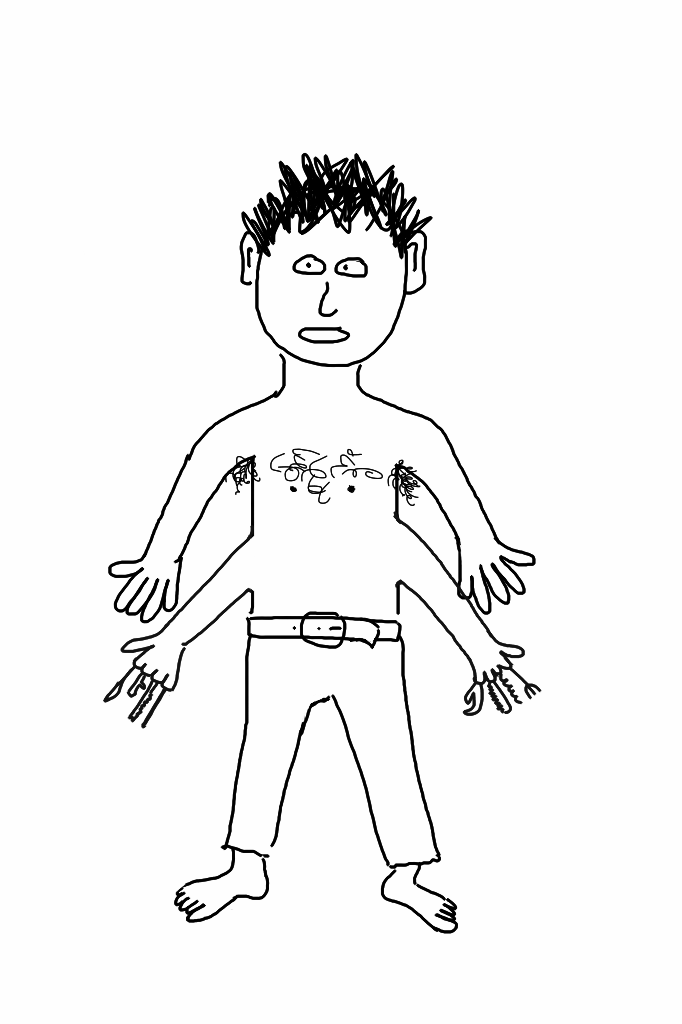
I am an atheist. I believe in evolution. Some people aren’t atheists. Some people believe in something called “intelligent design”. Well I take issue with this theory. God or no God, there is nothing remotely intelligent about human design. The design of humans is crap. Look, here comes one now.

Homo Sapien

Hardly inspiring, is it? If I were God I would have designed something far better and I will now show you exactly what. Ladies and Gentlemen, I give you Homo Perfectus. Homo Perfectus is like Homo Sapien but with the following improvements:

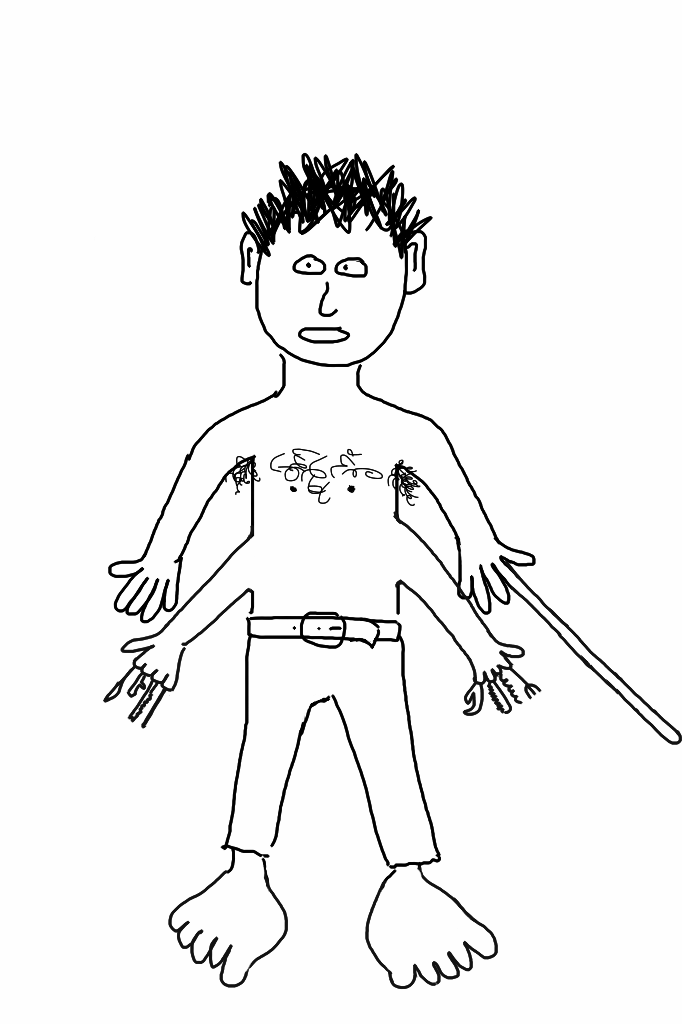
Arms

Two arms is not enough. What about all those times when you need to carry three things? Homo Perfectus has four arms. In this way he or she can carry three things and still have an arm spare for mischief and petty crime.

Extra arms for carrying three or four things

Extra arms for carrying three or four things

Hands

With four arms comes four hands. The digits on the two new hands would be utility digits – each finger would perform its own special function, like the tools on a Swiss Army knife:

Left Hand

  • Fork
  • Corkscrew
  • Saw
  • Can opener

Right Hand

  • Knife
  • Bottle Opener
  • Fish Scaler
  • Screw Driver

(NB Homo Perfectus will never actually use the fish scaler.)

Utility fingers

Utility fingers

One of Homo Sapien’s most fundamental flaws becomes apparent when wanting to push a button which is more than four inches away from the end of their arm. Homo Perfectus would therefore have a metre long index finger on the upper left hand.

Extra long finger for pushing distant buttons

Extra long finger for pushing distant buttons

Feet

Homo Perfectus would have feet three times as long and five times as wide as Homo Sapien so that he or she could walk on snow without sinking into it.

Big feet to allow easy traversing of snowy ground

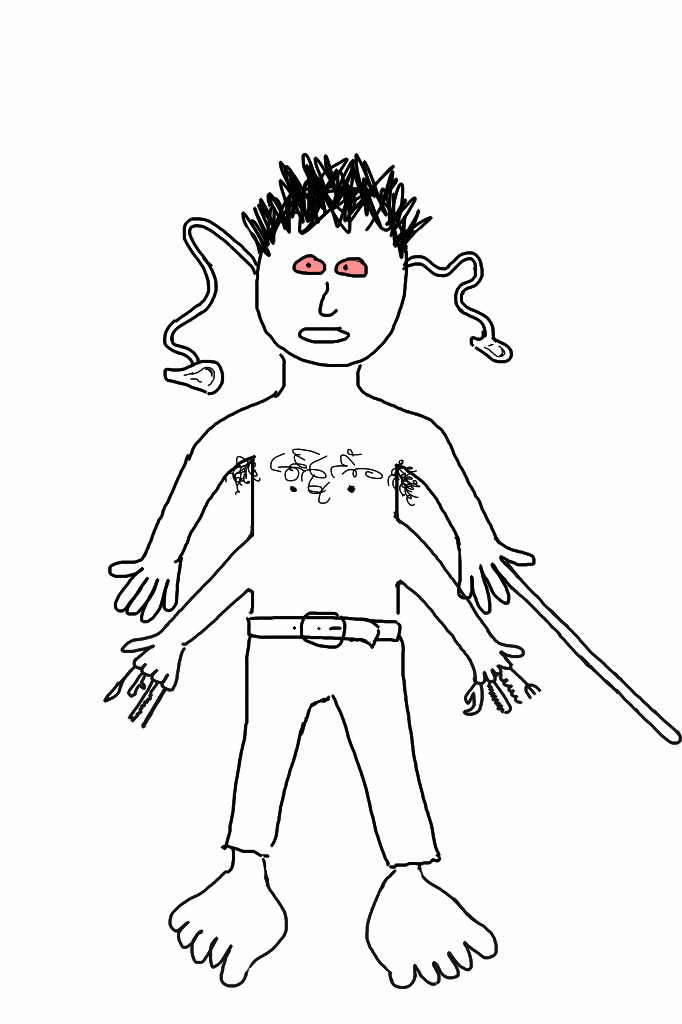
Eyes

Homo Perfectus can shoot powerful laser beams from his or her eyes and uses this ability for cooking food and shooting cats and dogs for recreational purposes.

Laser eyes for shooting cats and dogs

Laser eyes for shooting cats and dogs

Ears

Homo Sapien’s ears are useless for eavesdropping. Homo Perfectus solves this problem by having ears on the end of extendable tentracles, a bit like Mr. Tickle’s arms. The tentracles can be controlled such that if a private conversation is occurring across the room, Homo Perfectus would simply extend one or both tentracles until the ear(s) are within a few centimetres of the conversation, thus catching all the juicy details while the eavesdroppees are none the wiser.

Ears on tentracles for easy eavesdropping

Ears on tentracles for easy eavesdropping

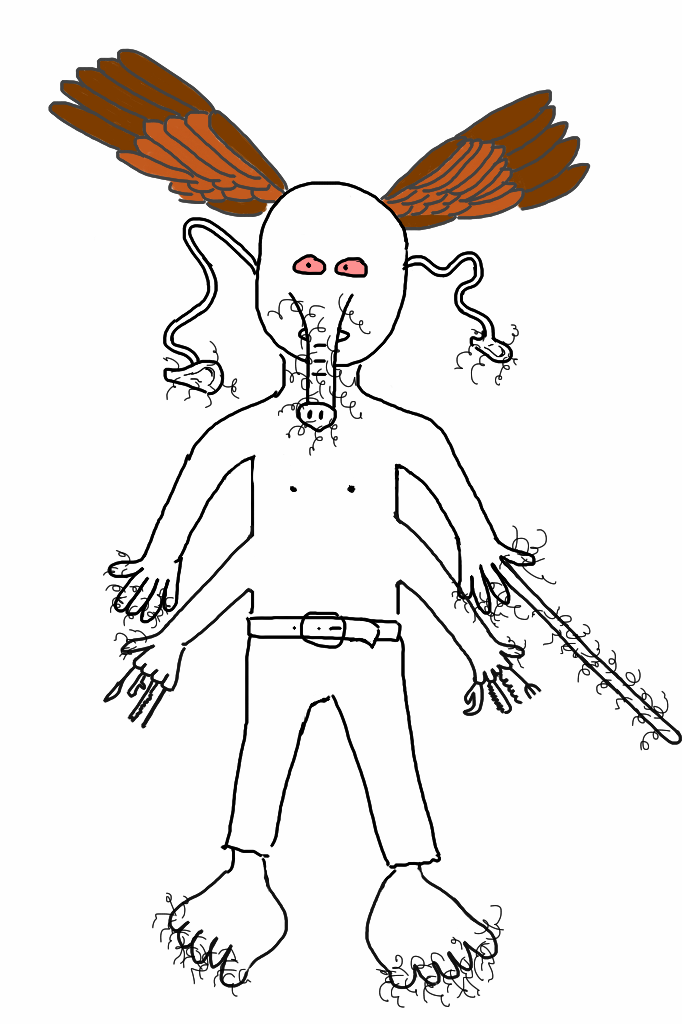
Nose

Homo Perfectus has an elephant’s nose as elephants have the best noses.

Elephants clearly have the best noses

Elephants clearly have the best noses

Hair

Homo Sapien has hair in all of the wrong places. How often do you hear one say, “Brrrr, my armpit is cold!” Never!! But Homo Sapien continually suffers with cold ears, nose, fingers and toes. Homo Perfectus has hair on all of these, but nowhere else.

Hair in all the right places

Hair in all the right places

Wings

Homo Perfectus has wings on its head, thus making aeroplanes obsolete and thereby solving global warming problems.

Homo Perfectus takes to the skies

Homo Perfectus solves global warming

Miscellaneous

Lastly, Homo Perfectus is blue so he or she is camouflaged from sharks when swimming in the sea.

Homo Perfectus

Homo Perfectus

Conclusion

This thought experiment is more important than it first seems. If Homo Sapien is the design masterpiece of the greatest intellect in the universe then how did I improve upon it with such ease? It blows the whole intelligent design theory out of the water! I have disproved intelligent design! What a moment in our existence!

Oh wait. That’s been done a billion times already.

RedEaredRabbit

P.S. If you have other suggestions for the design of Homo Perfectus, I would love to hear them.

The Poshest Meal I Ever Had

Nine years ago my girlfriend (now my wife) organised a surprise birthday party for me and what a job she did too. There were friends from work, friends from the wine shop I used to work in, friends from university and old friends from school. Getting them all into my flat that day while I was out must have been a massive logistical effort and I had to hold back the tears when I walked in and saw them all.

A few months later it was her birthday. I’d just got my first bonus at work and I wanted to give her something special in return, so I booked a table at Le Gavroche. Le Gavroche is a restaurant in London which was opened by Albert and Michel Roux in 1967 and is now run by Albert’s son, Michel Roux Jr. It was the first restaurant in the UK ever to be awarded three michelin stars and it is more than a bit posh.

I should point out that at the time I was working as a software developer in the financial sector. My job involved taking business requirements and then developing the software to make the numbers work. Dining in high society was a million miles away.

The day of the dinner arrived and in my excitement I had a look at the Le Gavroche website:

….blah blah…exceptional cuisine…..blah blah….unparalleled service….blah blah….gentlemen must wear a suit….blah blah….luxurious bogs…..

What? Oh shit. Gentlemen must wear a suit? I didn’t have a suit. It was 3pm and I was due at the restaurant in 5 hours. And I needed a suit. My exceedingly understanding boss let me leave and I departed with a plan. I’d just got my bonus – I was going to see Paul Smith.

The Paul Smith shop on Floral Street is the Aladdin’s cave of clothes. Although I clearly had no fucking clue what I was doing a friendly assistant sorted everything out for me and in an hour my transformation from scruffy computer programmer was complete. Well almost.

Me: It looks fantastic. I just need you to take up the trousers and we’re done.

Him: No problem. It will be ready in 3 days.

Me: Oh. Poo.

I explained my situation. He could have turned up his nose at the idiot in front of him who clearly didn’t belong there but he didn’t. “Don’t worry. I know a trick,” he said. He then proceeded to pin the trousers and then fasten them up on the inside with double-sided tape. “They’ll be good for tonight if you’re careful. Come back in when you can and we’ll get them done properly.”

What a legend he was. Anyway, I hurried back to my flat, got ready and made it to the restaurant only a few minutes late. We were shown in and seated in the bar where we viewed the menus over champagne and amuse-bouches. When I saw the prices, I began to sweat a little. Secretly hoping Miss Rabbit would have a sudden hankering for soup, I told her “Don’t worry about the prices, just have what you want.” “What prices?” she replied.

Her menu, it transpired, had no prices. Yep, only the gentleman’s menu had prices on it. Sexist? No, I don’t think so, at least. More a tongue-in-cheek nod to an old-fashioned tradition. I had also been handed a wine list. It was like an encyclopaedia – had I received it in other circumstances I could have spent an afternoon reading the thing. No opportunity for that but I did have time for a quick peek at the uber posh stuff though. Anyone for Chateau d’Yquem 1849? Yours for just £30,000 a bottle. I didn’t order that.

I ordered Lobster Mousse with Caviar, followed by Dover Sole with Wild Mushrooms.(This probably sounds extravagant but remember where I was – it wasn’t as though Pot Noodle with Cheesey Strings was an alternative.)

Miss Rabbit ordered Langoustines followed by Lobster although I don’t remember exactly how each was done.

We were shown in to the restaurant and seated. This place was posh. Silver cutlery, bone china crockery, crystal glasses and Andrew Lloyd-Webber on the table next to us. Seriously. He and Lady Lloyd-Webber had the duck. I did my best not to look at him while he was eating it though.

The food was mind blowing. I thought lobster mousse would be nice but it was like eating a lobster flavoured cloud. The texture was like nothing I’d had before and nothing I’ve had since. It was also the first time I’d had caviar and it was quite nice. Probably not nice enough to justify how eye-wateringly expensive it is, but quite nice nonetheless.

It wasn’t just the food though – the service was equally amazing. It was almost as if the staff existed in another dimension until you needed them for something. They would then appear from nowhere, carry out their task with unimaginable care and efficiency, then vanish once more, reappearing again only when you wanted them to do so.

Despite my formal and unfamiliar surroundings, I soon began to relax. The food was going down nicely as was the wine, and I was beginning to forget that I was essentially a fish out of water. After the main course I needed to go to the toilet so I got up and started to walk towards the bathroom. Then disaster struck.

I am not used to eating with a napkin on my lap and as I stood up it had fallen on the floor. Worse still, some of my double sided sticky tape had popped out and fastened to it. I found myself walking down the middle of the poshest restaurant I have ever visited with my napkin stuck to the bottom of my trousers.

I stopped in the middle of the restaurant, turned round and looked at Ms. Rabbit with a look of utter defeat. It had been going so well, but now I had revealed in front of the whole restaurant that there was an impostor in their midst. It was a bit like that bit in Shaun of the Dead when they all pretend to be zombies until one of them makes a mistake. I realised I was going to be torn to pieces.

But then, just as I was looking for a window to jump out, a miracle occurred. The waiters suddenly appeared from their other dimension, fixed my trousers, retrieved the napkin, folded it into a swan, set it back on the table and vanished. And no one else had even had time to look up from their ’82 Lafites to notice. (No one that is except Miss Rabbit – she notices everything.)

And above all, that was the thing that really stood out for me that day. I was a couple of years out of university, the poorest person in the restaurant by some margin and obviously not naturally comfortable in my surroundings. The staff made me feel comfortable though. They weren’t there to judge the computer programmer treading his napkin half way down the restaurant. They were there to help us have a brilliant evening and we did. Just as the assistant in Paul Smith had helped me out without judging me earlier in the day.

When I got back to the table, we both ordered the Assiette du Chef for our dessert – seven mini puddings on one plate. We accompanied that with two glasses of Chateau d’Yquem 1990 (still to this day the best wine I have ever had) and they followed it up with petit fours and then truffles.

When we went to leave, the lady who had welcomed us into the restaurant asked if we needed a taxi, then proceeded to sprint down Upper Brook to Park Lane and hail one for us.

We’ve never been back to Le Gavroche, even though we both agree it was all round the most amazing experience we’ve had in a restaurant. You see, I have this perfect memory of the place and I worry it would be somehow diluted by a repeat visit….. and yet still, I do have a dream of going back again one day.

Either way, my objective for the day had been to do something special for Miss Rabbit’s birthday and despite one or two minor hiccups on the way I had truly achieved my goal. Between suit and meal I had spent my entire bonus in one day. What was the total bill? Worth every penny.

RedEaredRabbit

Rabbit’s Card Puzzle – The Solution

Last night I posted a puzzle on my blog. If you haven’t read it then you can read it here.
There were quite a few answers submitted but it was quickly solved by my fellow Stationery Club member, Adam Creen.

The answer to the puzzle was 9. Surprsingly, playing the game with nine players means that it is probable that a pair will occur on the first go but the most common guesses were much higher, 26 or 27.

It is quite strange when you think about it. Nine people with a shuffled pack of cards each turn over the top card and it is likely that two or more people will turn over the same card.
How can it possible be so low? If you have nine packs of cards you can prove it for yourself through practical means. However, you can also solve the puzzle with some reasonably simple maths as long as you approach it in the right way.
I have posted the maths below so you don’t need to read it if you don’t want to but you don’t need to worry about the maths to know why the answer isn’t 27 as instinct suggests. I think this is what our instinct tells us:

I am playing in this game and I turn over the top card from my pack and I have the Ace of Spades.
Player 2 turns over their card and there is 1 chance in 52 that it is the Ace of Spades.
Player 3 turns over their card and there is 1 chance in 52 that it is the Ace of Spades.
Continue going until we have 27 players and adding it all up we have 27 “1 out of 52” chances so a pair is likely.

Where our instinct let’s us down is that we neglect to account for the fact that the other 26 players may have pairs with each other. In fact when 27 players are in the game there are many more chances of them having pairs with each other than there are of them having a pair with me.

While there are 26 opportunities for them to have a pair with me there are a total of 351 opportunities for pairs in total. The opportunity for the players to have pairs with each other, not just with me, is why you only need 9 players and not 27.

While I did come up with this puzzle, it is heavily based on the famous birthdays problem – if you take a group of 23 people, it is probable that two of them share a birthday. I think that is rather astonishing and a lovely example of when it may be better not to trust our instincts.

If you want to see the numbers then keep reading. Otherwise thanks for playing.

RedEaredRabbit


The Solution

It is easier to first look at the game being played out card by card and look at the probability of no pair being formed. Let’s go through it in order with 9 players:

Anna turns over her card first.

Now it is Belinda’s turn to turn over her card. Of her 52 cards there are 51 which will not result in a pair. Therefore the probability of no pair being formed is:

(51/52) = 98.08%

Now it is Cathy’s turn to turn over her card. Out of her 52 cards there are 50 which which will not result in a pair. Therefore the probability of no pair being formed after Cathy’s turn is:

(51/52) x (50/52) = 94.30%

Now it is Deborah’s turn to turn over her card. Out of her 52 cards there are 49 which which will not result in a pair. Therefore the probability of no pair being formed after Deborah’s turn is:

(51/52) x (50/52) x (49/52) = 88.86%

Now it is Erica’s turn to turn over her card. Out of her 52 cards there are 48 which which will not result in a pair. Therefore the probability of no pair being formed after Erica’s turn is:

(51/52) x (50/52) x (49/52) x (48/52) = 82.03%

Now it is Fanny’s (sorry) turn to turn over her card. Out of her 52 cards there are 47 which which will not result in a pair. Therefore the probability of no pair being formed after Fanny’s turn is:

(51/52) x (50/52) x (49/52) x (48/52) x (47/52) = 74.14%

Now it is Gertrude’s turn to turn over her card. Out of her 52 cards there are 46 which which will not result in a pair. Therefore the probability of no pair being formed after Gertrude’s turn is:

(51/52) x (50/52) x (49/52) x (48/52) x (47/52) x (46/52) = 65.59%

Now it is Harriet’s turn to turn over her card. Out of her 52 cards there are 45 which which will not result in a pair. Therefore the probability of no pair being formed after Harriet’s turn is:

(51/52) x (50/52) x (49/52) x (48/52) x (47/52) x (46/52) x (45/52) = 56.76%

Now it is Imogen’s turn to turn over her card. Out of her 52 cards there are 44 which which will not result in a pair. Therefore the probability of no pair being formed after Imogen’s turn is:

(51/52) x (50/52) x (49/52) x (48/52) x (47/52) x (46/52) x (45/52) x (44/52) = 48.03%

So after Imogen’s turn the probability of no pair occurring has dropped below 50%. Therefore the probability of a pair occurring has risen above 50%.

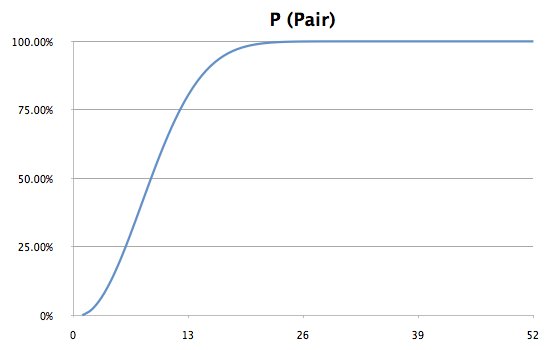
You can see how the probability of a pair increases with the number of players in the graph below. Note where the probability of a pair occurring is when you do get to 27 players – you will get a pair on the first go in about 499 out of every 500 games!

Rabbit’s Card Puzzle

Two people sit down at a table, each with a shuffled pack of standard playing cards in front of them.
They each turn over the top card and place it face up on the table. If they have the same card they shout “SNAP!”

For this to occur both number and suit must match. Four of Spades does NOT match with Four of Hearts.

The chances of this happening on the first go is 1 in 52.

Now more people want to join this fantastic game. Each time a new player joins they bring their own pack of shuffled cards.
i.e. When there are 4 players, 4 cards are turned over. If there is a pair anywhere among the 4 cards they all shout “SNAP!”

As the size of the group increases, the chances of shouting “SNAP!” increases.

At some point the group becomes so large that it is more likely than not that “SNAP!” will be shouted when they each turn their first card over.

What is the smallest number of players required to make it more likely than not that “SNAP!” will be shouted when they each turn their first card over?

I will donate £10 to the chosen charity of the person with the first correct answer.
They need a rough reason though. You can’t just guess 1,2,3,4 etc. until you get the right number.

Please put your answer in the comments on this post, not on Twitter.

Good luck!

RedEaredRabbit

And Now A Small Confession…

Last night, I published the results of my eagerly awaited jazz-sushi survey, where I attempted to find whether or not there was a correlation between liking jazz and liking sushi.

If you have not already done so you can read it here. (Feel free to skip the numbers bit if that stuff bores you.)

So I proved that a correlation existed and made it into a law and all is well. Well not quite. I should come clean about something. It didn’t really prove anything and I’ll explain why.

Firstly, (as many people pointed out), my questions asked for Yes/No answers to complex questions. There are lots of different types of jazz and usually someone doesn’t like or dislike all of them. My survey forced them to interpret the question as they saw fit. Worse, it caused people to give me long-winded answers which I had to interpret.

Why’s that worse? Well I knew what I wanted the outcome of my survey to be and while I didn’t consciously seek to influence the results in this manner, I am hardly in the best position to be a neutral judge.

Also as @mapsadaisical quickly pointed out, I had a self-selecting sample. This means people were free to choose whether to take part or not. Why is that bad? Well people knew that I was trying to find a correlation between people who liked jazz and people who liked sushi. When people know what is trying to be proven it influences whether they respond or not.

On Friday night I did my sums and found that there was a correlation but it was not significant enough to prove anything one way or the other. I explained this on Twitter and asked for some more responses. Of the next 12 responses 11 were either likes both or likes neither. This wasn’t coincidence, it was simply people wanting to help me show a correlation. Those who did like both or neither kindly though “I’ll help you out.”

Another example of this came when I was watching a morning day time TV show a few years ago. It was GMTV, or Anne & Nick or Richard & Judy or some bollocks, and they had a phone in poll. A phone in poll is even worse for this problem than Twitter because the effort of making the call is greater and they charge you money for doing so. You aren’t going to bother voting unless you have some compelling reason to do so.

The poll asked people to vote on whether or not they were currently in an abusive relationship. About 50% said yes. At no point did the programme mention that the surprisingly high result could be influenced by the fact that this poll was much more important to someone in an abusive relationship and they were therefore more compelled to vote than someone who wasn’t. In fairness to the programme they didn’t try to conclude that 50% of all relationships were abusive.

There is another problem with the way in which I gathered the stats. Even if everyone who saw the question had responded, I didn’t survey a proper cross-section of the public. Supposing I did a poll on Twitter to find out whether people thought Social Networking sites were a good thing. I would certainly get a higher proportion saying Yes than if I stopped people in the street and asked. Although there is no obvious reason for people who use Twitter to have different views on jazz/sushi to the public at large, the whole experiment was to find a correlation between two seemingly unrelated things so really I should have excluded any other similarities between the respondents.

A good example of this is in the polls which newspapers do on their online websites. If the Daily Mail asks a question about immigration on its website is the response going to reflect the views of the country at large? Probably not, because people who read the Daily Mail website are likely to have different views on immigration than the average person on the street.

You should treat with skepticism any survey that can’t show clearly how it gathered and interpreted its data to avoid external factors like this affecting the results. Companies like Ipsos MORI go to huge lengths to try to minimise these problems. I didn’t and as such you should just interpret my survey as a bit of fun.

RedEaredRabbit

The Jazz Sushi Survey

When I was just a young rabbit, I was taken, as a treat, to see the National Youth Jazz Orchestra who happened to be playing in my village. It was an epiphany and I was transfixed. Never in my life had I imagined music could be made so utterly awful. Equally shocking was that a good many people around me seemed to be enjoying it, and not just a little bit either. A ginger man a couple of seats away with his eyes closed looked for all the world like he was having an orgasm for the entire concert and for all I know he was.

Years later, I was having a pint with a mate in our local pub, The King of Toss, near Marble Arch. Above the King of Toss was a restaurant to which neither of us had paid any attention in the years since we’d been drinking there. Seemingly no one else had been paying it any attention because on that night a member of the waiting staff came into the pub with a plate of sushi, offering free samples in a bid to entice some drinkers upstairs. So I tried some. This, ladies and gentlemen, was my second epiphany. Never in my life had I imagined food could be made so utterly awful. How could it possibly have been that bad? After all, I like rice, I like fish. In fact given the same ingredients I could probably have made something quite nice. This was anything but. The rice has a texture like it had been cooked the day before, left in the pan to dry then scraped off. It was topped with little red things which seemed to have been sprayed with essence of unwashed genitalia and it was wrapped in one of those unbreakable plastic ribbons that bind up telephone directories. Bizarrely my mate liked it.

At some point in the years since, it occurred to me that I thought about jazz and sushi in pretty much the same way. Not simply in my dislike for them but in the way that I just didn’t get them. I knew plenty of people who were enjoying these pleasures and I would never be able to understand why.
I don’t like Crufts but I can understand why people like it. They get to see the most classically beautiful dogs all standing in a row. I just prefer dogs when they’re fetching sticks and eating slippers but that’s just my preference and I understand theirs.

Jazz and sushi were incomprehensible to me though and the more I thought about it, the more I wondered if these two seemingly unconnected things were in fact connected through people’s preferences. i.e. was there a correlation between people who liked jazz and people who liked sushi? Were these two things completely unrelated or was there a disproportionately high proportion of us who liked both or disliked both compared with the proportion of people who liked one or the other?

This previously unidentified correlation has been an untested theory of mine in the years since but then came Twitter and suddenly I had the perfect opportunity to test it out.

Last week I asked people two Yes/No questions:

  • Do you like jazz?
  • Do you like sushi?

And thanks to those who responded and retweeted it I ended up with 112 responses.

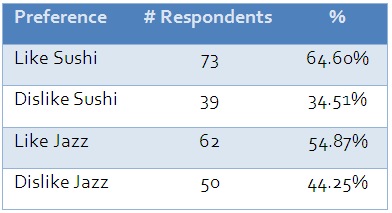
And so to the numbers. Firstly, I worked out the proportion of people who like jazz and the proportion of people who like sushi. The results were:


Using these numbers, I worked out my ‘null hypothesis’. i.e. what the results would be if there is no correlation.
i.e. of the 112 respondents, if there is no correlation between liking jazz and liking sushi then the proportion of people who like sushi and like jazz is:

112 x (64.6% x 54.87%) = 40.41 people.

The full results of this are:

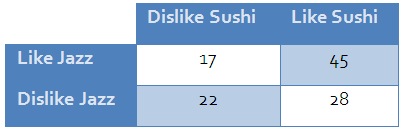
Then I compared this with what the 112 people actually said:

Interesting… there are more people in the like both and like neither than there should be if the null hypothesis is true. Sure enough when I calculated the correlation it came out at 0.17.

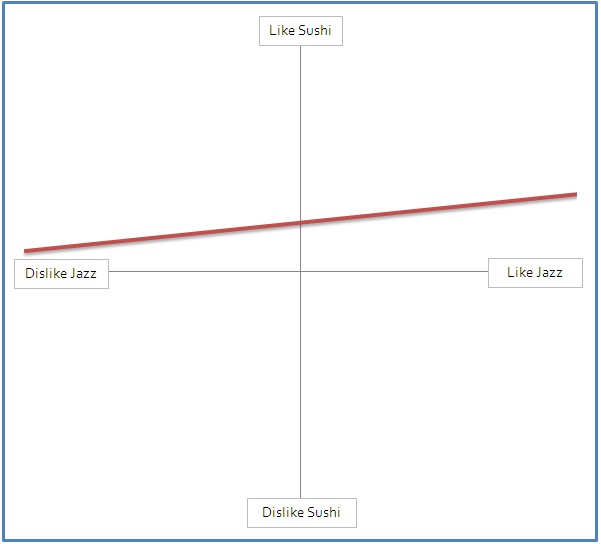
Correlation is expressed as a number between -1 and 1. A correlation of 1 means that the correlation is perfect i.e. for me to get a correlation of 1 everybody who liked sushi would have to like jazz and everybody who disliked sushi would have to dislike jazz. A correlation of -1 represents a perfect negative correlation. In my case this would have meant that everyone who liked jazz disliked sushi and everyone who disliked jazz liked sushi. A correlation of 0 would mean there was no correlation at all between the data. My correlation looked like this:

So I had a correlation and better still it was a positive one, but although my figures had a correlation could it just have been I got lucky?

To determine this I needed to work out what the probability of this happening by chance would be if the null hypothesis were true.
I decided to use a fairly standard way of testing significance – that the probability of such an outcome would have to be less than or equal to 1 in 20. i.e. if there is no correlation then results as convincing as mine could come up no more than 1 in every 20 repeats of such an experiment – a significance level of 0.05.

Therefore, if the probability of my set of results coming up is greater than 0.05 then the probability of it having happened by chance is too great, my correlation is not significant and my results are inconclusive. If the probability is less than 0.05 then the chances of this having happened by chance are negligible and my correlation is statistically significant.

Are you ready? Drum roll, please. The probability of a correlation as pronounced as mine having happened by chance is……..0.045!!

That’s right, I really did it. I really did find a correlation between liking jazz and liking sushi. The theory I have held for ages has at last been proven.

I am not going to call it RedEaredRabbit’s Law. After all it is too important to be just mine – it should belong to all of us. I am instead going to call it Cole’s Law. (Nothing to do with Cole Porter  – I’ve just always wanted to call a law that.)

At some point I’ll explain why my method of gathering the data wasn’t perfect but for now I’m just going to bask in my glory.

RedEaredRabbit

P.S. I didn’t mean to imply that jazz and sushi were awful in absolute terms. Just that I dislike them and am personally unable to appreciate them. Don’t lynch me, please.

P.P.S. Please also read the follow up post to this survey here.

When the History Grad took on the IFS…..

It was interesting to read today’s publication from the Institute for Fiscal Studies regarding their analysis of George Osborne’s emergency budget. At the budget, you may remember, George Osborne presented his policies and stated that they would proportionally impact the poor less than the rich.

I like the IFS because it is independent of any political party but is extremely well equipped to analyse their economic policies and give us a viewpoint unbiased by any political persuasions.

The IFS have spent lots of time looking at George Osborne’s policies and doing their own sums. They have included lots of things that George Osborne didn’t include in his model. Things like the cost of mortgage payments do actually affect poor people, as do cuts in housing benefits and tax credits. They have also included the years 2013 and 2014 in their analysis which were missing from George Osborne’s.

At this point, I would have liked the government to thank the IFS for their analysis, review it in detail and decide, based on this review, whether or not they should change their policies. This wasn’t what happened. Within hours, the government had given a press release stating that the IFS had missed some important things from their analysis, such as economic growth and if they had included these they would have come to a different conclusion. This is a bit odd, because the IFS have included more things in their analysis than the government did in theirs. They haven’t as far as I can see missed out anything which they government included in their model, they have just added things the government forgot to include. To my mind, this doesn’t make it a worse analysis, it makes it a better analysis.

If George is going to get into a verbal ruck with the IFS about economics, I worry his modern history degree won’t help him out much but there is a bigger concern that I have. For the government to have so quickly found a the flaw in the data presented by the IFS they would have had to take the IFS model, incorporate the things they felt had been missed and then recalculate everything on that basis. i.e. they would have to have an even better analysis already prepared and ready to go. If they have this analysis then they should publish it so the IFS, you, me and everyone else can read it and respond. I suspect this analysis has not been done and their reaction is purely a defensive one.

In an ideal world a government would form policies by gathering the available evidence, analysing it and then determining the best policy based on that analysis. Before they implemented it they would determine the way in which they would measure its success or failure and if it were not behaving as expected they’d adjust the policy accordingly. This might seem an unattainable idealism but actually we are all doing such an exercise in our every day lives all of the time.

Supposing you live in Wimbledon and you get a new job in Canary Wharf. You now have to decide how you will get all the way across town and back every day. There is nothing direct so you have lots of combinations of options. You could take buses, tubes, mainline trains or even river boats.

You start off by typing your journey into your iPhone app. It suggests that the quickest route is taking the District Line through Earl’s Court, changing at Monument and taking the DLR. You try this for a while but realise that every morning you get stuck outside Earl’s Court for 20 minutes because the people who manage the arrivals and departures there are half-witted. The model on your iPhone app didn’t take this into account so in this situation you would try a couple of the other suggested journeys a few times and after a while, based on your experience, you’d settle on the route which worked the best for you.

The government equivalent is to decide that on the first day of work, they need an emergency iPhone app journey plan. After this, no matter how inconvenient it becomes they will stick to the route they took on the first day and claim it is the best.
When newer better apps become available they accuse them of not including something their original model had never included anyway like “leaves on the line” and stick to sitting outside Earl’s Court for 20 minutes every morning, pretending they meant to do it.

No one would go in for this nonsense with their journey to work so why do politicians insist on it for something as important as the economy? The difference is this:

How much would it cost you to admit you were wrong?

Sadly we live with a political system which overly punishes this natural human trait. When the apple fell on Newton’s head his reasoning didn’t go like this:

I need an emergency gravity law. It is very important to get this out asap. Thinking it through would be an unnecessary waste of time.

…and then…

My emergency gravity law is that apples are attracted to heads, through a strange new force.

And then refuse to change his law when someone pointed out it was a bit more generic than that and in fact everything was attracted to everything else.

Of course he didn’t. Science would hardly be where it is if all scientists were to all insist that the first thing they ever thought of were the absolute truth. Politics a bit different though. For one there is the opposition. Imagine there were someone employed for the sole purpose of taking your job off you. If there were, would you want to admit you’d got something wrong? Also there is the press. Every newspaper has a political agenda, and while I think being able to learn from experience and adjust accordingly is a good trait, the press seem to call it a “U-Turn” and think it makes you a weak politician, not fit to do the job. All this gives an incentive for governing politicians to refuse to admit their mistakes and pretend the policy they first thought of was the best one.

I admit though, the comparison with Newton was harsh because politicians are under a lot more time pressure than Newton was. As important as Newton’s theory of gravity turned out to be, it wasn’t as though anyone at the time was having a terrible time directly because they didn’t have an equation to explain why they were sticking to the Earth. The new government didn’t have that luxury. When they came to power they were under immense pressure to put in place some policies to start addressing their finances – after all they had promised to do so and been elected on that basis. I don’t have a problem with them doing this, as long as they could have a process to continually review what they were doing, take on board other people’s opinions where necessary and adjust their strategy accordingly when they were wrong.

The reality is a long way from this though and the best model available to us today, from the IFS, suggests that our current economic policies are punishing the poor more than the rich. The government deny this but haven’t produced a better model to show how they can be so sure.

Would it be so bad to have a political system where a government could take constructive criticism of their policies into account and improve upon them because of it?

Wouldn’t that benefit to the country as a whole?

Would it really be so terrible of them to at least read the IFS publication with an open mind before responding?

I don’t think it would be terrible. In fact, I think they should read it. It is rather good.

RedEaredRabbit

Blame it on the Bonus?

It seems to me that politicians are very keen on blaming the recent financial crisis on the bankers who earn big bonuses.

I rather think it is a little more complicated than that but before I stray too far into why, I’ll give a basic example of why a trader may tempted to take a risk.

I recently found out that Scottish Power have overcharged me on my direct debit by so much for so long that they owe me £1,000 and have to send me a cheque. I could invest this in a savings account with a high street bank. I may get an interest rate of 1% on such a deposit, meaning in 1 year’s time I will have £1,010. The £10 I have made doesn’t really set my world on fire (especially when taking inflation into consideration I will have made a loss) but the upside is my money is safe. It is so safe that it is even guaranteed by the UK government in the event of the bank going bust.

Alternatively I could invest my £1,000 in the stock market. The stock market is much less predictable – my money in a year’s time could easily be £1,250. It could easily be £800. If things went really badly for the company I invested in it could be worth £0. In fact I have very little idea about how much it is going to be worth but returns in the stock market historically outperform returns on a bank account so I may be tempted by the risk.

This is also the reason why a trader takes risks in a bank. Simply, risky investments are more likely to yield a larger return. If there were a risky investment which had a likely lower return than a safe investment no one would bother going near it. Therefore we can say that when a trader takes a risk they think it is more likely to yield a larger reward than the safer option.

Now let’s extend this principle to Evelyn. Evelyn is an evil, heartless trader who, when she isn’t out running over old ladies in her Ferrari, has a bonus scheme which pays her according to the profit she makes for the bank. If she put all of her available funds into a safe bank account she’s going to get no bonus – anyone could have done that. In order for her to get the new Lamborghini she’s got her eye on she is going to have to take some risks.

Evelyn has taken risks with the money for the last few years and every year the risks have worked out and she has made a fortune for the bank and a fortune for herself. Until 2008. In 2008 everything didn’t work out and she lost 100 fortunes for the bank. The bank couldn’t foot the bill and the tax payer had to bail it out. Therefore Evelyn caused the financial crisis.

It was all Evelyn! Case closed, right? Wrong. Who spotted the real problem in the above paragraph?

“…and the tax payer had to bail it out.”

It may not seem immediately obvious but Evelyn hasn’t actually done anything wrong in all of this. All she has done is respond to her incentives. She knows the riskier the strategy the more chance she has of making the big bucks. The smallest her bonus can be is zero – if her strategy doesn’t come off it’s not like she has to fund the loss herself. She has simply responded to the incentives the bank gave her.

In a bank as well as the traders, they have people called risk managers. Risk managers are responsible for determining what traders are allowed to invest in and how much they are allowed to invest in it. They do lots of complicated maths and put in place policies to police the traders. If I were going to start pointing fingers at bank employees I would probably have a good look at them before the traders. I’m not though.

Recently @WH1SKS, (one of the greatest people on Twitter, follow him) said he thought that the banks didn’t seem to have really paid for their failure, although everyone else did seem to be paying for it. He was completely right.

Banks, you see, are “too big to fail.”

“Too big to fail.” It drives me nuts. Outside the financial sector you will find no one “too big to fail” and you will find no one who could possibly fail in such a big way as they have.

I work in a small company. If we made enough bad decisions we could probably make ourselves go bust. At that point we could go to the chancellor and ask for a bailout but we won’t get one because outside our staff and our clients no one gives a stuff whether we’re there or not. Our company therefore has a massive incentive not to take unnecessary risks – a bunch of risky strategies could be the end of us. A risky strategy for a bank now means either a massive profit or, if it all goes tits up, a handout to keep it going. The bank is now no different to Evelyn – in the good years make a bundle and in the bad ones know your maximum downside is you keep going anyway and someone else pays for it.

The banks could not be allowed to go bust because the impact on the global economy would have been far worse than it was to bail them out. They each had so much in the way of liabilities that them going bust would not only have taken out the finances of many individuals and companies, it would also have taken out other banks and the whole thing would have gone down like dominoes.

So what’s changed? If RBS tomorrow were to announce they were in a pickle they’d get bailed out again because the same problem is true today. If the banks were too big to fail before, it’s even worse now because due to the mergers which followed the financial crisis, they are bigger now than they were before.

All this has proved is that it is a completely unworkable system to have organisations which cannot be allowed to go bust when they make bad enough decisions. If that is the case, they have no incentive to abandon risky strategies and they will continually need to be bailed out when the strategies don’t come off.

So what’s the solution? There are several contenders. Perhaps banks should have to provide the impact of their potential bankruptcy as part of their financial reporting and auditors should have to verify they could go bust without causing financial meltdown and if they can’t prove it they would be broken up. Perhaps they just need to hold more capital? Perhaps there should be legislation forcing them to raise more money through equity rather than debt?

It’s a debate that needs to happen because it is a problem that must be solved and has not been solved. By bailing them out all we have done is put an Elastoplast over the underlying problem. There are still financial behemoths out there with incentive to take risks and nothing to guarantee it won’t result in a bailout. I don’t know the full solution, but I do know one thing:

If a bank is too big to fail – it’s too big.

RedEaredRabbit