Good News

Today David Cameron gave a strong hint that the GDP figures to be released tomorrow will be “good news”. As Jonathan Portes quickly pointed out, someone in the know even hinting at the figures before they are released is illegal. David surely knows this and it is a sign of the pressure he is under over the economy that he has blurted this out today.

When the GDP figures are bad the government says things along the lines of, “Things are worse than we thought, this is even more of a reason to pursue austerity!” And when they are good tomorrow they’ll say, “Austerity is working!” So whatever is going on they’ll say austerity is the right policy because they’re in too deep now to say anything else. But will these “good news” figures really mean a good economy?

GDP figures are always quoted relative to the previous quarter. The previous quarter was an absolute disaster so doing well in comparison to that is not necessarily good news. As I wrote three months ago:

We will almost certainly do better in Q3 – it is virtually impossible for us to repeat a quarter that bad. And when we get a recovery in Q3, the government will be saying it is advocation of their policy.

Q3 being better than Q2 isn’t that important. If the economy had been in free fall it would be important but the economy hasn’t been in free fall, it has been in depression and as I’ve mentioned on here before, the results in an individual quarter don’t tell us much at all. The important thing is not whether Q3 was better than Q2 – it is the longer-term trend, i.e. how much longer we have to wait until the economy returns to a healthy level?

Whatever the numbers are tomorrow it will certainly not represent an advocation of austerity – the expiry date on that fallacy is long passed and, in a depression longer than The Great Depression of the 1930s, it would be fairly ridiculous to claim it had worked.

The question we should be asking now is not, “When will the economy be bigger than it was in the second quarter of 2012?” A much better question would be, “When will the economy be bigger than it was at the start of 2008?”

And I promise you this much – that ain’t going to happen tomorrow.

RedEaredRabbit

Unemployment

Really quick post. I saw a lot of government ministers today giving themselves massive pats on the back because of our brilliant unemployment figures. Down 50,000 they say!

That may be the case but we need to put this into perspective. This is the graph from today’s ONS report and the bit circled in red is the bit they are all getting over-excited about:

UK unemployment (source ONS)

UK unemployment (source ONS)

While any decrease in the rate of unemployment is good, this is way too slow, especially considering that many of the extra jobs seem to be coming from people moving from previous full-time employed to now part-time employed.

It really does take an incumbent government to think that graph looks like anything other than a disaster.

I’m not going to be popping the champagne just yet.

RedEaredRabbit

It’s the Economy, Stupid.

Today I listened to David Cameron’s Conservative Party Conference speech on the wireless. Below is a transcript of what he said about the economy and (roughly) what I said back at the radio.

– – – – – – – – – – – – – – – – – – – – – – – – – – – – – – – – – – – – – – – – – – – – – – – – – – –

David Cameron: To help our people rise, then – number one – we need an economy that creates good jobs. We need businesses, of every size, in every type of industry, in every part of the country – investing and taking people on.

RedEaredRabbit: Sounds good.

DC: There are some basic things they need to do that. Low interest rates so they can afford to take out a loan. And confidence that it’s worth investing – because the customers will be there, whether at home or abroad. Getting the deficit down is essential for both.

RER: No it isn’t. Throughout the last few years when we have had a large deficit and interest rates have been the lowest in living memory. I would also argue that confidence in the economy comes from people seeing sustained economic growth and job creation, neither of which we have.

DC: That’s why our deficit reduction plan is not an alternative to a growth plan: it’s the very foundation of our growth plan.

RER: I realise it’s the foundation of your growth plan but two and a half years in it has yielded precisely no growth. That doesn’t suggest it’s a particularly good growth plan.

DC: Now I know you are asking whether the plan is working.

RER: No I’m not. I know the answer to that.

DC: And here’s the truth: the damage was worse than we thought, and it’s taking longer than we hoped…yes it’s worse than we thought, yes it’s taking longer, but we are making progress. Thanks to the grit and resolve of George Osborne, we have cut a quarter off the deficit in the past two years.

RER: I’m confused. In 2010 you said that if we didn’t cut spending the deficit would, by this time, only have reduced by 25%. You said this would be disastrously slow so you needed to cut spending to do it much faster. You’ve cut the deficit by the amount you said would be disastrous but have additionally killed the economy in the process. Is that good now?

DC: That’s helped to keep interest rates at record low levels, keeping mortgages low. Leaving more money in your pockets. Giving businesses more confidence to invest.

RER: I’ll take these one by one.

  • Interest rates are low because the economy is screwed
  • If you think people have more money in their pockets you are even more out of touch than I thought
  • Businesses are not investing. I have no idea where you got that idea from.

DC: Now, the Labour politicians who got us into the mess say they have a different way out of it. They call it Plan B and it goes like this: “We should stop worrying about deficit reduction, borrow more money and spend it to boost the economy.”

RER: Ah, those bastards are using “macroeconomics”. I think though, you’re giving them a bit too much credit by suggesting they invented it.

DC: Right now, while we’ve got a deficit, the people we’re borrowing money from believe that we’ll pay it back – because we’ve set out a tough plan to cut spending and live within our means. That’s why our interest rates are among the lowest in the world…

RER: They believe we’ll pay it back because we are a large developed economy whose debt is in its own currency. We have never been at any risk of default. See my previous point on interest rates.

DC: If we did what Labour want, and watered down our plans, the risk is that the people we borrow money from would start to question our ability and resolve to pay off our debts. Some may actually refuse to lend us that money.

RER: No they wouldn’t. People are queuing up to lend us money. In an era where banks are risky and Eurozone economies borrowed in a currency they can’t control the UK has been and will always be a safe bet.

DC: That would hurt the economy and hit people hard.

RER: So your plan is to cut out the middle-man and do this yourself?

DC: If you have a mortgage of £100,000, just a 1 per cent interest rate rise would mean an extra thousand pounds to pay each year.

RER: I don’t know if you’ve looked at mortgage rates offered by banks recently. They bear no relation at all to the rate at which the UK government can borrow.

DC: Labour’s plan to borrow more is actually a massive gamble with our economy and our future.

RER: Whereas at least with you we know we’re fucked.

DC: And it would squander the sacrifices we’ve already made.

RER: You have sacrificed jobs and growth. Wouldn’t squandering those disasters be quite good?

DC: We’re here because they spent too much and borrowed too much.

RER: No, the banks caused the crisis, it had nothing to do with government borrowing at all.

DC: How can the answer be more spending and more borrowing?

RER: Are you familiar with the book, “Economics for Dummies”?

DC: I honestly think Labour haven’t learned a single thing.

RER: As opposed to your “learning” government who has blindly pursued an economic policy that has continually delivered the opposite of what they said it would?

DC: When they were in office, their answer was always borrow more money.

RER: Actually their borrowing level in 2007 on the eve of the crisis was almost exactly the same as their borrowing level they took on in 1997 and was fairly flat throughout. The numbers are not hard to find.

DC: Now they’re out of office it’s borrow more money.

RER: Ha, those fools! Pursuing their “macroeconomics” again!

DC: I sometimes wonder if they know anything about the real economy at all.

RER: If only they could know all that you do because you’re really good at it.

DC: Did you hear what Ed Miliband said last week about taxes?

RER: No? Did he think it was the plural of taxi?

DC: He described a tax cut as the government writing people a cheque.

RER: Oh.. he got it right. That’s not nearly as funny.

DC: Ed… Let me explain to you how it works.

RER: Time to dispel the macroeconomics witchcraft.

DC: When people earn money, it’s their money. Not the government’s money: their money. Then, the government takes some of it away in tax. So, if we cut taxes, we’re not giving them money – we’re taking less of it away. OK?

RER: Ah.. you’re not giving them money, you’re taking less of it away. Got it. Ed probably hadn’t realised he could make tax-cuts for rich people sound that nice when he said it.

DC: And while we’re on that – who suffers when the wealthy businessman goes off to live in Geneva?

RER: His new neighbours?

DC: Not him – he’s paying about half the tax he would do here…

RER: Well I for one have stopped feeling sorry for the poor and the unemployed now. That rich businessman is clearly the victim. Also, did you know that women are allowed to be successful business people now?

DC: …it’s those who want to work who suffer because the jobs aren’t being created here.

RER: Oh, I see! The jobs aren’t being created here because the rich aren’t rich enough. And all the time I thought it was because of that depression you created.

DC: We promised that those with the broadest shoulders would bear the biggest burden and with us, the rich will pay a greater share of tax in every year of this Parliament than in any one of the thirteen years under Labour.

RER: Yes, but I don’t think cutting the poor’s tax burden by making them all unemployed was what they had in mind.

DC: We remember who busted our banks, who smothered our businesses

RER: Yes, the banks busted themselves, which led to an economic disaster that smothered our businesses.

DC: …who wracked up our debts, who wrecked our economy…

RER: Really glad you’re finally going to have a go at the banks.

DC: …who ruined our reputation, who risked our future…

RER: You tell those banks, David!

DC:…who did this?

RER: I seem to recall it was something to do with the banks.

DC: Labour did this.

RER: Damn. I honestly thought you were going to get something right then.

RedEaredRabbit

The Blame in Spain

As you are no doubt aware, the Eurozone is going through a bit of a tough time at the moment. While the economy in Germany has remained resilient throughout the crisis, many other Euro members have not been as lucky. Take Spain for example. Here’s how Spanish unemployment compares with German unemployment during the crisis:

Spanish and German Unemployment Rates (Source IMF)

Spanish and German Unemployment Rates (Source IMF)

Yes, it’s awful but we all know how this happened, right? The Spanish government borrowed far beyond its means during the good years, running up huge debts and when the economic crisis hit they couldn’t afford to pay it off. How do we know this? Well, Angela Merkel told us. Anyway, it’s easy enough to prove – the IMF database has everything we need. So let’s grab the data and see how terribly irresponsible Spanish government borrowing was during the good years of the Euro:

Spanish and German Debt:GDP Ratio (Source IMF)

Spanish and German Debt:GDP Ratio (Source IMF)

Oh. So if Spain was doing the precise opposite of plunging itself deeper into debt, what exactly is going on?

At the moment Spain is a deeply ill patient and Germany is her self-appointed doctor. Not only has Germany (as we’ve just seen) misdiagnosed the cause of the problem but they have also prescribed austerity as the cure.

I’ve talked before about the fallacy of attempting to solve a depression with austerity and we need not go through those details again to know why it is a fallacy. What I do want to think about though, is why Germany has been so quick to misdiagnose the cause of Spain’s problems and for four years has chosen not to look at the numbers in the graph above.

There is a theory about this but to understand it we first need to travel back in time to the 28th of June 1919.

On that day in history, Germany and The Allies marked the end of war by signing The Treaty of Versailles. The treaty, amongst other things, laid out the reparations that Germany would have to pay The Allies in compensation.

At the time that the treaty was signed the British economist John Maynard Keynes described the reparations not as a compensation but as a “deliberate impoverishment”, and went on to predict (rather chillingly) that they would lead initially to mass poverty and then on to vengeance and another war.

When the reparations began, Germany soon didn’t have enough Marks to buy the foreign currency needed to make the repayments so they printed more Marks. Each time they did this the value of the Mark decreased, so that the next time they went to the printing press, they had to print more Marks than last time. Inflation turned into hyperinflation and the value of the Mark fell off a cliff and then kept going in spectacular fashion.

At the end of The First World War, one US dollar was worth about nine Marks. By the end of 1923, one US dollar was worth 4.2 trillion Marks. Inflation was so high that prices were doubling every two days. Saving money was a pointless exercise, so people spent it as soon as it was in their hands. Workers were paid hourly so they could hand the money to their families to go out and spend immediately while they could still get something for it. If someone went to the pub intending on having a couple of beers, they would buy their two beers on entry for fear that otherwise the second would be more expensive by the time that they came to order it. To help to put this into perspective, here’s a fifty billion mark postage stamp.

A 50 Billion Mark Postage Stamp (Milliarden means Billion)

A 50 Billion Mark Postage Stamp (Milliarden means Billion)

Living through such a period is almost unimaginable for us and it is little wonder that the current generation in Germany have such an inherent fear of inflation. A leader who would even give a hint of allowing some of it would immediately become deeply unpopular.

So how, you may ask, does this have any bearing at all on the current crisis in the Eurozone? Sadly, the solution that is needed, inconvenient as it may be, is German inflation.

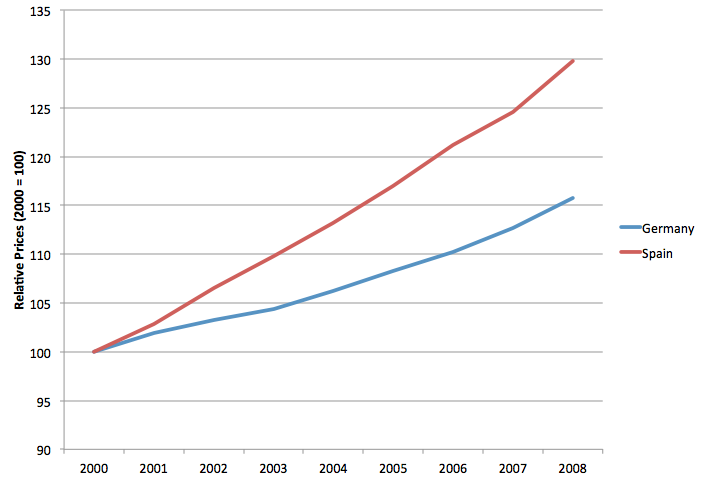
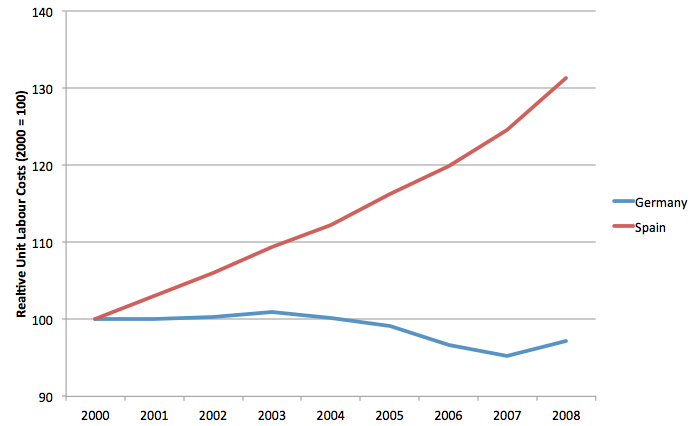
During the good years of the Euro, Spain’s economy did well. Adoption of the single currency led to huge capital inflows from German banks to Spanish banks. The German banks’ perceived risk of lending lots to Spanish banks (and the Spanish banks’ perceived risk of borrowing lots from German banks) reduced significantly (and erroneously) once they were all using the same currency. The German banks thought that since they were both on the same currency now, lending to Spain was like lending to Germany. The Spanish banks eagerly accepted the German loans and invested them in the Spanish housing bubble (they didn’t call it a bubble at the time). As more and more money passed from Germany to Spain the bubble grew, Spanish wages increased and Spanish prices increased.

This is how relative Spanish and German prices changed throughout this period:

German and Spanish Price Inflation (Source IMF)

German and Spanish Price Inflation (Source IMF)

And this is how relative Spanish and German labour costs changed throughout this period:

German and Spanish Unit Labour Costs (Source OECD)

German and Spanish Unit Labour Costs (Source OECD)

As you can see, during this time the cost of Spanish workers became much higher relative to their trading partners in the north. When the financial crisis hit and demand dropped off, this left Spain with a deeply uncompetitive economy. Production of goods and services for export to Germany, France and other economies in the north is simply too expensive now.

This is the primary problem that needs to be solved in order for Spain to recover and you might note, it has nothing to do with government spending.

So now we understand the problem, what’s the solution? Well, one solution would be Spanish deflation but deflating your way to competitiveness is extremely difficult because it means everyone taking pay cuts and people don’t really like taking pay cuts. The Spanish government could start by cutting the wages of all public sector employees (and deal with the riots) but how do you convince the private sector to do the same? Also, Spanish deflation effectively increases their debt burden*, which means it’s pretty unworkable in any case.

There is another option – inflation in Spain (and Italy, Portugal, Ireland**) that is low relative to the Eurozone as a whole. The Eurozone economy is dominated by Germany so essentially this means German inflation. We’re not in any way talking hyperinflation but something like inflation of 1% in Spain and say 5% or 6% in Germany would start moving things back toward competitiveness.

With the horrors of 1920s hyperinflation still ingrained in German minds, Angela Merkel will have no easy task in pushing such a policy through and her current policy of blaming the problem on Spanish government spending in the good years and prescribing austerity as the cure has certainly helped to maintain her popularity with German voters.

Sadly though, Angela Merkel being popular won’t be enough to save the Euro.

RedEaredRabbit

*Although Spain’s debt wasn’t high during the good years it is high now due to their economy collapsing. It’s important to understand the the high debt was caused by the crisis rather than the other way around.

** You might have noticed I didn’t mention Greece. They actually did borrow beyond their means for a sustained period and relative deflation is not sufficient to save them. From what I can see they are pretty much done for.

Taking the Hard Road

I was thinking the other day that GCSEs aside, the past couple of months have been quite good for the government. They have not introduced any new stupid policies, nor have they been forced to scrap any existing ones. Compared with the year they have had this seemed quite promising. Then I remembered that they had been on summer holidays for six weeks.

Anyway, today, with the holiday coming to an end, it was time for David Cameron to reappear with another broken light bulb taped to his forehead. The new policy is planning deregulation which will make it easier to build houses in rural areas such as the Green Belt area around London. This, in his own words, is the problem he is trying to solve:

A familiar cry goes up, “Yes we want more housing; but no to every development – and not in my back yard.” The nations we’re competing against don’t stand for this kind of paralysis and neither must we.

The construction sector, according to Cameron, is paralysed due to a lack of places to build houses.

There is no doubt that the construction sector, along with the rest of the economy, is depressed but once again, the government is failing to understand the problem. Example time.

Imagine that Susan runs a shop that sells television sets. Susan opened her business in 2003 and her business grew nicely for four years. In 2007 she tried to get planning approval to double the size of the shop by building an extension on the park next to her. Demand was high for her televisions and by expanding she could sell even more televisions. Her application was rejected though and she had to make do with the floor space she had.

Then in 2008 the economic downturn happened and her sales dropped off a cliff. All thoughts of expanding the business disappeared and instead she had to downsize, making two of her staff redundant and cutting the number of televisions she held in stock.

Then in 2012 the council comes back to her:

Council: About that planning application you filed in 2007 – the rules have changed and you can expand your shop now!

Susan: No thanks. Things aren’t too good with my business right now.

Council: You’d be helping the construction sector.

Susan: <click>

Council: ….Hello? ….Hello?

In a depression, the problem Susan has isn’t that she doesn’t have enough shop space, it is that people are not buying televisions. Increasing the number of televisions she has in her shop won’t help if she can’t sell the few she already has. Similarly, the problem that the construction sector has is the number of people who want to have houses or extensions built has also dropped off a cliff. When people don’t want to pay for new houses or new extensions, there is no benefit in making more land available to build on – the construction industry will only build more houses when they can see there is a demand for them.

Cameron’s policy demonstrates that he either doesn’t understand the relationship between supply and demand or he believes that the construction sector suddenly fell off a cliff in 2008 because they ran out of land to build on and it happened at the same time that the rest of the economy fell off a cliff by coincidence.

I’ve talked a lot on here in the past about how to solve the problem with demand and it’s really not that complicated. But as Cameron boldly pointed out in his article:

At every turn we are taking the hard road over the easy path

Yes David, we certainly are.

The Voice of a Siren

Do you remember Going for Gold with Henry Kelly? No? Come on, did you never have a school-day off sick in the early 90’s? In case you haven’t watched it, someone has helpfully posted a whole episode on YouTube:

If you don’t want to watch all of it (and I recommend you don’t) – at least watch the opening titles. Probably the worst TV theme song that’s ever been made.

So now we’ve reminisced, we’re going to have a quick quiz now, in the format of Going for Gold. Fingers on buzzers.

WHAT AM I? I am a chronic condition of subnormal activity for a considerable period without any marked tendency either towards recovery or towards collapse.”

; Only Fools and Horses Christmas Specials?

Incorrect. Knut, you’re out of the rest of the round.

; Steve Martin?

Incorrect. Bjorn, you’re out of the rest of the round.

; An economic depression?

Correct! RedEaredRabbit, you’re through to today’s final!

#Win

The definition wasn’t really Henry Kelly’s. It was that of John Maynard Keynes and he wrote it in 1936. Although written 72 years ago, you could easily mistake it for something written yesterday describing the current state of the UK economy. We haven’t imploded but there’s no growth and the economy continues to operate below potential, with lots of workers available to work but a lack of demand for their services.

A common misconception is that a depression is just a long recession – i.e. the economy has to shrink quarter on quarter for a long time. A much better way of thinking about it is that, following a recession, the economy operates below potential for a long time. So what do I mean by ‘below potential’?

I mean that at the moment our economy:

  • Is much smaller than it used to be
  • Has the potential to a produce a lot more goods and services than it does
  • Does not produce more goods and services because we choose not to produce them

That sounds crazy. If we can produce them then we should, right?

The economy is largely based on supply and demand. At the moment we are all good to go on the supply side but we are have a major problem on the demand side and this is very important in understanding why we are in depression and also important in understanding what we should do about it.

I can explain this a bit better with some examples.

The car manufacturer is producing fewer cars because fewer people want to buy cars. She could easily employ more people and produce more cars but as long as the demand for them is low she won’t do it. Her costs would go up and her revenue would stay the same. She is waiting for the economy to recover before producing more cars.

The garden centre owner is growing fewer plants because fewer people want to buy plants. She could easily employ more people and grow more plants but as long as the demand for them is low she won’t do it. Her costs would go up and her revenue would stay the same. She is waiting for the economy to recover before growing more plants.

The car manufacturer and the garden centre owner can easily ramp up their operations because taking on new employees is easy – their are lots of people who need jobs. They don’t though because demand for their products is low.

The people who don’t get jobs because the car manufacturer isn’t taking on staff don’t buy new plants from the garden centre. The people who don’t get jobs because the garden centre isn’t taking on new staff don’t buy cars from the car manufacturer.

You can see how the whole thing is self-perpetuating. Remember, my spending is your income and your spending is my income. At the moment I am awaiting for you to spend before I can spend and you are waiting for me to spend before you can spend.

We just looked at two examples but this is the case across the whole economy. The demand for goods and services is low, therefore spending is low, therefore income is low, therefore the demand for goods and services is low.

While everyone waits for everyone else we have economic deadlock and the economy is depressed. We need to appreciate this problem in order to know what to do about it.

Suppose that the government took a look at our school buildings and admitted that they probably need investment. Workers are easy to come by when unemployment is high, so they have no trouble in finding available resources to work for the next few years repairing, rebuilding and redecorating old classrooms, school halls and gymnasiums. The newly employed workers have cash in their pockets and so they start to buy other things like plants for their gardens. The garden centre take on more staff and now there are even more people with cash in their pockets. They start to buy cars and so on.

That’s how government spending solves the problem. The government could spend on pretty much anything to solve the problem with demand but it makes a lot of sense to spend it on things like schools and renewable energy because that is money we need to spend soon anyway. We can wait another five years to do it or do it now but we spend pretty much the same amount of money either way.

Not everyone agrees with this solution though. The UK government for example, believes that if they cut spending, rather than increase it, everyone will become more ‘confident’ and they’ll then start spending. How this works is a bit of a mystery but we are continually assured that it does work. Somehow.

So how’s that policy going? The latest figures are out so without further ado… let’s update The Depression Tracker!

(The blue line is the Great Depression of the 1930s and the red line is the current depression.)

Depression tracker

Damn, that doesn’t look very good. Here’s George Osborne’s reaction:

You will hear those arguing that we should abandon our plan and spend and borrow our way out of debt…these are the siren voices luring Britain onto the rock. We won’t go there.

George had clearly been working on that metaphor. Probably for most of the three months since he had to explain the last set of figures.

Here’s David Cameron’s reaction:

My message today is clear and unequivocal. Be in no doubt: we will go on and finish the job.

Finish it? Starting it would be nice. The economy is smaller now than when he took office.

The confidence argument is great for soundbites but do any of its proponents actually bother to look at the data? Do they actually look at figures like those in the graph above and think, “Hold on a moment, if my argument was a good one, that graph would not look like that.”

Not only is it not backed up by evidence, the logic of the theory seems extremely shaky. From where exactly is the car manufacturer suddenly going to gain the confidence to start employing people and building more cars? I can understand a person gaining confidence from seeing sustained economic growth but no one is going to look at that graph, see what the government has done to the economy, get all confident and then go on a massive manufacturing bender.

Referring to people as “sirens” for making a logical, evidence-based argument as opposed to an illogical, fantasy-based one demonstrates the heart of the problem. A problem that started as an economical one is now purely political, and it is two-fold.

  • We have a government whose base political beliefs are centred around a small public sector, so they will try to bring this in irrespective of the economic situation.
  • We have a government who have so publicly trumpeted the economic growth that austerity would bring that they simply cannot go back on it now without committing political suicide.

Remember, the depression definition though. Despite the 0.7% contraction in Q2 we are not falling off a cliff. We will almost certainly do better in Q3 – it is virtually impossible for us to repeat a quarter that bad. And when we get a recovery in Q3, the government will be saying it is advocation of their policy.

It won’t be though. The underlying problems will remain and while we wait around for those problems to be solved by ‘confidence’, our economy will continue to flat-line, and millions of people who want to work will be forced, because of those two political problems, to sit at home, waiting for the demand to return to our economy.

And how long will that take? Well, we know from our economics textbooks that long-term output is determined by the supply side. That is, as long as the depression isn’t so bad that we lose our ability to make things, we will eventually recover anyway but we also know that we have all of the tools available to fix the problem with demand right now, so why not do it? After all, as John Maynard Keynes said, in the long run we are all dead.

With this government though, sitting around waiting for the long-run to sort things out is all the help our unemployed are going to get.

Where’s Going for Gold when you need it?

RedEaredRabbit

The Least Blunt Instrument

I am often accused of being overly critical of the government. I am certainly critical and whether I am overly so depends to some extent on your personal perspective. I should be clear though, that I do think they have been unfortunate to be in power at such a difficult time. If you compare their predicament with those of many previous governments you would have to concede that they didn’t have much luck with the hand they were dealt.

In normal times, the UK has been shown to have a remarkably robust economy, able to deal with a huge amount of bad governing and still somehow manage to achieve growth. These aren’t normal times though and unfortunately for the current government they came to power at a time when the usual robustness of the UK economy could not be relied upon to deliver growth in the short-term. When Labour came to power in 1997, they would have had to implement something fairly ludicrous to avoid economic growth over the next couple of years. Cameron’s government was not so lucky – the choices they would have to make would decide whether, with natural robustness absent, the UK would recover or stagnate.

Anyway, this week the IMF warned that the UK economy was still all busted up and the government should start to think about a Plan B to encourage some growth. Well hoorah for that.

As I mentioned, the government has a tricky economic problem to solve and unfortunately only has four fairly blunt instruments trying to do it. Those four blunt instruments are:

Monetary Policies:

  • Cutting interest rates
  • Increasing the money supply (also, more confusingly, called “quantitative easing”)

Fiscal Policies:

  • Cutting taxes
  • Increasing government spending

With that usual robustness gone, I am very strongly in favour of some action to stimulate the economy. My favourite of the above is to increase government spending but as an alternative, the IMF suggested all three of the others. I suppose they might be reluctant to promote my favourite, having, at the start of the mess, advocated spending cuts to promote growth (oops!), but let’s look at how the other three compare.

Cutting Interest Rates
Cutting interest rates makes borrowing cheaper. If the private sector can borrow more cheaply then they are more likely to do so, thereby financing business expansion and job creation. We do have a problem though.

UK interest rates have been at 0.5% for three years. We could cut them a tiny bit more but we’re already so close to zero, there’s little room to make any real difference.

Despite the current low rate from The Bank of England, the banks themselves have not passed low borrowing rates on to the private sector. I logged onto my Internet banking the other day and saw an advert for me to take out a loan at 7.9% APR. I’m fairly sure I saw the same advert when interest rates were 4%. Banks simply don’t want to lend cheaply at the moment. Due to the economic climate they see people and companies as risky. And in fairness why shouldn’t they? The last time they lent to risky people their lending led to a global financial crisis. Banks are not going to start lending before the economy has recovered. Interest rate cuts won’t solve the problem.

Increasing the Money Supply
The Bank of England can print some money (they have the keys to the money printer). When they create money they can use it to buy bonds and other long term assets from the banks. By doing this they replace those bonds with cash that is free to lend. This blunt instrument has the same problem as the previous one though. It still requires the banks to actually lend to someone. If a bank thought it had a liquidity problem it would sell some bonds to the Bank of England and keep the cash. Its liquidity problem has been solved but no more money has actually been lent.

Don’t misunderstand me, low interest rates and an increase in the money supply have made things better than they would have been otherwise but while banks don’t want to lend, these measures are not enough to solve the problem.

Tax Cuts
Cutting taxes can stimulate the economy because people have more money to spend and in the economy your spending is my income. More spending means more income, more jobs and more growth.

This is ok as an idea as long as the tax cuts actually lead to more spending. So why might they not?

We could aim tax cuts at rich people but rich people already have plenty of money to finance their lifestyles so most of the extra money would simply go into their savings. Your spending is my income; your savings are not. Or at least they aren’t going to be any time soon. This is an inefficient way to try to make a short term stimulus to the economy.

We could aim tax cuts at the middle classes. This would be a bit better as they would spend more of it than the rich people. However, the middle classes at the moment, despite low interest rates, are firmly in save mode. Because the depression has no end in sight, middle income people are still worried about their jobs and many are probably regretting how little they squirrelled away in the good times. It’s more efficient to give them tax cuts than the rich but a lot of the extra money will still be saved. It’s still not that efficient.

So who’s left? Yes, the poor. If we cut taxes on the poor, much more of the money will be spent. Poor people for obvious reasons, save a much lower proportion of their income. If the government puts extra money in their pockets through tax cuts they will spend it.

So tax cuts can be good if they are focused in the right places.

Now that I’ve looked at the first three blunt instruments, I’ll talk about the other one – the one I like the best.

Increasing Government Spending
Let me start by making it clear that I am not such a lefty that I think all spending should always come from the government. I would love it if we had a private sector that was rapidly expanding and eating up all of the job applications from the unemployed.

I think even the austerity fans can probably admit this is not a fair reflection of reality though. So if the private sector doesn’t want to spend on something then the government can do so instead and as long as the public sector isn’t treading on private sector toes then every pound spent is a pound that would otherwise not have been spent and the economy has a very efficient boost. You might say that this logic makes it a policy that only works when we have high unemployment. Yep, it would be a terrible policy to pursue if employment was high and government spending were competing with the private sector. We’re a long way away from that situation at the moment though.

Like tax cuts, government spending needs to be carefully focused. If we choose this option we should spend the money on infrastructure improvements, renewable energy, school buildings etc. These are things we need to spend money on anyway. Far from being an excuse not to do these things, the depressed economy should be seen as an opportunity. The government can, at the moment, spend without any competition with the private sector and can later reduce its spending once the private sector is ready to run. This policy is, I think, efficient.

So in summary, cut taxes for poor people and increase government spending. Yes, I know I sound like a terrible lefty for proposing that but I hope you see that I have taken time to explain why I think those policies have the best chance of ending the depression. If you think that the other options are better I would love to hear from you.

If, like the government, you feel that any kind of stimulus is a bad idea then that’s also ok. But bear in mind – no stimulus = no growth for a long time. It’s that simple.

RedEaredRabbit

Lies, Damned Lies and Austerity

Today David Cameron once again reiterated his intention to continue down the path of austerity in order to sort out the UK’s economy. David does this a lot and continually comes back to his belief that government spending caused the mess and that only a severe reduction in government spending can restore economic growth. As you probably know, in contrast to David, I am in favour of an economic stimulus.

When I write about that on here I often receive comments along the lines of David’s – that government spending caused the mess in the first place and more of it would just cause an even bigger mess. I have perhaps not addressed this directly in the past so, hold on to your hats, I will do so now.

First of all saying that the cause of the mess was purely the previous government’s spending is at best an extremely simplified view. There were many factors that combined to cause the financial crisis. People who say it was caused by government spending are conveniently forgetting what the banks were up to. That’s another story though and I do need to address the misconceptions about government spending. I am going to try to explain why I think spending is sometimes a good idea and sometimes a bad idea and why at the moment I think it is a very good idea indeed. So here goes…

Over time the economy swings between periods of growth and periods of contraction. Governments (despite often making claims to the contrary) have never been able to stop this happening and perhaps this shouldn’t be too much of a surprise. After all, a government has only simple tools at its disposal and economies are complicated things in which bad things have a habit of finding ways to happen.

Although we should accept that there will always be good and bad periods in the economy we should also appreciate that the government is certainly not powerless to help out. A government can use some of its simple tools to reduce the impact and duration of the bad times when they arrive and bring back the good times as soon as possible.

One of these tools is government spending and to see how this can help we need to first take a look at the private sector. Companies in the private sector have important short-term financial goals. They generally seek to make a profit every year and additionally have certain cash flow considerations (e.g. they need to be able to pay salaries, buy stock, pay rent etc). So if their revenue drops off, they may well look to reduce their spending in line with it. If their revenue increases, they may well look to increase their spending accordingly. For example, if a company is doing badly they may reduce their costs by making redundancies and if a company is doing well they may take on more staff. Simple enough. Let’s look at what happens in economic cycles.

In periods of strong economic growth, lots of companies do well and expand and take on staff. In periods of economic contraction, lots of companies do badly and lots of people lose their jobs.

This means that private sector spending closely follows how well the economy is doing as a whole – when the economy is doing well, private sector spending increases and when the economy is doing badly, private sector spending decreases. These spending swings in the private sector actually amplify the effect of the economic cycle. i.e. the redundancies they make during weak economic times weaken the economy further because unemployed people stop having money to spend and rely on benefits and in weak economic times they cannot easily find new employment.

One way the government (or actually the Bank of England since it is now independent) can influence this is through changes in interest rates. By lowering interest rates, it becomes cheaper for companies to borrow money and therefor encourages them to spend.

There is a problem with this approach though as you can only cut interest rates so far. Once they are down to almost zero (as they have been in the UK for over three years) then there is no way to stimulate the economy by cutting them further.

Another way the government can influence things is by spending money. When spending in the private sector dries up the government can step in and fill the gap. Governments of developed economies (who borrow in their own currency) can borrow very large sums over very long periods of time and don’t have to worry about the same short term profit or cash flow issues that companies face.

When the private sector is expanding, the government can reduce public spending and let the private sector fill the gap. When the private sector is contracting, the government can increase public spending and fill the gap. If the gap is not filled then we end up with unemployment and recession.

That’s what happens if the government does nothing but now imagine an even worse situation. In this situation the government spending tracks that of the private sector. i.e. when things are going well, the government increases spending and when things are going badly the government reduces public spending. Pushing up government spending when the private sector is trying to expand will help boost the economy a bit but it is an inefficient use of funds because the public and private sectors are in effect competing against one another. Essentially we create a strong supply of jobs for which there is weak demand. In contrast, reducing government spending when the private sector is contracting further amplifies the effect of the downturn. In this situation we are reducing the supply of jobs when there is strong demand. In the latter situation the government may cause a full-blown economic depression from which the economy may take many years to recover.

Actually, that sounds familiar.

Anyway. During the years preceding the economic crisis, the UK was experiencing some unspectacular growth. The Labour government at the time coupled this with some unspectacular increases in government spending when they should have, if they were sensible, made some unspectacular reductions in public spending.

So yes, I agree that they got things wrong. Their increase in spending was certainly fairly benign compared with the current government’s version of what happened but yes, they would have been better to reduce spending overall.

Since the crisis hit, however, the economy has contracted hugely and the private sector has shed hundreds of thousands of jobs. Now we have one of those spending gaps I mentioned and it’s a really big one. This is why government spending now would be a good idea – we’re not competing with the private sector, we are simply trying to increase the supply of jobs to help meet the huge demand for them. Let me be very clear – I am not saying that fiscal policy under the previous government was right but just because they got it wrong does not mean that we should be backing a plan now that is even wronger.

If it is this simple though, why is our government backing an austerity plan at all? Given the above argument, isn’t it the exact opposite of what they should be doing? Yes it is. Politicians are people with agendas though.

Let me give an example of an agenda. Suppose you were a politician who very much liked rich people. Your ideal UK might consist of low taxes on rich people but that’s expensive so you might try to fund those tax cuts by severely cutting public spending. Of course, since most people are not rich, you couldn’t just say that’s what you were doing because you need more than just rich people’s votes to stay in power. You might therefore invest significant time and effort trying to convince people that government spending during bad economic times was a terrible thing and the only way to restore economic growth was through reducing spending and cutting taxes on rich people.

The government has managed to get away with it quite well so far because the economy is complicated so it’s very hard for people to know whether they are telling the truth or have a hidden agenda. Additionally, the government is extremely effective at misleading the electorate. For most people the “reduce spending when things are bad” makes a lot of sense because they are able to relate it directly to their personal finances. If I have a big credit card bill and my household income drops I’d better cut back spending and pay off my credit card, right? Yes, that’s right for your household but there is a subtle and very important difference between household finance and the economy as a whole.

In your personal finances you are only concerned about your own personal incomings and outgoings. In the economy though, your spending is my income and visa versa. If we decide to kill off spending in the economy we by definition kill off income too. The government continually draws an analogy with personal debt and never takes the time to explain this distinction.

You might say that you accept the above arguments but it’s too late for us to borrow money because we already have so much debt no one will lend to us. You’d be wrong though – we have people queuing up to lend to the UK at the moment. A developed economy borrowing in their own currency (this importantly excludes the Eurozone) has a truly amazing capacity to borrow money cheaply. If you think we’re anywhere near the limit then have a look at Japan’s government debt in comparison:

And guess what? They can borrow even more cheaply than us!

Also worth pointing out on this graph is how little our debt actually increased during the years preceding the financial crisis. Yes, it should have been reducing but it wasn’t exactly the mad spending spree that everyone seems to think it was. Labour had, on the eve of the financial crisis, more or less the same amount of debt they inherited when they were elected in 1997.

In summary there are three important points in this post that David Cameron doesn’t want you to know because if you know them his argument falls to pieces:

  • Government spending during a period of economic growth and spending during a period of economic contraction are very different things. Just because the former is bad does not mean the latter is, especially when interest rates are at zero.
  • The personal spending analogy does not work when considering the economy as a whole because one person’s spending is another person’s income.
  • There is plenty of scope for the UK to borrow money

I know this post is quite a lot to digest but I have done my best to explain why I think the things that I do. Perhaps you’ve read through the post and think my reasoning is wrong and David Cameron’s is right. Perhaps you think austerity really is the way to restore economic growth. That’s fine, after all David and I each have a theory and at the end of the day that’s all they are – theories.

I suppose though, if I were being really picky, I might point out that the growing evidence strongly supports my one.

RedEaredRabbit

Taking it on the Chin

…when the facts change, the responsible thing to do is to examine the decisions you have made and to be willing to change your mind, however inconvenient that may be…not burying your head in the sand and ploughing on regardless…

So said Defence Secretary, Philip Hammond this week.

What was he changing his mind about? I don’t know, something about ordering the wrong type of aeroplane; the details are not material to my point. My point is that whether or not he made a bad decision previously, no matter how terrible his judgment at the time was, it is still a good thing to be able to adapt his policy now based on how things are going. The alternative would be, as he said, ploughing on regardless with a strategy that he knew wasn’t working. He may have made a bad decision in the past but this week he made the right choice.

Shadow Defence Secretary, Jim Murphy was not impressed though, gleefully calling it a U-turn and finding another occasion to use Labour’s new favourite word, omnishambles.

Omnishambles was very funny when Malcolm Tucker used it and still a bit funny when Labour used it the first time but (shambolic as the government is) it won’t be funny if we have to hear it every week until the next general election. Perhaps they should steal another Malcolm Tucker quote to keep things fresh. For example when David Cameron and George Osborne next take their seats in the House of Commons, Ed Miliband could shout:

Laurel and fucking Hardy! Glad you could join us. Did you manage to get that piano up the stairs ok, yeah?

Or they could just think of their own jokes.

Where was I? Oh yes. It is an unreasonable expectation that the government should get every policy perfect in the very beginning and never have to change it. If they implement a policy that later turns out not to be delivering the benefits that they predicted and they change it, not only should they not be ridiculed, I would say that they should be praised.

A more reasonable expectation would be that the government should continually monitor their policies, keep them if they are working and adapt them if they aren’t.

I wrote a whole post on this subject last year, Creationist Economics and in it I was fairly scathing of politicians’ ability to admit when they were pursuing a bad strategy and adapt it into a better one.

So could it be that politicians have learned their lesson and have abandoned Creationist Economics in favour of Evolutionary Economics? Let’s recap on what Philip said:

…when the facts change, the responsible thing to do is to examine the decisions you have made and to be willing to change your mind, however inconvenient that may be…not burying your head in the sand and ploughing on regardless…

And let’s have a look at how the government has applied these words of wisdom to their economic policy.

Last week, the government got a fairly massive kicking at the local elections and therefore had the perfect opportunity to review the policies that weren’t working and adapt them. The early signs were good:

George Osborne:

The government understands your message. We take it on the chin and we have got to learn from what you are saying.

David Cameron:

The message people are sending is this: focus on what matters, deliver what you promise – and prove yourself in the process. I get it.

But does he really “get it”? David Cameron a couple of days later:

…we can’t let up on the difficult decisions we have made to cut public spending…

David and George say they understand exactly why they lost loads of votes and it was because, although their economic policy was really popular, they lost votes because they were focusing on other things too – people were worried they would reform the House of Lords or legalise gay marriage rather than purely focusing on their excellent work on the economy. In other words, this seems to be the government’s interpretation of the message the electorate were sending:

Dear David and George,

We love what you are doing with the economy, high five! Absolutely love this economic depression and always thought that having a job was overrated.

But, (and this is a big but) we have to let you know that we are voting for someone else because of your evil attempts to have a discussion about whether all of your unelected posh mates should be responsible for deciding the laws of the land. Additionally we are all intrinsically homophobic and hate the fact that you might consider treating homosexuals as equal citizens.

And in any case, it’s not like the government can possibly do more than one thing at once.

Kind regards,

The Electorate

P.S. In addition to the above, this vote is definitely in no way influenced by your NHS reform, which was also really popular.

David and George say they “get it” and want to “take it on the chin” but in reality all they are doing is trying to market a disastrous election result as support of a failed economic strategy, and opportunistically trying to bin some other proposals that don’t fit in with their own idealism.

Since I don’t think they did “get it” I’ll offer an alternative interpretation of the message from the electorate:

Dear David and George,

You said that you could revive the economy through spending cuts. You said that in 2011 we would have 2.6% economic growth but we had none and now we are in a recession again. You said that your spending cuts in a depressed economy would bring growth through “confidence” but two years later there is still no growth. We are in the worst depression in recent history, worse than The Great Depression of the 1930s – and your continual refusal to change course has put us here. Your policy is not working and while the opposition’s is at best vague, we need to send you a message to let you know that we think you have no idea what you are doing.

Kind Regards,

The Electorate

P.S. Don’t try to get out of this by saying something pathetic like we want you to put House of Lords reform or gay marriage on the back burner – you should be able to do more than one thing at once.

David and George’s public interpretation of the electorate’s message is so ridiculous that it’s funny. What is less funny though is that two years after promising growth and prosperity through spending cuts all we have is economic depression. But what exactly should they do about it? Let’s ask Philip Hammond:

…when the facts change, the responsible thing to do is to examine the decisions you have made and to be willing to change your mind, however inconvenient that may be…not burying your head in the sand and ploughing on regardless…

Well said, Philip. I couldn’t have put it better myself.

RedEaredRabbit

Depression

Do you remember that time that Alistair Darling did that terribly apolitical thing of trying to tell the truth and said there was a recession coming that would be the worst since the Great Depression? And then Gordon Brown “unleashed the forces of hell” on him? I think in hindsight, there are a couple of interesting points to make about this event.

The first one, which is important to Christians, is that the forces of hell are clearly far weaker than we were taught at school. As we can see from this recent interview, Darling is alive and well, having suffered little more than a minor singeing of the eyebrows.

Secondly, we can say that Alistair was wrong. The Office for National Statistics published their quarterly Economic Review today and conveniently it contained some figures comparing the current economic cow-pat with that of the Great Depression. The below graph shows their results of comparing quarterly GDP against the pre-crisis peaks. The red line shows how GDP has changed since Q1 2008. The blue line shows how GDP changed for the equivalent period in the Great Depression (starting at Q1 1930).

(I have added a green dot to show when David Cameron came to power.)

Darling got it wrong because the current depression is actually worse than the Great Depression. By this stage in the Great Depression, the UK was going through a period of significant economic growth and had already passed the pre-crisis peak. The UK’s current GDP is still 4.3% lower than it was at the start of 2008.

The report said also, as you have probably heard today, that the UK economy has now contracted in two consecutive quarters and therefore, by the government’s definition, we are once more in recession.

If the government had achieved 0% growth as opposed to -0.2% in the first quarter they would have avoided recession and the media would be reporting it as such. The media, I feel, often puts so much weight on whether we are in or out of recession that we are essentially missing the big picture. Look at the red line on the graph above since David Cameron was elected and you see the real picture. We might be technically sometimes in growth and technically sometimes in recession but what we are actually in is a sustained period of economic stagnation.

Predictably, Cameron and Osborne have each made statements today saying that they will be strong in the face of the recession and stick with their current policy of reducing government spending. It makes me want to weep. Recession, stagnation, whatever you want to call it, this situation was caused by them. The government’s fiscal policy since they took office has been the exact opposite of what was needed to create growth in the economy and the effects are there for all to see.

When proposing a stimulus, I am often told that spending more would send us into a recession! Well, without spending more we’re now back in one but nevertheless I will explain my stimulus thoughts in a bit more detail.

Let’s take a look at say, renewable energy. By 2020 we are legally obliged to have 20% of our energy consumption coming from renewable energy. How’s that going to happen? Well it won’t happen without investing a lot of money building wind farms, tidal power stations and the like. This is money we need to spend anyway – we have agreed to be legally bound to the target. Why not bring the investment forward and spend the money now? The difference in government debt between spending the money now or in a couple of years is nigh on nothing and believe me, we won’t even get close to that target if we don’t get our arses in gear.

Or how about schools? I find it hard to believe that there are not thousands of state-funded schools not needing their ailing buildings, classrooms, gymnasiums fixing and rebuilding.

As you can see, I am not promoting the idea of spending money on things we don’t need – we need to do these things anyway so this money has to be spent sooner or later. All I am proposing is spending it now, at a time that we have economic stagnation and lots of people waiting for the jobs that such spending will create.

The government chose to implement a policy that opposed basic macroeconomic theory and that policy has had exactly the effect that basic economic theory predicts – depression. So how could they have got it so wrong? How could they not see that the fiscal policy they were pursuing was not just erroneous, it was completely irresponsible and entirely negligent?

One may as well ask, how could they not see that cutting tax on the rich at the expense of the poor was a terrible idea? Or, how could they not see that selling places at the Prime Minister’s dinner table in return for influence over government policy, was both morally and democratically abhorrent?

The answer is both surprisingly simple and hugely depressing. This government, (as with many other governments throughout history and throughout the world), did not come into power, assess the circumstances and devise the best possible policies to benefit the population and the country as a whole. They came into power with a particular idea of how they wanted the country to be. It involved private health care, lower taxes on the rich and yes, low government spending.

The fact that basic economics said that cutting spending would screw the economy was totally irrelevant. They probably knew it would. Their efforts have not gone into putting good policies into being but have instead gone into trying to make the country into their Etonian Utopia. They have cleverly coupled this with a massive campaign of bad marketing to mislead the electorate into thinking that all of these things are necessary. They know that economics is not a subject that is easily understood by the majority of the public and know they can use this to their advantage.

In forcing through the changes they wanted to make anyway, they have unnecessarily caused a depression on a scale not seen in recent history. As a direct result of these policies, people have lost their jobs and people have lost their houses.

If the 1930s was the Great Depression, then our current day situation will surely be looked on in history as the Even Greater Depression.

And the most depressing thing of all is that this was completely avoidable.

RedEaredRabbit